A4 vs A5 Wagyu: The Complete Comparison Guide
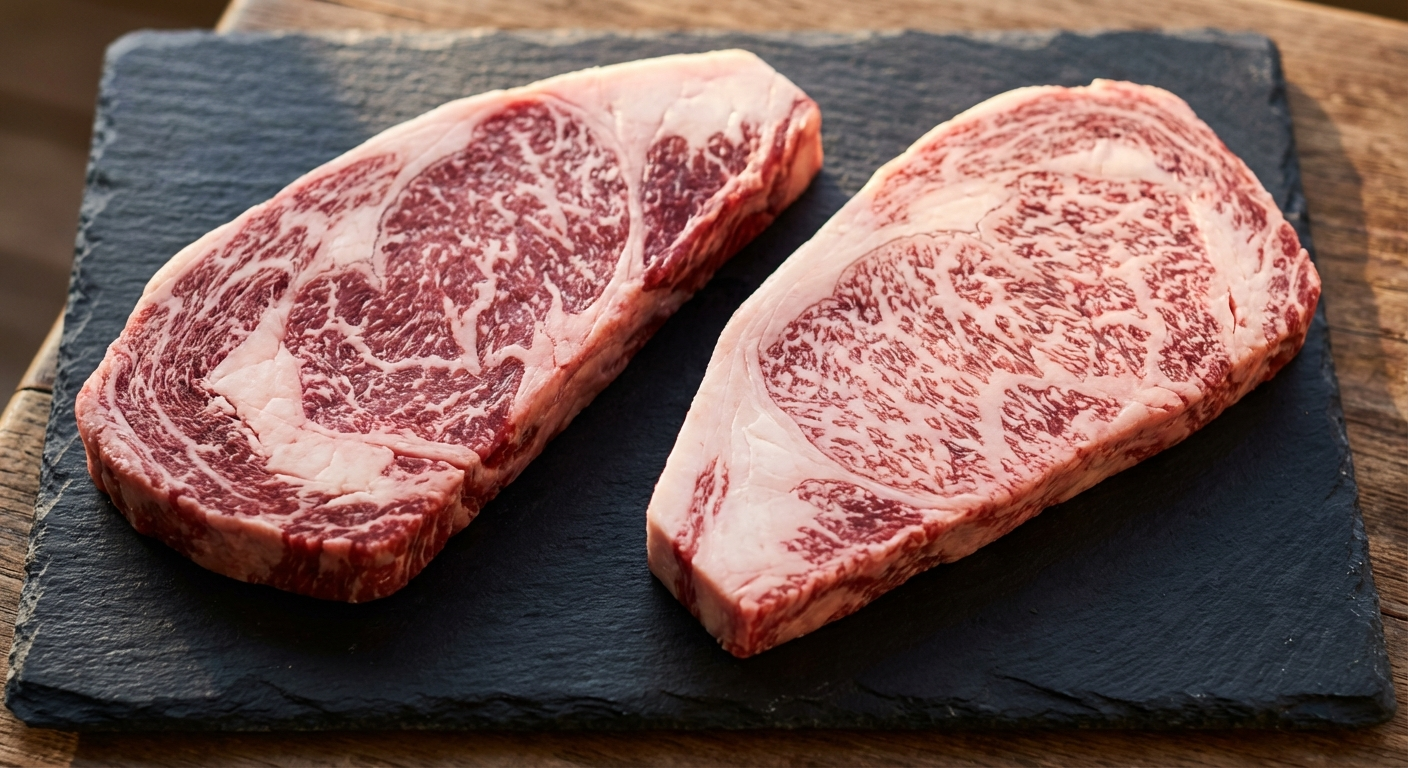
When you're spending serious money on Japanese wagyu, the difference between A4 and A5 isn't just a number — it's a fundamentally different eating experience. Both grades represent the top tier of beef worldwide, but they serve different purposes, suit different palates, and make sense for different occasions.
After two decades evaluating wagyu across Japanese grading houses and American import programs, I've seen countless people overspend on A5 when A4 would have been the better choice — and vice versa. This guide will help you understand exactly what separates these two grades so you can make the right call every time.
Understanding the Japanese Grading System
Before comparing A4 and A5 directly, you need to understand how Japan grades its beef. The Japan Meat Grading Association (JMGA) evaluates every carcass on two axes:
- Yield grade (A, B, or C): How much usable meat the carcass produces relative to its size. A is the highest yield. Nearly all exported wagyu is grade A because only the best carcasses justify the export logistics.
- Quality grade (1 through 5): Determined by the lowest score across four factors — marbling, meat color/brightness, fat color/quality, and firmness/texture. This means a carcass needs to score highly in every category to earn a 5.
So "A5" means the highest yield grade plus the highest quality grade. "A4" means the same top yield with the second-highest quality score. Both are exceptional — the question is how they differ and whether that difference matters for your situation.
Marbling: Where the Real Difference Lives
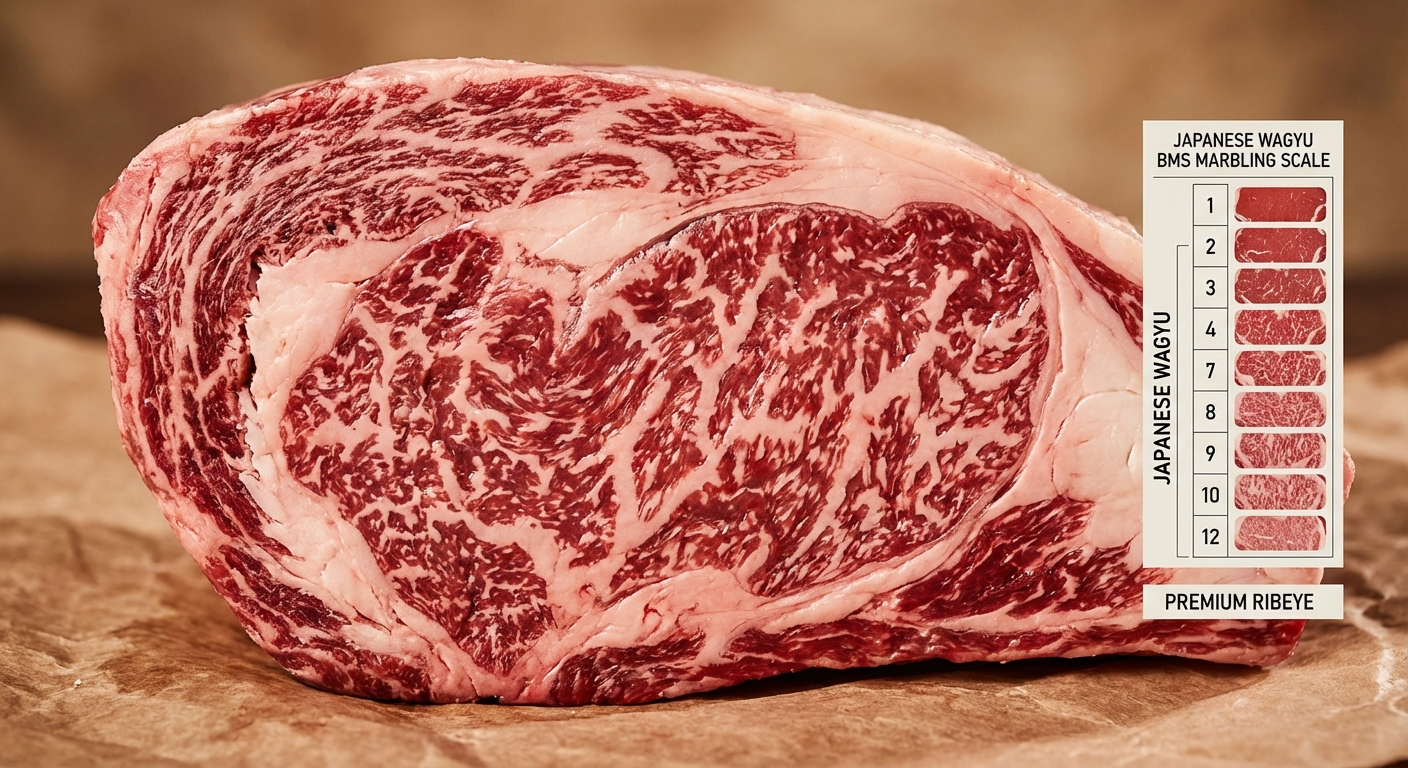
Marbling is the primary driver of the quality grade difference between A4 and A5, and it's measured on the BMS (Beef Marbling Standard) scale from 1 to 12.
A4 Wagyu Marbling (BMS 6-8)
A4 wagyu requires a minimum BMS of 6, and most A4 product falls in the BMS 6-8 range. At these levels, you're looking at pronounced intramuscular fat — visibly more marbled than any American Prime steak — with clear white veining through deep red lean meat. The fat is well-distributed but the lean muscle is still the dominant visual element.
BMS 6-8 translates to roughly 25-35% intramuscular fat. That's abundant marbling by any standard. An A4 ribeye will show beautiful fat threading that's immediately recognizable as premium wagyu.
A5 Wagyu Marbling (BMS 8-12)
A5 requires a minimum BMS of 8, with most retail A5 scoring BMS 10-12. At BMS 10+, the cross-section of the meat appears more white than red. The intramuscular fat comprises 40-50% or more of the muscle, creating the distinctive shimofuri (frost-fall) pattern that makes Japanese A5 instantly recognizable.
The visual difference between A4 and A5 is striking. Place them side by side: the A4 shows rich marbling with clear red lean meat structure. The A5 shows a dense white web where the lean muscle appears almost as thin red threads suspended in fat. Both are beautiful — but they're clearly different products.
Marbling Comparison at a Glance
| Metric | A4 Wagyu | A5 Wagyu |
|---|---|---|
| BMS range | 6-8 | 8-12 |
| Intramuscular fat % | 25-35% | 40-50%+ |
| Visual impression | Rich marbling, red dominant | Dense web, white dominant |
| Marbling pattern | Well-distributed veining | Ultra-fine shimofuri |
| Fat-to-lean ratio feel | Beefy with richness | Buttery, almost creamy |
Flavor and Texture: Two Different Experiences
This is where the A4 vs A5 conversation gets genuinely interesting, because more marbling doesn't automatically mean "better." It means different.
A4 Flavor Profile
A4 wagyu delivers what I'd call the "best of both worlds" experience. You get pronounced wagyu richness — that distinctive buttery, umami-forward flavor — but you also get substantial beef flavor from the lean muscle. The fat enhances without overwhelming. You can eat a full 8-12 oz steak of A4 and enjoy every bite from first to last.
The texture has real substance. There's a satisfying chew to the lean portions, punctuated by pockets of dissolving fat. It feels like eating steak — incredibly premium steak, but recognizably steak. Many seasoned wagyu enthusiasts actually prefer A4 for this reason.
A5 Flavor Profile
A5 is a different category of food. At BMS 10+, the intramuscular fat is so abundant that the meat doesn't chew like steak — it dissolves. The sensation is closer to foie gras or high-quality toro than it is to a conventional steak experience. The flavor is intensely rich, with a pronounced sweetness from the oleic acid in the fat and deep umami notes.
This richness is exactly why A5 is traditionally served in small portions in Japan. A thin-sliced 3-4 oz serving of A5 is a luxurious, complete experience. Eat an 8 oz A5 ribeye and most people hit a wall of richness around bite four or five. The fat satiety signal kicks in hard. This isn't a flaw — it's the nature of the product. A5 is meant to be savored in small quantities.
Head-to-Head Tasting Notes
| Quality | A4 Wagyu | A5 Wagyu |
|---|---|---|
| Primary flavor | Rich beef with buttery finish | Intensely buttery, sweet umami |
| Texture | Tender with satisfying chew | Dissolves on the tongue |
| Richness level | High but manageable | Extreme — satiating quickly |
| Ideal portion | 6-12 oz per person | 3-5 oz per person |
| Closest comparison | The perfect steak | Beef butter / beef sashimi |
The Other Three Grading Factors
Remember, the quality grade is determined by the lowest score across four factors. While marbling gets all the attention, the other three — meat color, fat color, and firmness/texture — also contribute to the A4 vs A5 distinction.
Meat Color and Brightness
Both A4 and A5 must score well here, but A5 requires the highest tier. A5 wagyu typically displays a brighter cherry-red lean color. The protein is well-oxygenated and the color is uniform. A4 may have slightly less uniform coloring, though still excellent by any standard.
Fat Color and Quality
Premium wagyu fat should be white to slightly cream-colored. Yellowish fat (from older cattle or grass-heavy finishing) scores lower. A5 fat is consistently pure white, indicating young cattle finished on a controlled grain diet. A4 fat is also high quality but may show very slight cream tones.
Firmness and Texture
This measures the structure of the lean meat. A5 wagyu has a fine, smooth muscle fiber structure that contributes to its melt-in-your-mouth quality. A4 has slightly more defined muscle fiber structure — which actually gives it better "steak" texture and a more satisfying bite.
Price Difference: What You're Paying For
Price is where the rubber meets the road for most buyers. The gap between A4 and A5 is significant:
| Cut | A4 Price Range (per lb) | A5 Price Range (per lb) | Premium % |
|---|---|---|---|
| Ribeye | $80-120 | $150-250 | 80-110% |
| Striploin (NY Strip) | $70-100 | $120-200 | 70-100% |
| Filet / Tenderloin | $90-130 | $180-300 | 100-130% |
| Chuck / Shoulder | $40-60 | $70-100 | 65-75% |
A5 commands roughly a 70-130% premium over A4 depending on the cut and source prefecture. That's a meaningful jump. The question is whether that premium delivers proportionally more value — and for many scenarios, it doesn't.
Value Analysis
Consider this: a 12 oz A4 ribeye at $90 gives you a full, luxurious steak dinner for one person. A 12 oz A5 ribeye at $180 gives you enough for two people (at appropriate 4-6 oz portions) — but now you need sides, and the per-person cost is similar anyway.
For entertaining, A4 is often the smarter buy. You can serve generous portions that feel like a proper steak dinner. For a special two-person occasion where you want the most extraordinary beef experience possible, A5 in small portions is transcendent.
When to Choose A4 Wagyu
A4 is the right call in these situations:
- You want a full steak dinner. A4 works in traditional steak portions (8-12 oz) without overwhelming richness.
- You're entertaining a group. Guests can enjoy generous servings. A4 is impressive enough to create "wow" moments while being approachable for people unfamiliar with wagyu.
- You prefer beef flavor with wagyu richness. A4 delivers the best balance of pronounced beef taste and luxurious fat. Many chefs consider A4 the "sweet spot."
- You're grilling or using high-heat methods. A4 holds up better on a grill or in a screaming-hot cast iron. The lower fat content means less flare-up risk and better sear development.
- Budget matters. You get 90% of the wagyu experience at 50-60% of the A5 cost. Dollar for dollar, A4 often delivers more total enjoyment.
When to Choose A5 Wagyu
A5 is the right call in these situations:
- You want the ultimate wagyu experience. Nothing compares to the dissolving texture and intense umami of BMS 10+ wagyu. For a once-in-a-lifetime meal, A5 is it.
- You're serving small, curated portions. Japanese-style thin slices, yakiniku, tataki, or shabu-shabu — these preparations are designed for A5's extreme marbling.
- You're cooking for two. A single 8-12 oz A5 steak split between two people makes an intimate, memorable dinner at a reasonable per-person cost.
- You want the visual spectacle. A5 cross-sections are genuinely stunning. For a dinner party where presentation matters, A5 makes an unforgettable centerpiece.
- You've had A4 and want to level up. If you already know and love wagyu, A5 is the natural progression for experiencing the absolute peak.
Best Cooking Methods for Each Grade
The fat content difference between A4 and A5 means they respond differently to various cooking methods.
A4 Cooking Methods
- Cast iron sear: Excellent. Render fat slowly on medium-high heat. 2-3 minutes per side for medium-rare.
- Grill: Works well. The slightly lower fat content means manageable flare-ups. Great for teppanyaki-style preparation at home.
- Sous vide + sear: Excellent for precise doneness. 130°F for 2 hours, then quick sear.
- Reverse sear: Ideal for thicker A4 cuts. Low oven (225°F) to 115°F internal, then blast in cast iron.
A5 Cooking Methods
- Quick sear (thin slices): The classic approach. Slice 1/4" thick, sear 20-30 seconds per side. The fat renders instantly.
- Yakiniku / tabletop grill: Perfect for A5. Thin slices cook in seconds over high heat.
- Tataki: Sear exterior hard, leave interior nearly raw. Slice thin. The contrast of seared fat and cool, rich center is extraordinary.
- Shabu-shabu / sukiyaki: Paper-thin A5 slices swished in hot broth or simmered briefly. The fat melts into the liquid.
- Avoid: Well-done cooking with A5. The fat renders out completely, leaving dry, textureless meat and a pool of grease. Medium-rare maximum.
Source Prefecture: Does It Matter?
Within both A4 and A5, the source prefecture adds another layer of character. Different regions produce subtly different flavor profiles based on local breeding lines, feed programs, and water sources.
- Miyazaki: Known for consistent BMS 10+ scores and a clean, sweet fat flavor. Excellent A5; their A4 is also exceptional.
- Kagoshima: Japan's largest wagyu-producing prefecture. Wide range of quality. Their best A5 rivals anyone's; their A4 is often outstanding value.
- Matsusaka: Female-only cattle, fed beer mash in some programs. Extremely rich, distinctive flavor. Rarely seen below A5.
- Kagawa (Olive Wagyu): Fed spent olive pulp. Produces a slightly nuttier fat flavor. Available in both A4 and A5, with A4 offering a more balanced expression of the olive-fed character.
Common Misconceptions
"A5 Is Always Better Than A4"
This is the biggest myth. A5 is more marbled than A4, but "better" depends entirely on context. For a 12 oz steak dinner, A4 is arguably the superior choice. For thin-sliced yakiniku, A5 is unbeatable. Neither is universally "better."
"A4 Is Just Lower-Quality A5"
No. A4 is still top-tier wagyu. It's the second-highest quality grade in the world's most demanding beef grading system. An A4 wagyu steak outperforms USDA Prime by a wide margin in marbling, tenderness, and flavor complexity. Context: USDA Prime — America's best — would score roughly A3 on the Japanese scale.
"You Can't Taste the Difference"
You absolutely can, especially between A4 BMS 6-7 and A5 BMS 11-12. The texture difference alone is unmistakable. A4 has a satisfying chew; A5 dissolves. The flavor intensity also scales with the fat content. Where the difference narrows is between high A4 (BMS 8) and low A5 (BMS 8-9) — these can be nearly indistinguishable.
Where to Buy A4 and A5 Wagyu
Not all retailers stock both grades. Many online sellers focus exclusively on A5 because it has the highest profit margin and the most marketing cachet. Finding quality A4 can actually be harder.
- The Meatery — Japanese A5 Wagyu Collection — Curated selection of certified A5 from top prefectures. BMS 10+ guaranteed on all A5 products, with certificates of authenticity.
- The Meatery — American Wagyu Collection — For those who want wagyu richness at a more accessible price point. American Wagyu with Japanese genetics delivers excellent marbling.
When buying either grade, always look for: a certificate of authenticity (for Japanese wagyu), the BMS score if available, the source prefecture, and proper cold-chain shipping (overnight on dry ice).
Final Verdict: Which Grade Should You Buy?
Here's my honest recommendation after twenty years in the beef business:
Buy A4 if you want a steak dinner that happens to be the best steak you've ever eaten. It's the grade I serve most often at home when I want to enjoy wagyu as a meal — not just an experience.
Buy A5 if you want the pinnacle of beef as a culinary experience. Plan for small portions, Japanese-influenced preparations, and pair it with something acidic (yuzu ponzu, good wine, pickled ginger) to balance the richness.
Buy both if you want to educate your palate. The side-by-side comparison is genuinely illuminating and will forever change how you think about beef quality and personal preference.
Either way, you're eating some of the finest beef on the planet. There's no wrong choice — only the choice that's right for your table tonight.
Frequently Asked Questions
What is the difference between A4 and A5 wagyu?
A4 and A5 are the two highest quality grades in the Japanese beef grading system. The primary difference is marbling: A4 has BMS 6-8 (25-35% intramuscular fat) while A5 has BMS 8-12 (40-50%+ fat). A5 has a buttery, dissolving texture while A4 has more traditional steak chew with pronounced beef flavor. A5 is best in small portions; A4 works for full steak servings.
Is A4 wagyu worth buying over A5?
Yes, A4 wagyu is often the better value choice. It delivers 90% of the wagyu experience at 50-60% of the A5 price. A4 is ideal for full-size steak dinners, grilling, and entertaining because you can serve generous portions without the extreme richness fatigue that A5 causes in larger servings. Many chefs and wagyu experts consider A4 the "sweet spot" of the grading scale.
How much does A4 vs A5 wagyu cost?
A4 wagyu ribeye typically costs $80-120 per pound, while A5 ribeye runs $150-250 per pound — roughly a 80-110% premium. Striploin and chuck cuts show similar proportional gaps. However, since A5 is served in smaller portions (3-5 oz vs 6-12 oz for A4), the per-serving cost difference is less dramatic than the per-pound price suggests.
Can you taste the difference between A4 and A5 wagyu?
Yes, the difference is noticeable, especially between A4 BMS 6-7 and A5 BMS 11-12. A5 has an unmistakable dissolving texture and more intense buttery sweetness, while A4 offers more pronounced beef flavor with satisfying chew. The gap narrows between high A4 (BMS 8) and low A5 (BMS 8-9), which can be nearly indistinguishable.
What is the best way to cook A4 vs A5 wagyu?
A4 wagyu excels with traditional steak methods: cast iron sear, reverse sear, or grilling at full steak thickness. A5 wagyu is best sliced thin (1/4 inch) and cooked quickly — yakiniku, tataki, shabu-shabu, or a fast 20-30 second sear per side. Avoid cooking A5 well-done, as the fat renders out completely. Both grades should be served medium-rare at most.
More Expert Guides
Wagyu Sous Vide: The Complete Guide to Precision-Cooked Wagyu Beef
Learn how to sous vide wagyu beef for flawless results every time. Covers ideal temperatures for each cut, timing charts, vacuum sealing tips, finishing sear methods, and why precision cooking is the best way to honor expensive wagyu.
13 min readWagyu New York Strip: The Complete Guide to Buying, Cooking, and Enjoying
Wagyu New York strip delivers the perfect balance between rich marbling and clean beefy flavor. Here's how to choose the right grade, cook it perfectly, and get the most from this premium cut.
13 min readWagyu Picanha: The Brazilian Cut That Transforms Japanese Beef
Picanha is Brazil's most prized cut. Add wagyu-level marbling and you get one of the most flavorful, juicy steaks available — with a built-in fat cap that bastes the meat as it cooks.