Wagyu Shabu Shabu: The Complete Guide to Japan's Most Elegant Hot Pot
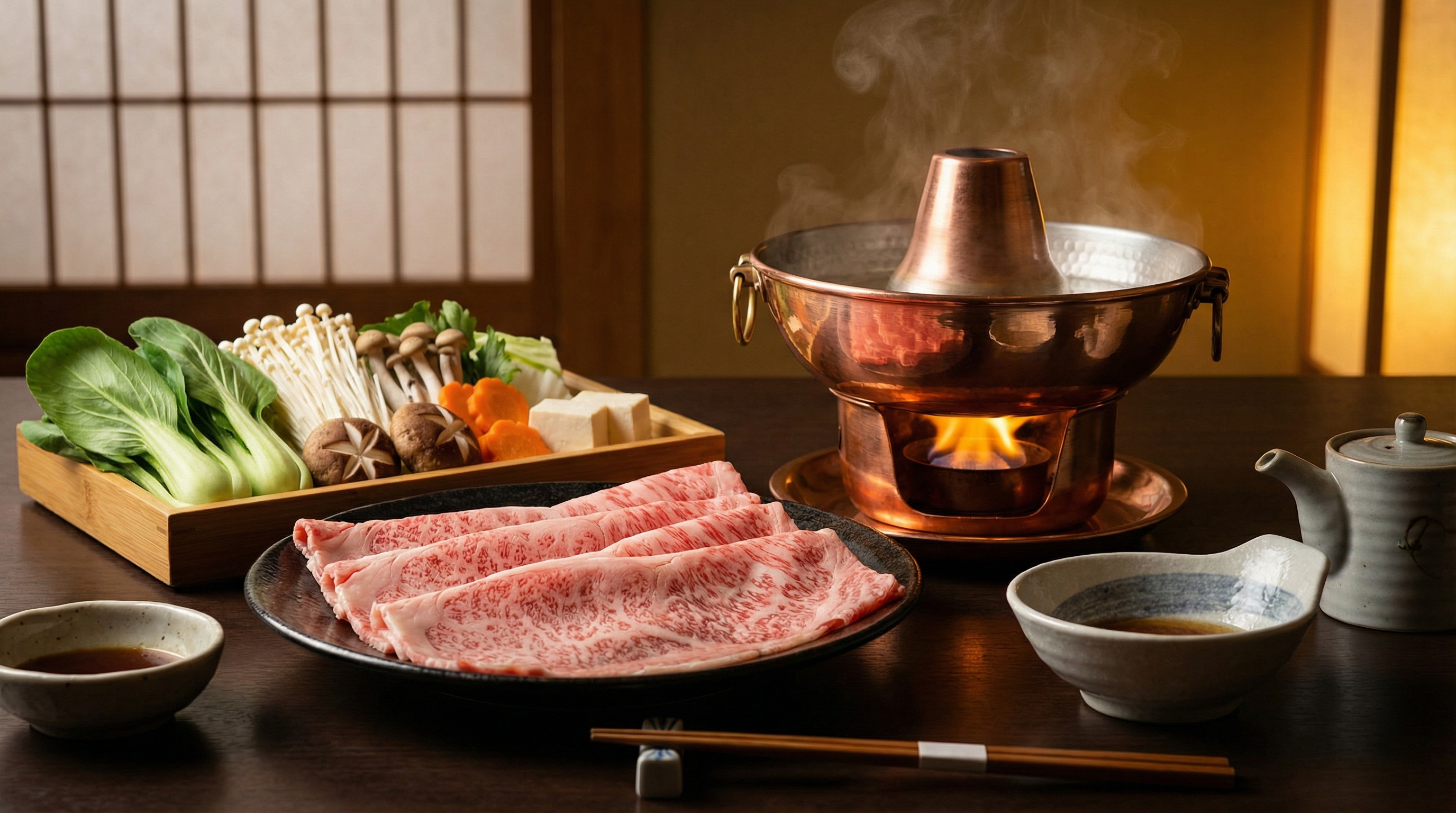
Shabu shabu is perhaps the purest way to experience wagyu beef. Where grilling introduces char and smoke, and sukiyaki bathes everything in a sweet soy glaze, shabu shabu strips the experience down to its essence: paper-thin slices of extraordinary beef, swished briefly through a gentle broth, revealing every nuance of marbling, texture, and umami that makes wagyu legendary. Having prepared thousands of shabu shabu courses across Japanese restaurants and private dining rooms, I can say with certainty that no other cooking method showcases the quality of premium wagyu quite like this one.
What Is Shabu Shabu?
Shabu shabu (しゃぶしゃぶ) is a Japanese hot pot dish where diners cook paper-thin slices of meat by briefly swishing them through simmering broth at the table. The name is onomatopoeia—it mimics the "swish-swish" sound the meat makes as it passes through the liquid. Unlike sukiyaki, which cooks everything together in a rich sauce, shabu shabu is a communal but individually paced experience. Each person picks up a slice with chopsticks, swishes it for a few seconds, then dips it in sauce before eating.
The technique originated in Osaka in the 1950s, though it draws from older Chinese hot pot traditions. What makes the Japanese version distinctive is its emphasis on restraint. The broth is deliberately mild—usually just water with kombu seaweed—so nothing competes with the natural flavor of the beef. This minimalism is exactly what makes wagyu shabu shabu so remarkable: when you use A5 or high-BMS wagyu, every second of that brief cook brings out butteriness, sweetness, and depth that lesser beef simply cannot deliver.
Shabu shabu is served year-round in Japan, though it's especially popular during the cooler months. It's a staple of high-end kaiseki restaurants, celebratory family meals, and increasingly popular izakayas that specialize in premium beef. At its finest, wagyu shabu shabu is considered a delicacy on par with the most refined sushi or tempura—deceptively simple, deeply satisfying, and entirely dependent on ingredient quality.
Best Wagyu Cuts for Shabu Shabu
Not every wagyu cut performs equally in the hot pot. Shabu shabu demands specific characteristics: the meat must be tender enough to cook in seconds, marbled enough to deliver richness, and structured enough to hold together when sliced paper-thin. Here are the ideal choices, ranked by how well they suit this preparation:
Ribeye (リブロース / Riburosu): The gold standard for wagyu shabu shabu. The ribeye's generous intramuscular fat melts instantly in hot broth, creating a luscious, buttery mouthfeel. The cap section (spinalis dorsi) is particularly prized—its loose grain and intense marbling make it practically dissolve on the tongue. If you're choosing one cut, choose this.
Sirloin (サーロイン / Sāroin): A close second. Wagyu sirloin offers a slightly firmer bite than ribeye with a clean beefy flavor that some diners actually prefer. The marbling is typically a touch less intense than the ribeye cap, which means you get more balance between meat flavor and fat richness. Excellent for diners who find full A5 ribeye too rich.
Chuck Roll (肩ロース / Kata Rosu): The value pick for shabu shabu. Well-marbled chuck roll costs significantly less than ribeye or sirloin but still delivers beautiful fat distribution. It has slightly more connective tissue, which benefits from the brief cooking—the collagen begins to soften without fully breaking down, adding a pleasant chew.
Brisket (ブリスケ / Burisuke): Less commonly used but worth considering. Wagyu brisket flat, when sliced properly, offers a leaner bite with concentrated beefy flavor. It works well as a complement to richer cuts, giving variety to the shabu shabu spread. Just be sure to slice it against the grain, or the texture will be chewy.
For the best experience, I recommend offering at least two cuts—typically ribeye and either sirloin or chuck roll. This variety lets diners experience different textures and flavor profiles within the same meal, which is how many premium shabu shabu restaurants in Japan present their courses.
Regarding BMS grade, aim for BMS 6–9 for shabu shabu. While BMS 10–12 is extraordinary, the extreme marbling can feel overwhelming in a hot pot format where you're eating many slices. BMS 6–9 provides beautiful richness while remaining enjoyable across a full meal. If you do use A5 grade wagyu (BMS 8–12), simply serve smaller portions—two to three ounces per person is plenty.
How to Slice Wagyu for Shabu Shabu
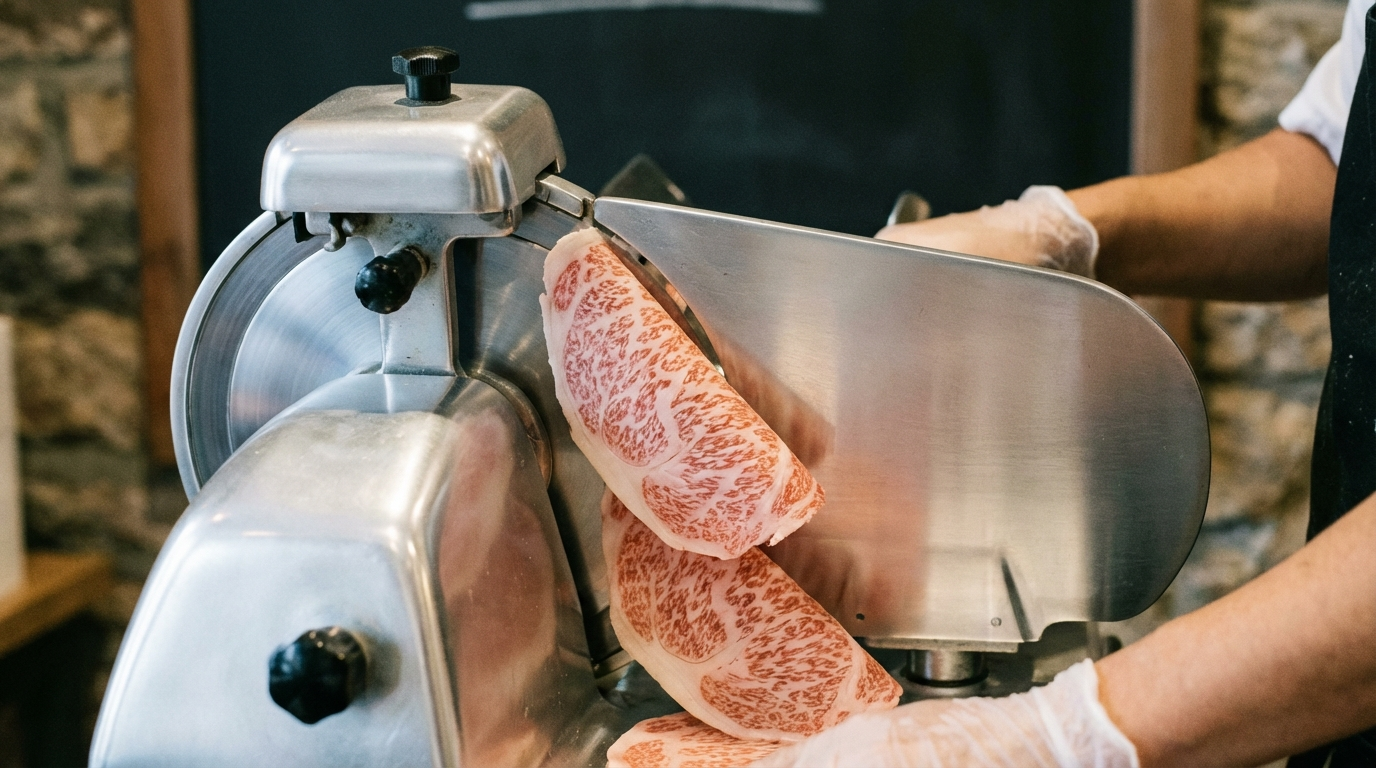
The slicing is arguably the most critical step. Too thick and the meat won't cook properly in seconds; too thin and it falls apart in the broth. The target thickness is 1.5 to 2 millimeters—roughly the thickness of a credit card. At this gauge, you can see the marbling pattern through the slice, and the meat cooks almost the instant it touches the broth.
Achieving this at home requires partially freezing the beef. Place your wagyu cut in the freezer for 45 to 60 minutes until it's firm but not frozen solid—you should be able to press your finger into it with moderate pressure. Then use the sharpest knife you have (a long slicer or sujihiki works best) to cut against the grain in smooth, single strokes. Don't saw back and forth; let the knife do the work in one motion.
If you have access to a meat slicer, use it. Set the thickness to 1.5mm and run the partially frozen block through slowly. This gives the most consistent results and is how every professional shabu shabu restaurant in Japan prepares their beef.
Once sliced, arrange the pieces on a chilled plate in a single layer, slightly overlapping like flower petals. This presentation isn't just aesthetic—it prevents the slices from sticking together and makes it easy for diners to pick up individual pieces with chopsticks. Keep the plate refrigerated until you're ready to begin cooking.
Preparing the Perfect Dashi Broth
The broth for shabu shabu should enhance the wagyu without competing with it. Traditional shabu shabu broth is remarkably simple: water and kombu (dried kelp). That's it. The kombu provides a subtle umami foundation—glutamic acid that amplifies the natural savoriness of the beef—while keeping the broth clean enough that the wagyu's own flavors remain front and center.
To prepare the broth, place a 4-by-6-inch piece of dried kombu in 8 cups of cold water and let it soak for at least 30 minutes, or up to 2 hours for deeper flavor. Then set it over medium heat and remove the kombu just before the water reaches a full boil—if kombu boils, it releases bitter compounds that muddy the broth. Maintain the liquid at a gentle simmer, not a rolling boil, throughout the meal.
Some variations add dried shiitake mushrooms to the soaking water for additional umami depth. Others float a few slices of fresh ginger for brightness. Both are legitimate additions, especially if your wagyu is on the leaner side (BMS 5–6) and benefits from extra flavor support. But for BMS 7+ wagyu, plain kombu dashi is all you need—the beef provides more than enough complexity on its own.
A critical detail: skim the broth periodically during the meal. As wagyu cooks, its fat renders into the liquid and proteins create foam on the surface. This is natural, but letting it accumulate makes subsequent slices taste greasy rather than clean. A small mesh skimmer beside the pot is essential equipment for proper shabu shabu service.
The Swishing Technique
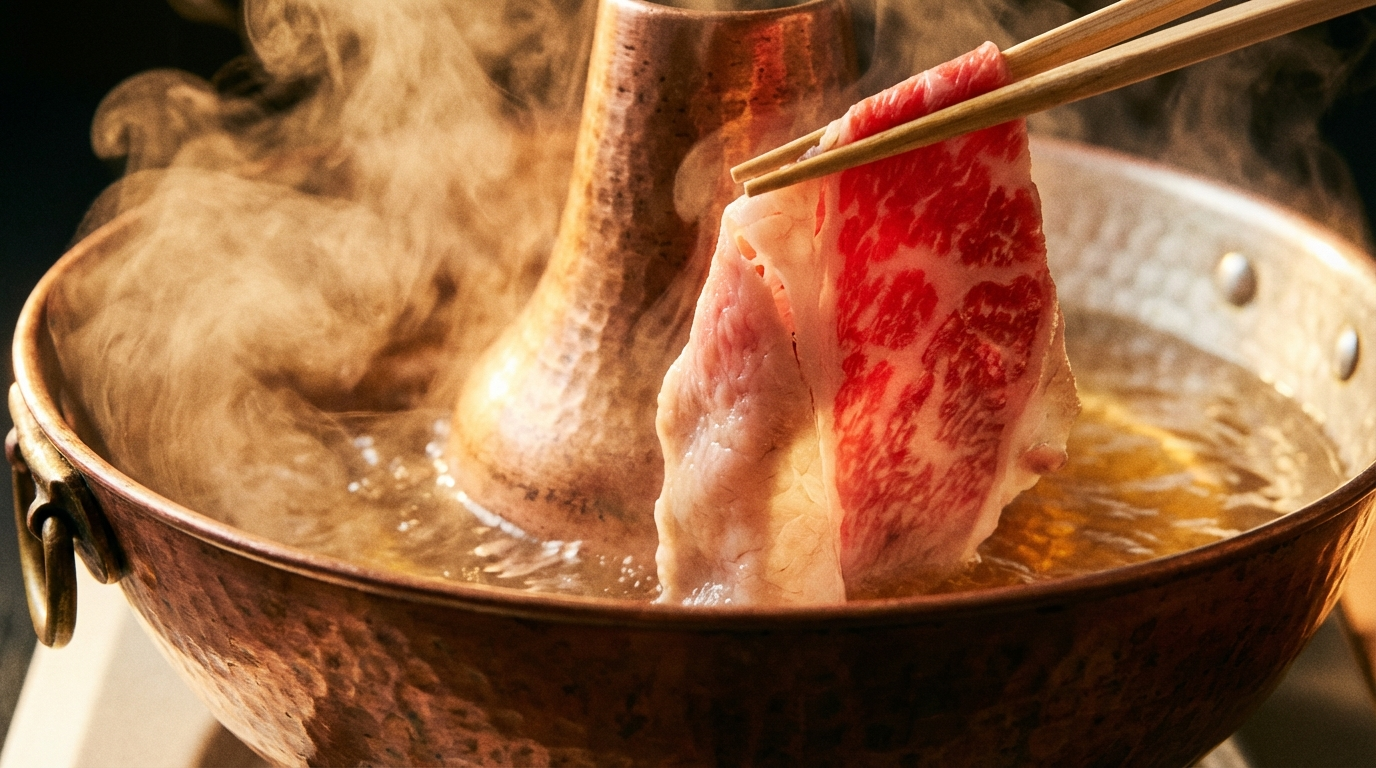
Here's where most people go wrong: they overcook the beef. Wagyu shabu shabu should be swished for no more than 2 to 5 seconds in the broth—just long enough for the exterior to turn from red to pale pink. The center should remain slightly rare. At this doneness, the intramuscular fat has softened and begun to melt but hasn't fully rendered out, giving you the maximum possible richness and the silkiest possible texture.
The technique is straightforward but worth practicing. Pick up a single slice with your chopsticks, gripping it near one edge. Lower it into the simmering broth and gently wave it back and forth two or three times—the "shabu shabu" motion. Watch the color change: as soon as the pink turns pale and the fat becomes translucent, lift it out. If you see the meat turning gray or brown, you've gone too far.
For fattier cuts like ribeye cap (BMS 9+), you can afford an extra second or two in the broth because the abundant fat keeps the meat moist even at higher doneness. For leaner cuts like sirloin, speed is more important—pull it the instant the color shifts. With practice, you'll develop an intuition for exactly when each slice is perfect.
One important note: swish one slice at a time. The temptation is to drop several pieces in at once, but this drops the broth temperature and leads to uneven cooking. Shabu shabu is meant to be a slow, meditative meal where you cook and eat one piece at a time. Embrace the pace.
Dipping Sauces: Ponzu and Gomadare
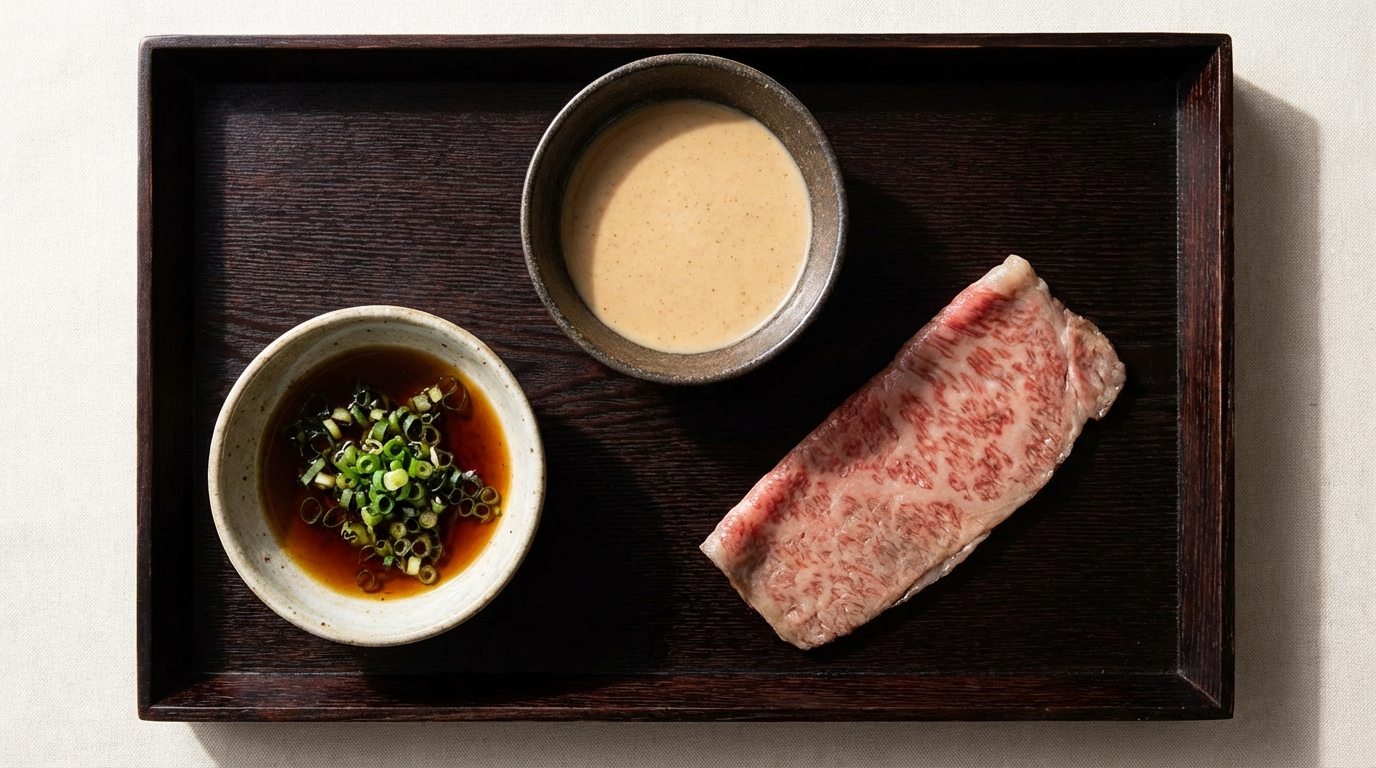
Traditional shabu shabu is served with two dipping sauces, and the interplay between them is what makes the meal endlessly interesting. Each sauce brings out different aspects of the wagyu, and experienced diners alternate between them throughout the course.
Ponzu (ポン酢): A citrus-based soy sauce made with yuzu or sudachi juice, rice vinegar, soy sauce, mirin, and dashi. Its bright acidity cuts through the richness of wagyu fat, cleansing the palate between bites and highlighting the beef's natural sweetness. Ponzu is especially effective with fattier cuts like ribeye—the acid creates a beautiful contrast. To make your own, combine 1/4 cup fresh yuzu or lemon juice, 1/4 cup soy sauce, 2 tablespoons rice vinegar, 1 tablespoon mirin, and a small piece of kombu. Let it rest overnight for the best flavor.
Gomadare (ごまだれ): A creamy sesame dipping sauce made from ground roasted sesame seeds, soy sauce, rice vinegar, mirin, sugar, and dashi. Where ponzu cuts, gomadare envelops—it adds a nutty richness that complements rather than contrasts with the wagyu's butteriness. This sauce works particularly well with leaner cuts and with the vegetables. Blend 3 tablespoons tahini (or freshly ground roasted sesame), 2 tablespoons soy sauce, 1 tablespoon rice vinegar, 1 tablespoon mirin, 1 teaspoon sugar, and 2 tablespoons warm dashi until smooth.
Beyond the base sauces, set out small dishes of condiments: grated daikon radish, finely sliced green onions, shichimi togarashi (seven-spice powder), and grated fresh ginger. These let each diner customize their dipping sauce to taste. A pinch of momiji oroshi (grated daikon mixed with chili) in ponzu is particularly popular—it adds gentle heat that pairs beautifully with rich wagyu fat.
Vegetables and Accompaniments
While wagyu is the star, the supporting cast matters enormously. Traditional shabu shabu accompaniments serve two functions: they provide textural contrast and variety, and they absorb the increasingly flavorful broth as the meal progresses. Here's the classic lineup:
Napa cabbage (hakusai): The workhorse vegetable of shabu shabu. The white stems stay crunchy while the leafy parts wilt into silky ribbons. Cut into 2-inch pieces and cook for 30–60 seconds. As the meal goes on, the cabbage absorbs wagyu-enriched broth and becomes increasingly delicious.
Enoki mushrooms: Their delicate crunch and mild sweetness complement wagyu without competing. Trim the base, separate into small clusters, and cook for 15–20 seconds. They also make an excellent wrap—drape a wagyu slice around a cluster of enoki before dipping.
Shiitake mushrooms: Score a cross into the caps for faster cooking and presentation. They need 2–3 minutes in the broth and develop a meaty, earthy flavor that enriches the liquid for later slices of beef.
Tofu: Use firm (momen) tofu cut into 1-inch cubes. It absorbs broth flavors like a sponge and provides a mild, creamy counterpoint to the intense wagyu. Cook for 2–3 minutes until heated through.
Chrysanthemum greens (shungiku): Their slight bitterness is a deliberate palate cleanser between wagyu slices. Add them in the last 10 seconds—they wilt almost instantly and overcook quickly.
Udon noodles or mochi: Traditionally added at the end of the meal. By this point, the broth has become incredibly rich from rendered wagyu fat and umami. Cooking udon or pounding mochi in this liquid creates a deeply flavorful finish that wastes none of that built-up flavor.
Shabu Shabu vs Sukiyaki: Understanding the Difference
Both are Japanese hot pot dishes featuring thinly sliced wagyu, but they deliver fundamentally different experiences. Understanding the distinction helps you choose the right preparation for your wagyu and your occasion.
Sukiyaki cooks everything together in a sweet soy-based sauce called warishita, made from soy sauce, mirin, sugar, and sake. The sauce is rich, sweet, and assertive—it flavors everything uniformly and creates a glazed, caramelized quality. The cooked ingredients are typically dipped in raw beaten egg before eating, which adds another layer of richness. Sukiyaki is bold, comforting, and a bit indulgent.
Shabu shabu, by contrast, is about purity and precision. The mild kombu broth lets the wagyu speak for itself. The quick-swish cooking preserves more of the beef's natural texture, and the two dipping sauces offer variety rather than uniformity. Where sukiyaki is a communal stew, shabu shabu is a personal, contemplative experience.
For the highest-quality wagyu (BMS 8+), shabu shabu is generally the better choice. The clean broth allows you to taste every nuance of that premium marbling. Sukiyaki's strong sauce can actually mask the subtleties that make top-tier wagyu special. Save sukiyaki for excellent but not ultra-premium wagyu (BMS 5–7), where its robust seasoning enhances rather than obscures the beef. That said, this is ultimately personal preference—many Japanese gourmands love A5 wagyu in sukiyaki, and there's no wrong answer.
Essential Equipment for Home Shabu Shabu
You don't need specialized equipment, but a few items make the experience dramatically better. At minimum, you need a wide, shallow pot (a Dutch oven works fine), a portable burner for the table, a mesh skimmer, and individual dipping bowls for sauces. If you're serious about shabu shabu, a traditional donabe (clay pot) holds heat more evenly and adds subtle mineral notes to the broth, though it's a luxury rather than a necessity.
A portable induction or butane burner is essential—shabu shabu must be cooked at the table, not in the kitchen. The whole point is cooking and eating in real time. Set the burner to maintain a gentle simmer; if the broth boils aggressively, it toughens the meat. Induction burners offer more precise temperature control, but butane burners are more affordable and create a nice theatrical flame.
For serving, use a large platter for the raw wagyu (chilled) and a separate platter or basket for vegetables. Each diner should have two small bowls—one for ponzu, one for gomadare—plus a rice bowl, chopsticks, and a ladle or small strainer for fishing out cooked vegetables. This setup might sound involved, but it's really just a matter of having enough small dishes. The ritual of setting the table is part of the shabu shabu experience.
Where to Buy Wagyu for Shabu Shabu
Finding wagyu pre-sliced for shabu shabu is the easiest route. Many Japanese grocery stores (Mitsuwa, Nijiya, H Mart) carry frozen shabu shabu–cut wagyu in their meat sections. These are typically Australian or American wagyu in the BMS 4–7 range and are perfectly suitable for a great meal. For authentic Japanese A5 wagyu, you'll need to look to specialty online retailers.
The Meatery carries a range of Japanese and American wagyu cuts suitable for shabu shabu. If you're ordering a whole cut rather than pre-sliced, request the butcher to slice it shabu shabu–style, or follow the partial-freeze technique described above to slice it yourself. When ordering online, ribeye and chuck roll are the best value for shabu shabu—they deliver maximum marbling impact per dollar.
Budget roughly 4 to 6 ounces of wagyu per person for a shabu shabu meal that includes ample vegetables and rice. For A5 wagyu, 3 ounces per person is sufficient—the richness adds up quickly. A 1-pound package of quality wagyu can serve 3 to 4 diners comfortably when supported by a full spread of accompaniments.
Frequently Asked Questions
How long do you cook wagyu in shabu shabu?
Swish each thin slice through the simmering broth for just 2 to 5 seconds. The meat should turn from red to pale pink on the outside while remaining slightly rare in the center. Overcooking wagyu in shabu shabu causes it to toughen and lose its characteristic buttery texture.
What is the best cut of wagyu for shabu shabu?
Ribeye is the top choice for wagyu shabu shabu because its intense marbling melts beautifully during the brief cook. Sirloin is a close second with a firmer, beefier bite. Chuck roll offers excellent value with good marbling at a lower price point.
What is the difference between shabu shabu and sukiyaki?
Shabu shabu uses a mild kombu broth and diners swish individual slices briefly before dipping in ponzu or sesame sauce. Sukiyaki cooks everything together in a sweet soy-based sauce (warishita) and is dipped in raw beaten egg. Shabu shabu highlights the pure flavor of wagyu, while sukiyaki offers a richer, sweeter experience.
Can you make shabu shabu with American wagyu?
Yes. American wagyu with BMS 6-9 works very well for shabu shabu. It offers excellent marbling at a more accessible price than Japanese A5. Just make sure it's sliced paper-thin (1.5-2mm) for proper cooking.
What temperature should shabu shabu broth be?
Maintain the broth at a gentle simmer, around 160-180°F (70-82°C). It should have small bubbles rising but never reach a rolling boil. Boiling broth toughens the delicate wagyu slices and creates excessive foam.
More Expert Guides
What Is Wagyu Beef? The Complete Guide to Grades, Origins & Quality
Discover wagyu beef origins, the difference between Japanese A5 and American wagyu, how BMS grading works, why marbling matters, proper cooking techniques, and what you should pay in 2026.
12 min readA5 Wagyu: Your Complete Buying & Authentication Guide (2026)
A5 wagyu represents the pinnacle of beef quality, but not all A5 is created equal. Learn how to authenticate real Japanese A5, decode BMS scores, find fair prices, and cook it perfectly at home.
14 min readA5 Wagyu Prefectures: Regional Guide to Japan's Best Beef
Discover the regional differences in Japanese A5 wagyu across 12 key prefectures. Learn which prefecture produces the flavor profile you'll love most.