A5 Wagyu Grading: The Complete Guide to Japan's Highest Beef Grade
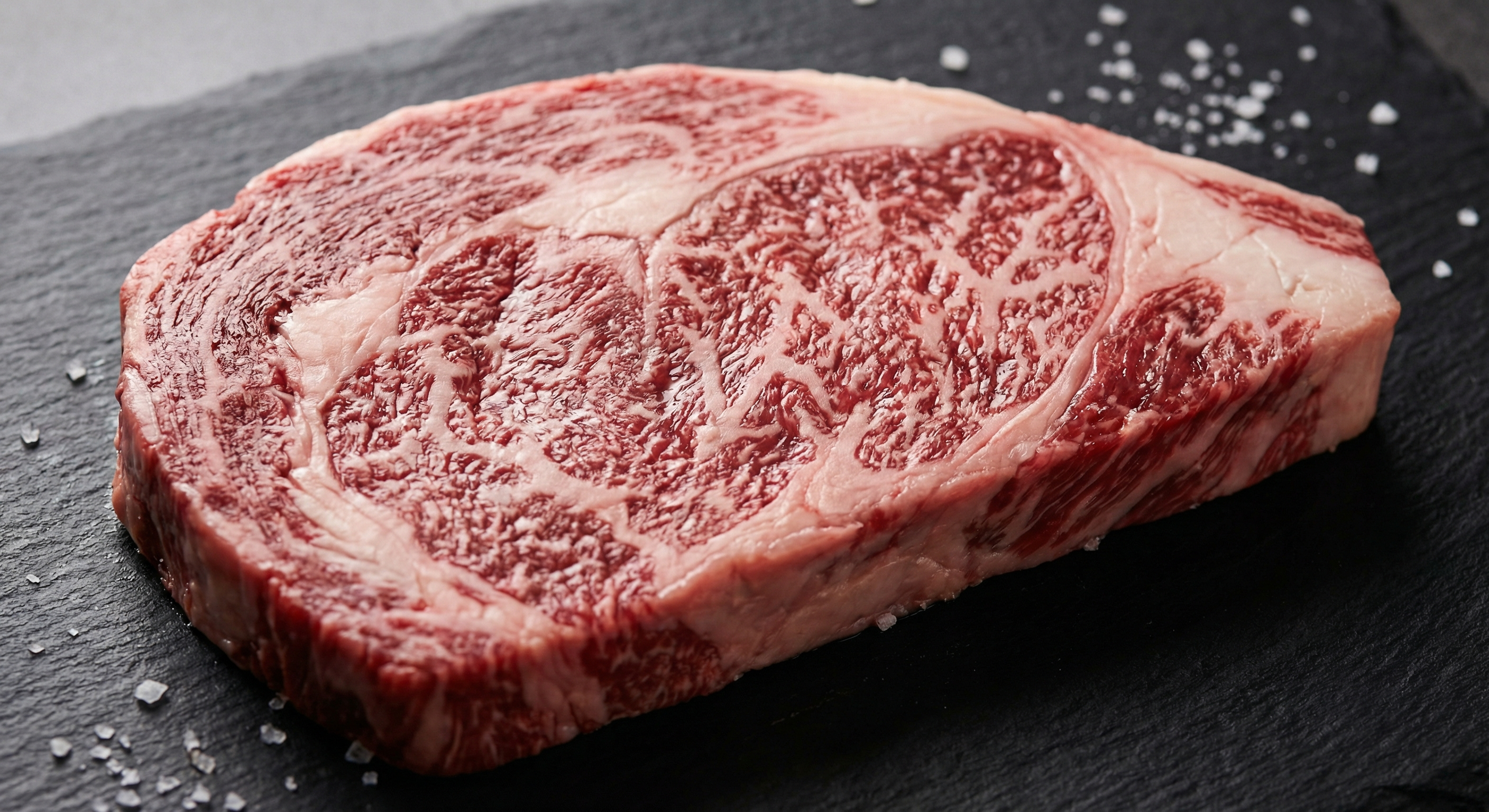
The grade "A5" carries almost mythical status in the beef world. It represents the absolute highest designation in Japan's rigorous grading system — a standard so demanding that only a fraction of Japanese Wagyu cattle achieve it. But what does A5 actually measure? And perhaps more importantly, what doesn't it tell you?
After two decades evaluating Japanese Wagyu across grading facilities in Miyazaki, Kagoshima, and Hyogo, I can tell you that understanding A5 grading is the single most valuable skill for anyone buying premium beef. It separates informed buyers from those paying top dollar based on marketing alone.
How the Japanese Beef Grading System Works
Japan's Meat Grading Association (JMGA) operates the most rigorous beef grading system in the world. Every beef carcass processed through Japan's commercial distribution undergoes standardized evaluation by certified graders. The result is a two-part grade — a letter followed by a number — that communicates both the economic value and the eating quality of the beef.
The grade "A5" breaks down into two independent assessments:
- The letter (A): The yield grade — how much usable retail meat the carcass produces
- The number (5): The quality grade — the overall eating quality based on four visual factors
Let's examine each component in detail.
The Yield Grade: What the Letter Means
The yield grade estimates the percentage of usable meat from the total carcass weight:
| Yield Grade | Estimated Cutability | Meaning |
|---|---|---|
| A | 72% or above | Above-average yield |
| B | 69–72% | Average yield |
| C | Below 69% | Below-average yield |
The yield grade is calculated from a formula using four measurements taken at the ribeye cross-section between the 6th and 7th ribs: ribeye area, rib thickness, subcutaneous fat thickness, and cold carcass weight.
What this means for you as a consumer: Very little. The yield grade matters to wholesalers purchasing entire carcasses — an "A" means more sellable meat per pound of carcass weight. But when you're buying an individual steak, an A5 and a B5 from otherwise identical carcasses will taste exactly the same. The "A" is about economics, not eating quality.
That said, most premium Japanese Wagyu grades "A" because the breeds and feeding programs are optimized for both yield and quality. You'll rarely encounter B5 or C5 at retail.
The Quality Grade: What the Number Means
The quality grade (1 through 5) is where the real information lives. It's determined by evaluating four characteristics at the ribeye cross-section, and here's the critical rule: the overall quality grade equals the lowest individual score among the four factors.
A carcass with spectacular marbling but poor fat color gets dragged down by its weakest score. Grade 5 requires excellence across every dimension.
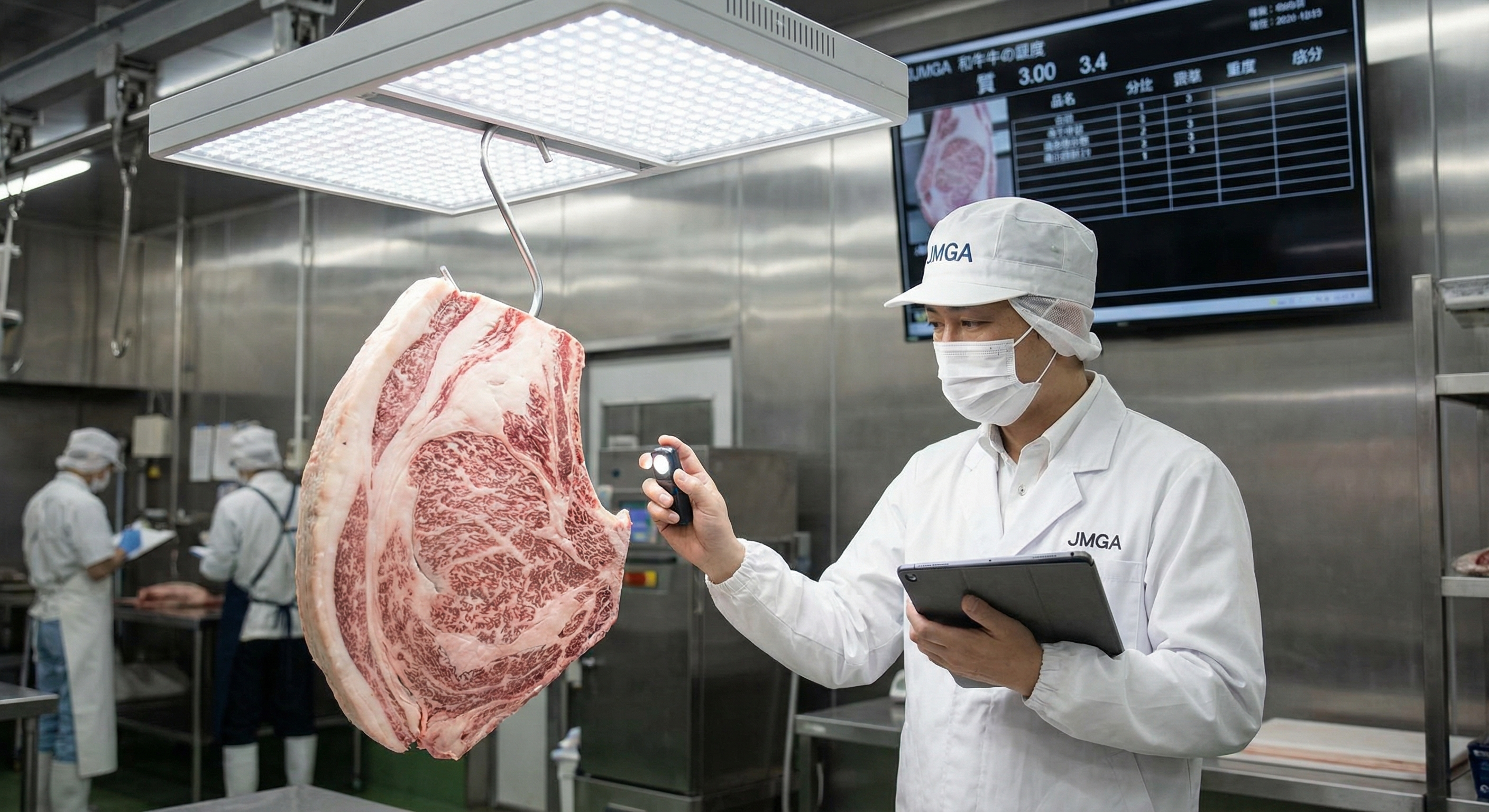
Factor 1: Marbling (BMS 1–12)
The Beef Marbling Standard (BMS) is the most scrutinized component and the primary driver of both grade and price. Graders compare the ribeye cross-section against standardized reference photographs to assign a score from 1 to 12:
| BMS Score | Quality Grade | Description | USDA Equivalent |
|---|---|---|---|
| 1–2 | 1 | Trace to slight marbling | Select |
| 3–4 | 2–3 | Small to modest marbling | Choice |
| 5–7 | 3–4 | Moderate to abundant marbling | Prime and above |
| 8–9 | 5 | Very abundant marbling | Beyond USDA scale |
| 10–12 | 5 | Extremely abundant marbling | Beyond USDA scale |
For A5 certification, the BMS must be 8 or higher. But this creates a wide quality range within the A5 designation — a BMS 8 steak and a BMS 12 steak are both "A5," yet the marbling intensity, eating experience, and price can differ by 100% or more.
This is the most important insight in Wagyu buying: always ask for the specific BMS score, not just the letter grade.
→ Deep dive: BMS Scale Explained — Understanding Wagyu Marbling Scores
Factor 2: Meat Color and Brightness (BCS 1–7)
The lean meat is compared against the Beef Color Standard (BCS), a set of standardized color reference tiles. The ideal range for a grade of 5 is BCS 3–5 — a bright, cherry-red color that indicates proper pH balance, adequate chilling, and stress-free processing.
- BCS 1–2 (very pale): May indicate PSE (pale, soft, exudative) conditions — a quality defect
- BCS 3–5 (bright cherry-red): Ideal. Indicates proper glycogen levels and handling
- BCS 6–7 (dark): "Dark cutting" beef, caused by pre-slaughter stress. Produces tough, dry meat regardless of marbling
Factor 3: Firmness and Texture (1–5)
The grader evaluates the muscle's resistance to pressure (firmness) and grain quality (texture). Grade 5 requires firm, fine-grained muscle — indicating proper protein structure, good chilling protocol, and meat that will cook evenly with satisfying bite.
Soft, coarse-textured muscle scores lower and typically indicates processing issues or breed characteristics that produce inferior protein structure.
Factor 4: Fat Color and Quality (BFS 1–7)
Both intramuscular and subcutaneous fat are evaluated against the Beef Fat Standard (BFS) reference tiles:
- BFS 1–4 (white to slightly cream): Ideal. Associated with grain-finished cattle — the standard for premium Wagyu
- BFS 5–7 (yellow): Indicates high beta-carotene, usually from pasture exposure before finishing
In Japan, white fat is strongly preferred for both aesthetic and culinary reasons. Yellow-fatted carcasses grade lower even if marbling and other factors are excellent. This cultural preference is deeply embedded in the grading system.
What Each BMS Level Actually Looks and Tastes Like
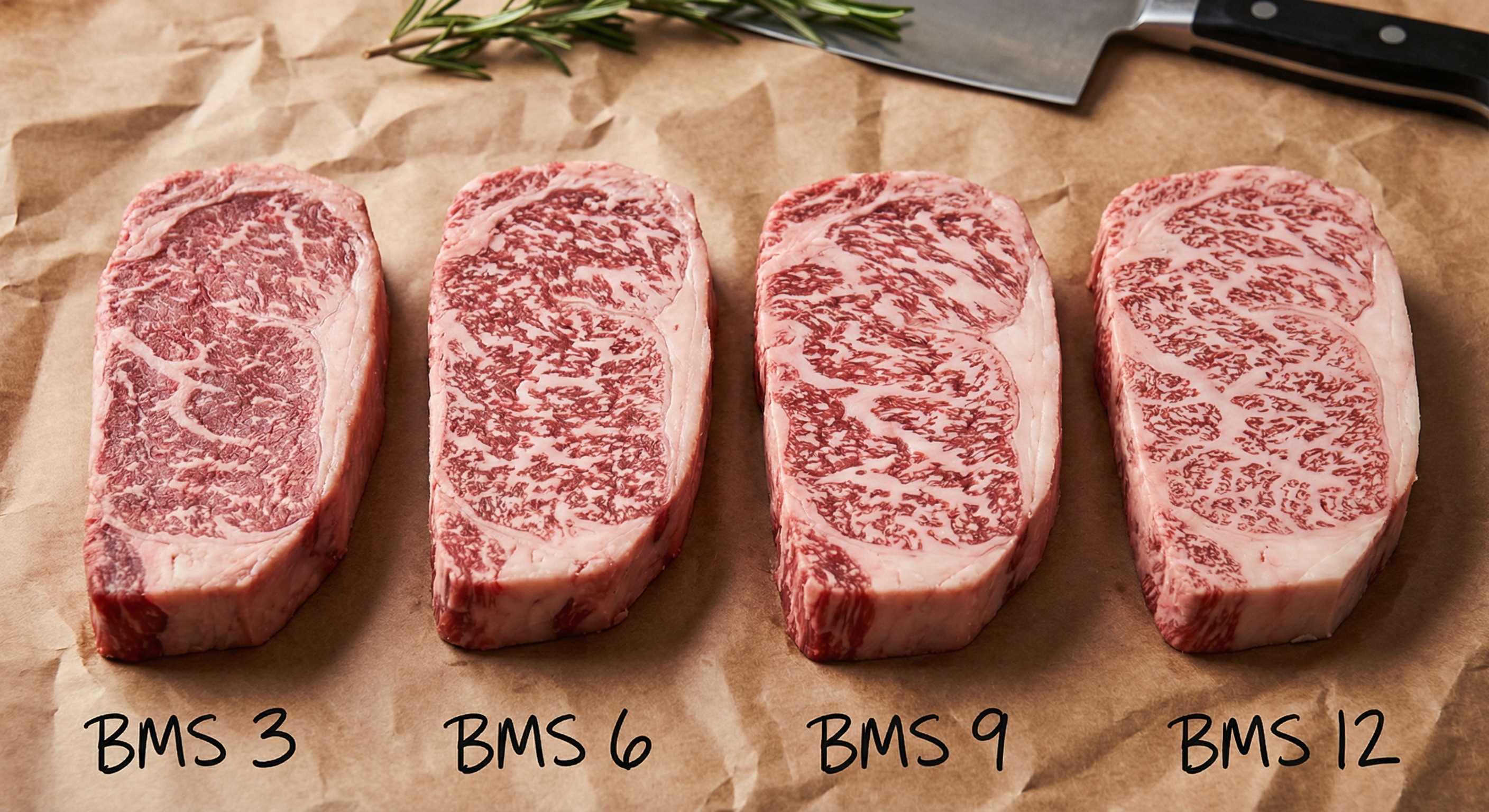
Since BMS is the most critical factor in A5 grading, let's break down what each level within the A5 range means for your eating experience:
BMS 8: The Entry Point to A5
Excellent marbling by any global standard — dramatically more intramuscular fat than even the best USDA Prime. The cross-section shows dense marbling with some visible lean areas between fat deposits. The eating experience is rich and buttery, with enough meat character to feel like a proper steak. For many people, BMS 8 represents the ideal balance.
BMS 9–10: The Sweet Spot
This is where most Wagyu enthusiasts find their preferred level. The shimofuri (frost-falling) pattern is fully developed — fine threads of white fat woven through every portion of the muscle. The texture when cooked is silky, almost custard-like. The "melt in your mouth" quality is unmistakable. At BMS 10, you're experiencing something that has no equivalent in any other country's beef production.
BMS 11–12: The Pinnacle
Extraordinarily rare — perhaps 3–5% of production even in top prefectures like Miyazaki and Kagoshima. The cross-section appears more white than red, with lean muscle visible only as thin threads within a dense matrix of intramuscular fat. The eating experience is intensely rich — a 3–4 ounce portion is genuinely all most palates can handle. BMS 12 commands steep premiums, often double the price of BMS 8 for the same cut.
Japanese Grading vs. Other Systems
Understanding how Japan's system compares to other countries' grading helps contextualize what A5 actually represents.
Japan vs. USDA (United States)
The USDA system grades beef as Select, Choice, or Prime based primarily on marbling at the ribeye cross-section. The problem: USDA Prime corresponds to roughly BMS 5–6 on the Japanese scale. The entire A5 range (BMS 8–12) sits above the USDA scale — there is literally no American grade for this level of marbling.
| USDA Grade | Approximate BMS | Japanese Grade |
|---|---|---|
| Select | 1–2 | 1 |
| Choice | 3–5 | 2–3 |
| Prime | 5–6 | 3–4 |
| No equivalent | 7–12 | 4–5 |
Japan vs. AUS-MEAT (Australia)
Australia's system uses a marble score of 0–9+ (with 9+ being the highest). Australian marble score 9+ roughly corresponds to BMS 11–12 in the Japanese system. Australia is the world's largest Wagyu producer outside Japan, and their grading has become increasingly granular to accommodate high-marbling fullblood Wagyu production.
Japan vs. Korea
Korea grades beef on a 1++ to 3 scale, with 1++ being the highest quality. Korean 1++ roughly corresponds to BMS 7–8 in the Japanese system — high quality, but not reaching the extremes of Japanese A5 BMS 10+. Korean Hanwoo cattle produce excellent beef, but the genetic potential for extreme marbling is lower than Japanese Black Wagyu.
How to Read a Japanese Wagyu Label
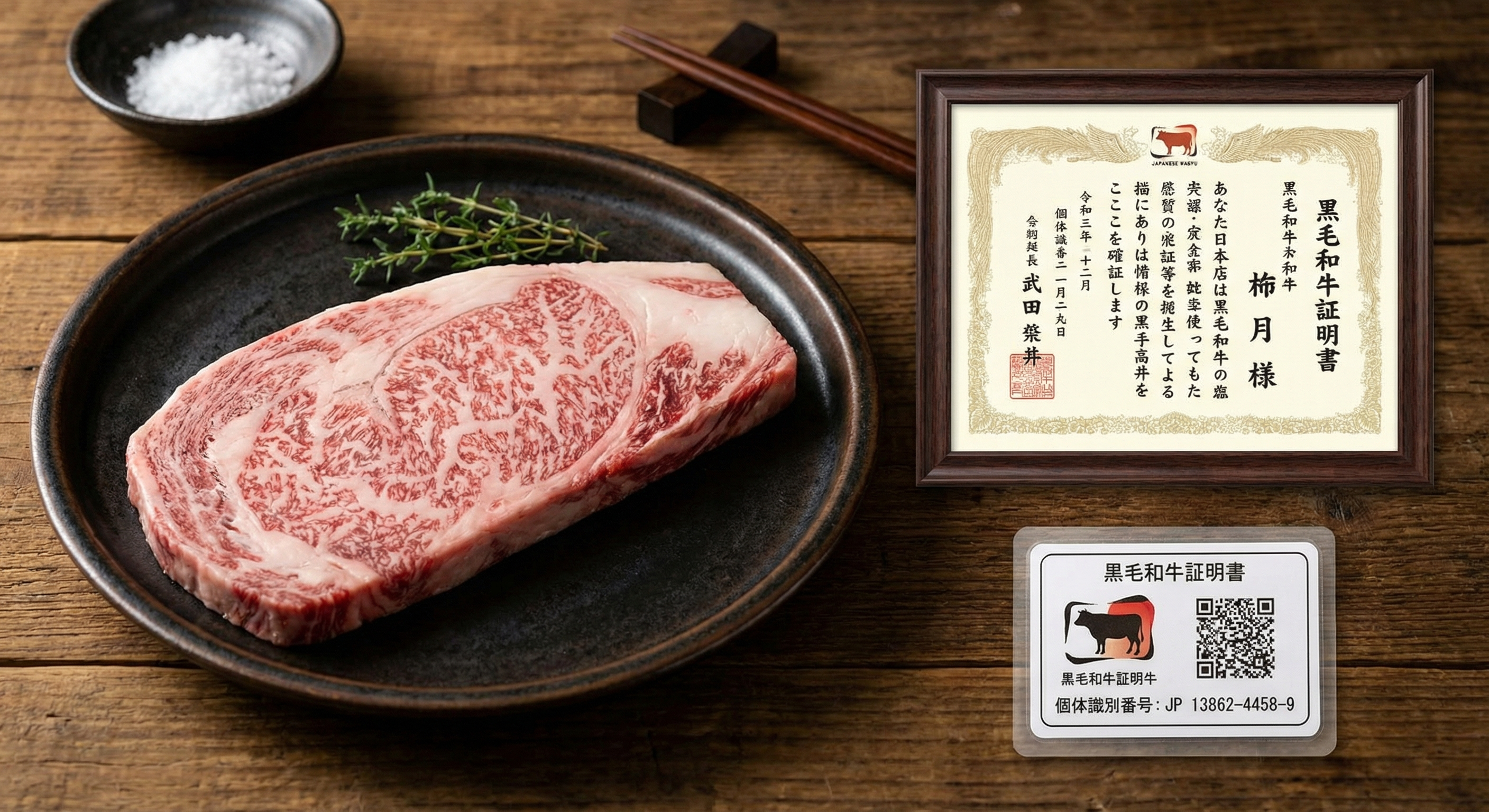
Authentic Japanese Wagyu comes with documentation that tells you everything about the animal. Here's what to look for on labels and certificates:
The 10-Digit Individual ID Number
Every Japanese beef animal is assigned a unique 10-digit identification number at birth. This number is tracked through Japan's national traceability database, recording the animal's birth date, breed, lineage, every farm it lived on, and its processing details. You can verify this number on the official Japanese traceability website.
If a seller cannot provide this number, question the product's authenticity.
Grade Information
The official grading certificate includes:
- Overall grade: The letter-number combination (e.g., A5)
- BMS score: The specific marbling number (e.g., BMS 10)
- BCS score: Meat color rating
- BFS score: Fat color rating
- Firmness/texture score: Muscle quality rating
- Carcass weight: Total weight of the graded carcass
- Processing date: When the animal was processed
Prefecture of Origin
The label should identify where the animal was raised. Different prefectures produce distinct flavor profiles — Miyazaki tends toward bold umami, Hyogo (the home of Kobe beef) produces elegant sweetness, and Kagoshima offers rich depth at relative value.
Brand Designation
Some Wagyu carries an additional brand name (Kobe, Matsusaka, Omi, Miyazaki) that indicates the animal met specific criteria beyond the standard JMGA grade. Each brand has its own requirements for breed lineage, raising conditions, and minimum grade. Brand designation adds a layer of quality assurance — and typically a price premium.
Red Flags: Spotting Inauthentic A5 Claims
The global market for Japanese A5 Wagyu has a significant fraud problem. Here's how to protect yourself:
- No traceability number: Authentic Japanese Wagyu always has a 10-digit ID. No number means no proof.
- Suspiciously low prices: Japanese A5 ribeye below $100/lb at U.S. retail should raise immediate questions. The cost of production, export, and import makes lower prices nearly impossible for genuine product.
- "A5 Wagyu" without specifying Japanese origin: The term "A5" specifically refers to the JMGA grading system. If a product says "A5 Wagyu" but is from Australia or the U.S., it's misrepresenting the grading system used.
- No BMS score listed: Reputable sellers like The Meatery list the specific BMS score. Sellers who only say "A5" without further detail may be hiding a BMS 8 behind the A5 marketing halo.
A5 Grading and Cooking: Why It Matters
The grade directly impacts how you should prepare the beef. A5 Wagyu with BMS 8+ contains so much intramuscular fat that it requires fundamentally different handling than conventional beef:
- No added oil: The marbling provides all necessary lubrication
- Small portions: 3–4 ounces per person for BMS 10+. The richness is intense.
- Brief cooking: The fat renders at low temperatures. Overcooking causes the intramuscular fat to melt out, leaving dry, expensive meat behind.
- Thin slicing: Many Japanese preparations — yakiniku, shabu-shabu — slice A5 paper-thin and cook for seconds, not minutes
→ Complete guide: How to Cook Wagyu Steak
The BMS Sweet Spot: What to Buy
After evaluating thousands of carcasses and eating more A5 Wagyu than I can count, here's my honest recommendation:
- First-time buyers: BMS 8–9. Delivers the full A5 experience without overwhelming intensity. Best value in the A5 range.
- Experienced enthusiasts: BMS 10. The sweet spot — dense, even shimofuri marbling with extraordinary flavor depth.
- Special occasions: BMS 11–12. The pinnacle, best shared in small portions as a tasting experience.
No matter which BMS level you choose, buy from a source that provides full traceability. The Meatery's Japanese A5 Wagyu collection lists BMS scores, prefecture origins, and individual animal IDs — everything you need to know exactly what you're getting.
Frequently Misunderstood Aspects of A5 Grading
Is A5 Always Better Than A4?
Not necessarily. A5 means more marbling, but more isn't always better for every palate or purpose. A4 (BMS 5–7) offers rich marbling with more beef character — many Japanese connoisseurs prefer it for larger portions and everyday enjoyment. A5 BMS 10+ is best appreciated in small, focused tastings.
Does the Yield Grade Affect Taste?
No. An A5 and B5 with the same quality scores will taste identical. The yield grade is about carcass economics, not eating quality. Don't pay a premium for the "A" — pay attention to the quality grade and BMS score.
Can Non-Japanese Beef Be A5?
No. The A5 designation is specific to the JMGA grading system, which only evaluates beef processed in Japan. Australian, American, or other Wagyu may achieve equivalent marbling levels, but they are graded under their own national systems. Any non-Japanese product labeled "A5" is misusing the term.
The Bottom Line
A5 Wagyu grading represents the intersection of rigorous science and centuries of breeding expertise. The system evaluates marbling, meat color, fat color, and texture — demanding excellence across all four to award the highest grade. But the grade is a starting point, not the full picture.
The informed buyer looks beyond "A5" to the specific BMS score, the prefecture of origin, the individual traceability number, and the reputation of the seller. Armed with that knowledge, you can navigate the market confidently and find beef that genuinely deserves its premium.
Ready to experience authentic A5 Wagyu? Browse The Meatery's verified A5 Wagyu collection — every cut listed with BMS scores and full traceability.
Frequently Asked Questions
What does A5 mean in Wagyu beef grading?
A5 is the highest grade in Japan's beef grading system. The "A" indicates above-average yield (72%+ usable meat from the carcass), and the "5" indicates the highest quality score — requiring BMS 8-12 marbling plus top scores in meat color, firmness, and fat quality. The quality grade equals the lowest score among all four factors, so A5 demands excellence across the board.
What BMS score is A5 Wagyu?
A5 Wagyu requires a BMS (Beef Marbling Standard) score of 8 or higher, on a scale of 1 to 12. This means A5 encompasses BMS 8 through BMS 12 — a significant quality and price range. Always ask for the specific BMS number rather than relying on the A5 grade alone.
How does Japanese A5 grading compare to USDA Prime?
USDA Prime corresponds to approximately BMS 5-6 on the Japanese scale. The entire A5 range (BMS 8-12) sits above the USDA grading scale — there is no American equivalent. The Japanese system was designed for cattle that produce far more marbling than typical American breeds.
How do I verify authentic A5 Wagyu?
Look for a 10-digit individual identification number from Japan's national traceability database. Authentic Japanese Wagyu should also come with the specific BMS score, prefecture of origin, and processing date. If a seller can't provide traceability documentation, question the product's authenticity.
What are the four factors in Japanese beef quality grading?
The four factors are: (1) Marbling — scored on the BMS 1-12 scale, (2) Meat color and brightness — scored on the BCS 1-7 scale, (3) Firmness and texture — scored 1-5, and (4) Fat color and quality — scored on the BFS 1-7 scale. The overall quality grade equals the lowest individual score.
Is A5 Wagyu always better than A4?
Not necessarily. A5 has more marbling (BMS 8-12 vs. BMS 5-7 for A4), but more fat isn't always better for every situation. A4 offers rich marbling with more pronounced beef character and works better for larger portions. Many Japanese connoisseurs prefer A4 for everyday eating.
More Expert Guides
What Is Wagyu Beef? The Complete Guide to Grades, Origins & Quality
Discover wagyu beef origins, the difference between Japanese A5 and American wagyu, how BMS grading works, why marbling matters, proper cooking techniques, and what you should pay in 2026.
12 min readA5 Wagyu: Your Complete Buying & Authentication Guide (2026)
A5 wagyu represents the pinnacle of beef quality, but not all A5 is created equal. Learn how to authenticate real Japanese A5, decode BMS scores, find fair prices, and cook it perfectly at home.
14 min readA5 Wagyu Prefectures: Regional Guide to Japan's Best Beef
Discover the regional differences in Japanese A5 wagyu across 12 key prefectures. Learn which prefecture produces the flavor profile you'll love most.