BMS Scale Explained: Understanding Wagyu Marbling Scores
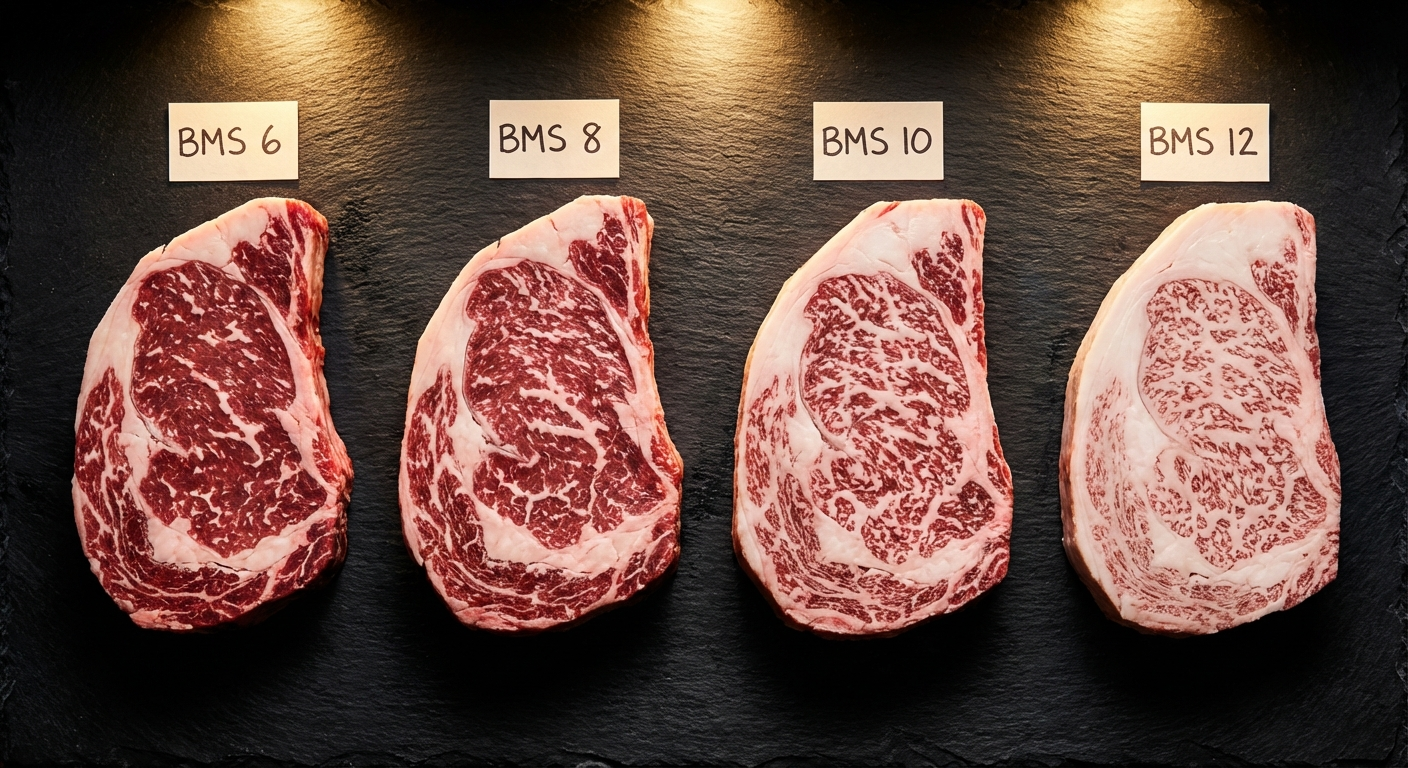
If you remember one thing about buying Japanese Wagyu, remember this: ask for the BMS score. The Beef Marbling Standard is the single most predictive indicator of eating quality in Wagyu beef, and understanding the scale gives you more buying power than any other piece of knowledge.
Let me walk you through the full 1-12 scale based on twenty years of evaluating carcasses across Japanese grading facilities.
The Scale: What Each Level Means
BMS 1-2: Minimal Marbling
At the bottom of the scale, BMS 1-2 represents beef with trace to slight marbling. This is roughly equivalent to USDA Select — lean beef with occasional flecks of intramuscular fat. You won't find this at any premium Wagyu retailer. It exists in the Japanese system for completeness, representing the lowest-quality carcasses from any breed.
BMS 3-4: Moderate Marbling
BMS 3-4 corresponds roughly to USDA Choice. The marbling is visible but modest — white flecks scattered through the lean, with significant areas of pure red muscle between them. This is decent beef by any standard, but it doesn't have the distinctive Wagyu characteristics that people pay a premium for. Most crossbred Wagyu (F1 Wagyu × Angus) falls in this range.
BMS 5-6: Abundant Marbling
This is where things start getting interesting. BMS 5-6 corresponds to upper USDA Choice through USDA Prime — but more importantly, it's where the Wagyu-specific fat characteristics begin to express noticeably. The oleic acid content is higher, the fat is softer, and the eating experience starts to differentiate from conventional beef.
Quality grades 3-4 live in this range. American Wagyu from better fullblood programs often hits BMS 5-7. At BMS 6, you have genuinely excellent beef that will impress anyone at the dinner table.
BMS 7-8: Excellent Marbling
BMS 7 is the gateway to territory that doesn't exist in conventional beef production. The marbling is dense enough that the cross-section begins to show that characteristic shimofuri pattern — white threads of fat woven through every part of the muscle. At BMS 8, you've crossed into A5 quality grade territory.
This is a significant inflection point for eating quality. The fat-to-lean ratio has reached a level where the beef cooks fundamentally differently — the intramuscular fat renders internally, creating self-basting that keeps the meat impossibly juicy. The flavor is rich, buttery, and distinctly Wagyu.
For many experienced Wagyu enthusiasts (myself included), BMS 7-8 is arguably the sweet spot for everyday enjoyment. You get the full Wagyu experience — the marbling, the tenderness, the flavor — without the intensity that makes BMS 11-12 a one-bite-at-a-time affair.
BMS 9-10: Exceptional Marbling
At BMS 9-10, the beef takes on an almost otherworldly quality. The marbling is so pervasive that the lean muscle appears as red threads within a matrix of white fat. When you touch the raw meat, your finger leaves an impression — the intramuscular fat is soft enough that the whole steak has a yielding, almost pudding-like quality.
Cooked properly (brief sear, barely past rare), BMS 9-10 Wagyu dissolves on the tongue. The fat renders so completely at such a low temperature that the texture is closer to foie gras than conventional steak. The flavor is intensely buttery with deep umami notes and a sweetness that's hard to describe if you haven't experienced it.
At this level, portion size becomes critical. Three to four ounces is a satisfying serving. More than that, and the richness becomes cloying. This is not a "bigger is better" product.
BMS 11-12: The Pinnacle
BMS 11 and 12 represent the absolute apex of beef production on Earth. These scores are extraordinarily rare — even in top-producing prefectures like Miyazaki and Kagoshima, BMS 11+ might represent 3-5% of production.
The visual is striking. A BMS 12 ribeye cross-section is predominantly white. The lean muscle is visible only as thin red lines within an overwhelming matrix of intramuscular fat. It's beautiful in an abstract way — like a piece of marble (which is, of course, where the term "marbling" originated).
The eating experience is polarizing. For devotees, BMS 12 is a transcendent food moment — so rich, so intense, so different from anything else that it redefines what beef can be. For others, it's simply too much. I've watched first-timers take one bite of BMS 12, eyes wide, and then struggle to finish a second piece.
My honest recommendation: if you've never had high-BMS Wagyu before, start at BMS 8-9. Work your way up. Jumping straight to BMS 12 is like starting wine appreciation with a $500 Burgundy — you might not have the reference points to fully appreciate what you're tasting.
BMS and Price: The Relationship
Price increases are not linear with BMS. The jump from BMS 8 to BMS 9 might add 15-20% to the price. The jump from BMS 10 to BMS 11 might add 30-50%. BMS 12 can command double the price of BMS 8 for the same cut — the scarcity premium is steep.
For most people, BMS 8-10 represents the best value in the A5 range. You get the full Wagyu experience at prices that, while still premium, don't require a special occasion to justify. Reputable retailers like The Meatery list BMS scores on every product so you know exactly what you're buying.
BMS Beyond the Number
Two steaks with identical BMS scores can eat quite differently. The BMS measures marbling quantity but not:
- Fineness: Fine, weblike marbling (shimofuri) creates a more uniform eating experience than coarse, clumpy marbling
- Distribution: Evenly distributed marbling is better than concentrated areas of fat alongside lean areas
- Fat quality: Oleic acid content, melting point, and flavor vary between individual animals and prefectures
When buying in person (at a specialty shop or from photos), look beyond the BMS number. Examine the actual marbling pattern. Fine, even, weblike fat distribution is always preferable to coarse deposits, even at the same BMS level.
Frequently Asked Questions
What BMS score should I buy for my first Wagyu experience?
Start with BMS 8-9. It delivers the full Wagyu experience — rich marbling, melt-in-your-mouth texture, buttery flavor — without the extreme intensity of BMS 11-12 that can overwhelm first-timers. It also offers better value per dollar than the highest scores.
What BMS is USDA Prime equivalent to?
USDA Prime roughly corresponds to BMS 5-6 on the Japanese scale. The entire A5 range (BMS 8-12) exceeds what the USDA system was designed to measure. There is no USDA equivalent for BMS 8+.
Is BMS 12 worth the premium over BMS 9?
For most people, no — BMS 9-10 delivers 90% of the Wagyu experience at significantly lower cost. BMS 12 is for collectors and enthusiasts who want to experience the absolute pinnacle. The marginal eating quality improvement between BMS 10 and 12 is smaller than between BMS 7 and 9.
More Expert Guides
Hida Beef: The Complete Guide to Gifu Prefecture's Legendary Wagyu
Hida beef is one of Japan's most prestigious regional wagyu brands, raised in the mountain valleys of Gifu Prefecture. Often overshadowed by Kobe in Western markets, Hida-gyu is revered in Japan for its delicate sweetness and fine-grained marbling. Here's what makes it special.
12 min readA4 vs A5 Wagyu: The Complete Comparison Guide
A4 and A5 are both elite Japanese wagyu grades, but they deliver meaningfully different eating experiences. This guide breaks down exactly how they differ in marbling, flavor, texture, price, and when each grade is the better choice.
16 min readWagyu Sous Vide: The Complete Guide to Precision-Cooked Wagyu Beef
Learn how to sous vide wagyu beef for flawless results every time. Covers ideal temperatures for each cut, timing charts, vacuum sealing tips, finishing sear methods, and why precision cooking is the best way to honor expensive wagyu.