Guide to Japanese Wagyu Prefectures and Regional Brands
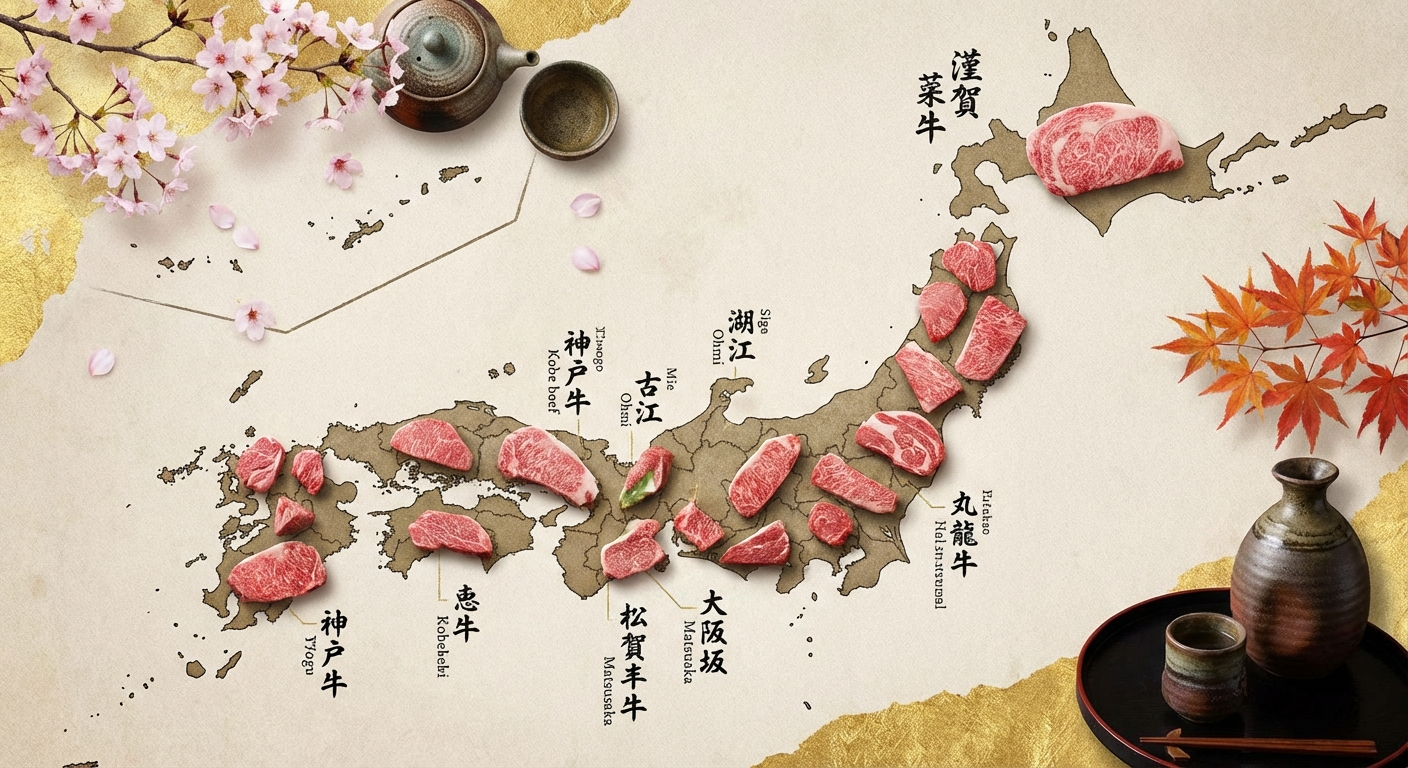
One of the most rewarding aspects of exploring Japanese Wagyu is discovering the regional differences. Like wine appellations, each prefecture has developed its own Wagyu character through decades of selective breeding, distinct feeding programs, and local traditions. The beef from Hyogo tastes different from Miyazaki, which tastes different from Kagoshima — and those differences are real, consistent, and fascinating.
I've visited production regions across Japan over the past twenty years. Here's what I've learned about the major players.
The "Big Three" Heritage Brands
Kobe (Hyogo Prefecture)
The most famous name in Wagyu — and the most misrepresented. Kobe beef comes exclusively from Tajima-gyu cattle born, raised, and slaughtered in Hyogo Prefecture, meeting strict grading requirements (BMS 6+ and quality grade 4-5).
Flavor profile: Delicate, sweet, almost floral. The marbling is characteristically fine — thin, lace-like threads rather than bold deposits. Many connoisseurs describe Kobe as the most "elegant" Japanese Wagyu. The fat has an exceptionally clean finish.
Production: Only 3,000-5,000 head annually qualify as Kobe beef. The Tajima bloodline has been genetically closed for over a century — no outside genetics. This produces remarkable consistency but also means Tajima cattle are smaller-framed, limiting yield.
Best for: Those who appreciate subtlety and finesse over raw intensity. Kobe is the Burgundy of the Wagyu world.
Matsusaka (Mie Prefecture)
Matsusaka beef is arguably the most luxurious — and most expensive — Wagyu in Japan. It comes exclusively from virgin heifers fed for 900+ days, producing extraordinarily soft, richly marbled beef.
Flavor profile: Ultra-rich, soft, almost pudding-like in texture. The extended feeding period allows maximum fat deposition, and the heifer-only requirement produces a distinctively delicate fat quality. Matsusaka has a sweetness and depth that's unique.
Production: Limited. The long feeding period, heifer-only requirement, and small production area constrain supply. Annual Matsusaka auctions see champion cattle sell for extraordinary sums.
Best for: Special-occasion splurges. Matsusaka is the Romanée-Conti of Wagyu — if you can find it and afford it, it's unforgettable.
Omi (Shiga Prefecture)
Omi beef is Japan's oldest branded beef, with 400+ years of documented history. Raised in the lush environment around Lake Biwa.
Flavor profile: Balanced. Neither as delicate as Kobe nor as rich as Matsusaka — Omi occupies a harmonious middle ground. The fat dissolves quickly and cleanly. Often described as "the connoisseur's choice."
Best for: Wagyu enthusiasts who want exceptional quality with less premium pricing than Kobe or Matsusaka. Omi is sometimes called the best value among the Big Three.
The Powerhouse Producers
Miyazaki Prefecture
Miyazaki has won the Wagyu Olympics three consecutive times — an achievement that has transformed it into arguably the most celebrated production region in modern Japanese Wagyu.
Flavor profile: Bold, robust, deeply umami. Miyazaki marbling tends to be heavier and more assertive than Kobe/Tajima. The flavor hits you with confidence rather than whispering.
Why it matters: Miyazaki's large production volume and aggressive export program make it the most accessible authentic Japanese Wagyu internationally. If you've had Japanese A5 Wagyu in the U.S., there's a good chance it was from Miyazaki.
Best for: First-time Japanese Wagyu buyers and anyone who wants a bold, rich Wagyu experience. Excellent value relative to the Big Three brands.
Kagoshima Prefecture
Japan's largest Wagyu producer by volume. Kagoshima's warm southern climate and volcanic soil create ideal cattle-raising conditions.
Flavor profile: Rich and savory, similar to Miyazaki but with some distinctive character. Kagoshima has been pioneering oleic acid testing and certification, which correlates with a sweeter, cleaner fat profile.
Best for: Value-conscious buyers who want genuine Japanese A5 quality. Kagoshima's large production volume keeps prices slightly below other top prefectures.
Saga Prefecture
Saga, in northern Kyushu, produces outstanding Wagyu that's increasingly gaining international recognition. Saga beef won the grand championship at recent national competitions.
Flavor profile: Fine-grained marbling with a mellow, approachable richness. Saga beef is sometimes compared to Kobe for its finesse, but with slightly more body.
Oita Prefecture
Oita's "Bungo beef" brand has a growing reputation, particularly for cattle raised in the prefecture's famous onsen (hot spring) regions — though the cattle don't actually bathe in the springs.
Flavor profile: Well-balanced, clean flavor with good marbling depth. Oita has been investing heavily in genetics and is producing increasingly competitive BMS scores.
How to Choose a Prefecture
If you're new to Japanese Wagyu, start with Miyazaki or Kagoshima — widely available, consistently high quality, and excellent value. As your palate develops, explore Kobe for finesse, Matsusaka for richness, and Omi for balance.
The most important thing is to buy from a seller who specifies the prefecture and provides traceability documentation. "Japanese A5 Wagyu" with no prefecture specified is a red flag — legitimate sellers are proud of their sourcing and will tell you exactly where the beef comes from. For verified A5 Wagyu with full prefecture and BMS documentation, browse authentic Japanese A5 at The Meatery.
Frequently Asked Questions
Which Japanese prefecture produces the best Wagyu?
There is no single "best" — it depends on preference. Miyazaki has won three Wagyu Olympics in a row. Kobe is known for fine, delicate marbling. Matsusaka is the most luxurious. Kagoshima offers the best value at scale. Each prefecture has distinct characteristics worth exploring.
Why does Wagyu taste different between prefectures?
Different prefectures have developed distinct bloodlines through decades of selective breeding. Combined with different climates, water sources, feeding regimens, and management traditions, these genetic differences produce meaningfully different flavor profiles — similar to how wine terroir works.
Is Kobe beef really the best Wagyu?
Kobe is the most famous, but not objectively "the best." It excels at delicacy and finesse. Other prefectures may produce higher BMS scores (Miyazaki, Kagoshima) or richer eating experiences (Matsusaka). Kobe's fame outpaces its production volume, which is part of both its allure and its fraud problem.
More Expert Guides
Hida Beef: The Complete Guide to Gifu Prefecture's Legendary Wagyu
Hida beef is one of Japan's most prestigious regional wagyu brands, raised in the mountain valleys of Gifu Prefecture. Often overshadowed by Kobe in Western markets, Hida-gyu is revered in Japan for its delicate sweetness and fine-grained marbling. Here's what makes it special.
12 min readA4 vs A5 Wagyu: The Complete Comparison Guide
A4 and A5 are both elite Japanese wagyu grades, but they deliver meaningfully different eating experiences. This guide breaks down exactly how they differ in marbling, flavor, texture, price, and when each grade is the better choice.
16 min readWagyu Sous Vide: The Complete Guide to Precision-Cooked Wagyu Beef
Learn how to sous vide wagyu beef for flawless results every time. Covers ideal temperatures for each cut, timing charts, vacuum sealing tips, finishing sear methods, and why precision cooking is the best way to honor expensive wagyu.