Wagyu Teppanyaki: The Complete Guide to Japan's Theatrical Steak Experience
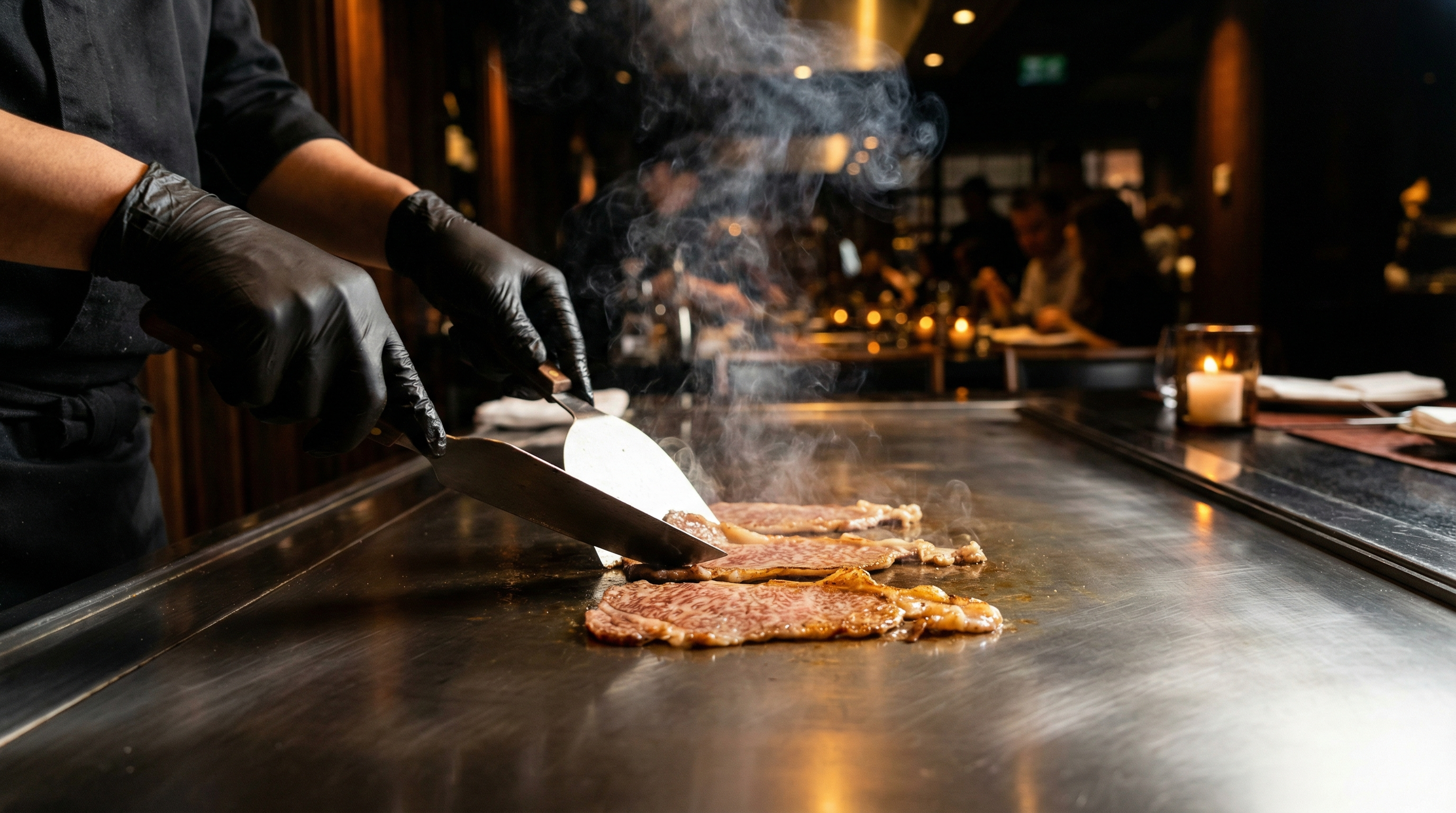
Teppanyaki transformed wagyu from an ingredient into a performance. The word itself — teppan (鉄板, iron plate) plus yaki (焼き, grilled) — describes cooking on a flat steel surface, but anyone who has sat at a teppanyaki counter in Tokyo knows it means far more than that. It is precision knife work, controlled heat, and timing that turns a piece of A5 beef into something you remember for years.
Unlike yakiniku where you grill your own thin slices, teppanyaki is chef-driven. The cook controls every variable — surface temperature, fat rendering, rest time — while you watch from inches away. And unlike a Western steakhouse where the kitchen is hidden, teppanyaki makes the cooking itself part of the meal.
This guide covers everything you need to recreate authentic wagyu teppanyaki at home, from choosing the right cuts to building the sauces that make the experience complete.
What Makes Teppanyaki Different from Other Wagyu Cooking Methods
Teppanyaki occupies a unique space among Japanese wagyu preparations. Where yakiniku uses thin slices on an open grill and sukiyaki simmers beef in a sweet soy broth, teppanyaki cooks thicker portions on a solid steel surface that maintains consistent, controllable heat.
The flat griddle surface is the key difference. It captures and redistributes the rendered wagyu fat across the cooking surface, essentially allowing the beef to cook in its own liquid gold. This self-basting effect produces a crust that no other method can replicate — deeply caramelized on the outside while the interior fat stays barely rendered, creating that signature teppanyaki contrast between crispy exterior and butter-soft center.
Three characteristics define authentic wagyu teppanyaki:
- Thicker cuts than yakiniku — typically ¾ to 1½ inches, not paper-thin slices
- Chef-controlled cooking — one person manages heat, timing, and portioning
- Sequential service — beef is cut into bite-sized pieces after cooking, served a few at a time so every bite arrives at peak temperature
The Best Wagyu Cuts for Teppanyaki
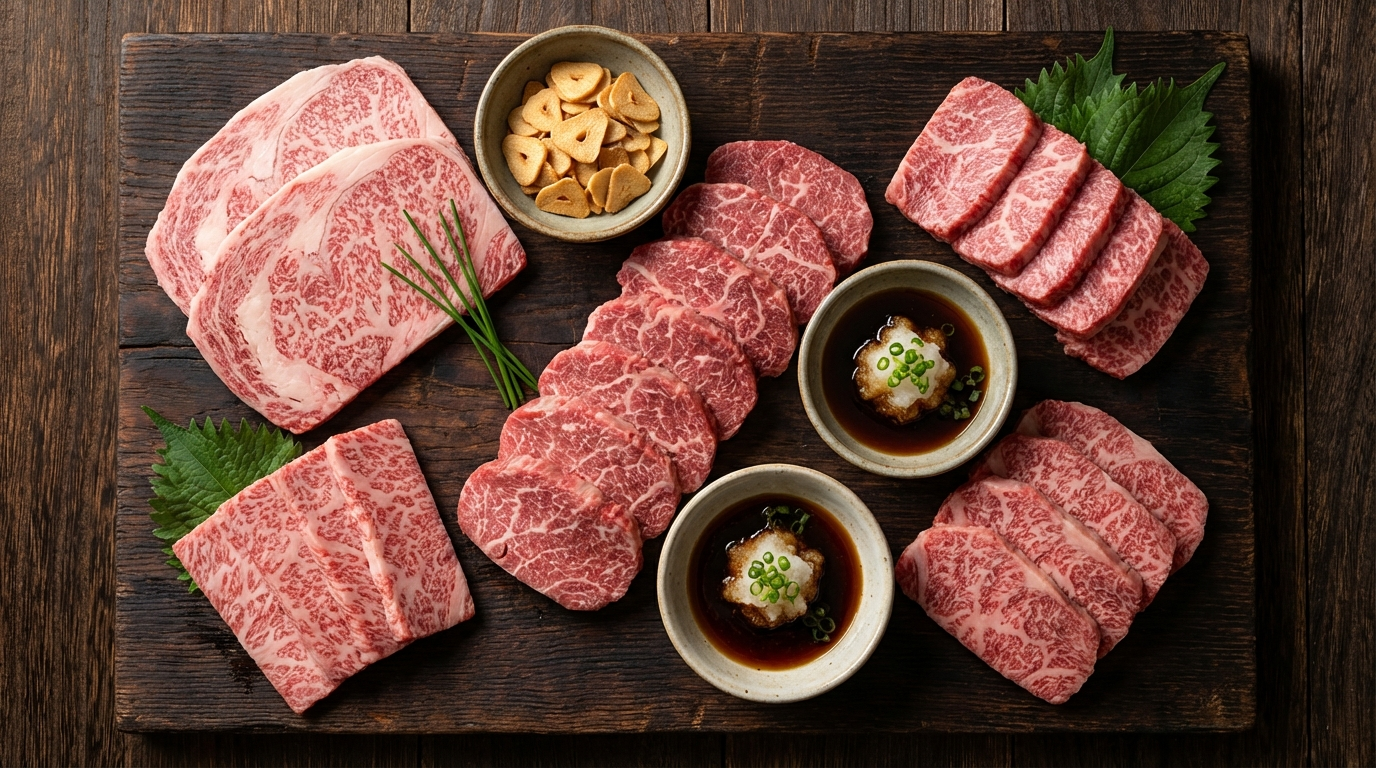
Not every wagyu cut works equally well on the teppan. The flat surface and higher heat suit certain muscles better than others. Here are the cuts ranked by their teppanyaki performance.
Sirloin (サーロイン) — The Teppanyaki Standard
In Japan, sirloin is the default teppanyaki cut, not ribeye. Japanese sirloin (which corresponds roughly to the American strip loin) has a cleaner grain structure than ribeye, with marbling that distributes heat evenly without creating pockets of unrendered fat. A5 sirloin on the teppan develops a remarkably even crust because the fat content is consistent across the entire surface.
Cut it 1 to 1¼ inches thick. Score the fat cap lightly if present. The sirloin's moderate marbling (relative to ribeye) means it handles high heat without flaring or over-rendering — you get caramelization without greasiness.
Tenderloin (ヒレ / Filet) — The Lean Luxury
Wagyu tenderloin is the most tender cut on the animal but carries less marbling than sirloin or ribeye. On the teppan, this works beautifully. The minimal intramuscular fat means you get a clean, pure beef flavor with extraordinary tenderness. Teppanyaki chefs often cook filet to a slightly more rare center than sirloin — the lack of heavy marbling means it doesn't need heat to render internal fat.
Cut 1¼ to 1½ inches thick. The cylindrical shape of the tenderloin makes it easy to get even contact with the griddle surface. Baste with the rendered fat from fattier cuts cooked earlier in the meal.
Ribeye (リブロース) — Maximum Richness
Ribeye delivers the most intensely marbled teppanyaki experience. The spinalis cap (ribeye cap) is particularly spectacular — its heavy fat content creates an almost crispy, lacey exterior when pressed flat against the hot steel. However, A5 ribeye can be almost too rich in large portions. Teppanyaki chefs compensate by cutting it slightly thinner (¾ inch) and serving smaller pieces with plenty of palate cleansers between bites.
Rump Cap (イチボ / Ichibo) — The Value Pick
Ichibo comes from the top of the rump and offers excellent marbling at a lower price point than the premium loin cuts. It has a slightly firmer texture and a more robust, mineral-rich flavor. On the teppan, ichibo performs well when cut across the grain at about 1 inch thick. It's the cut that teppanyaki regulars in Japan order when they want to eat well without paying A5 sirloin prices.
Teppanyaki Cooking Technique Step by Step
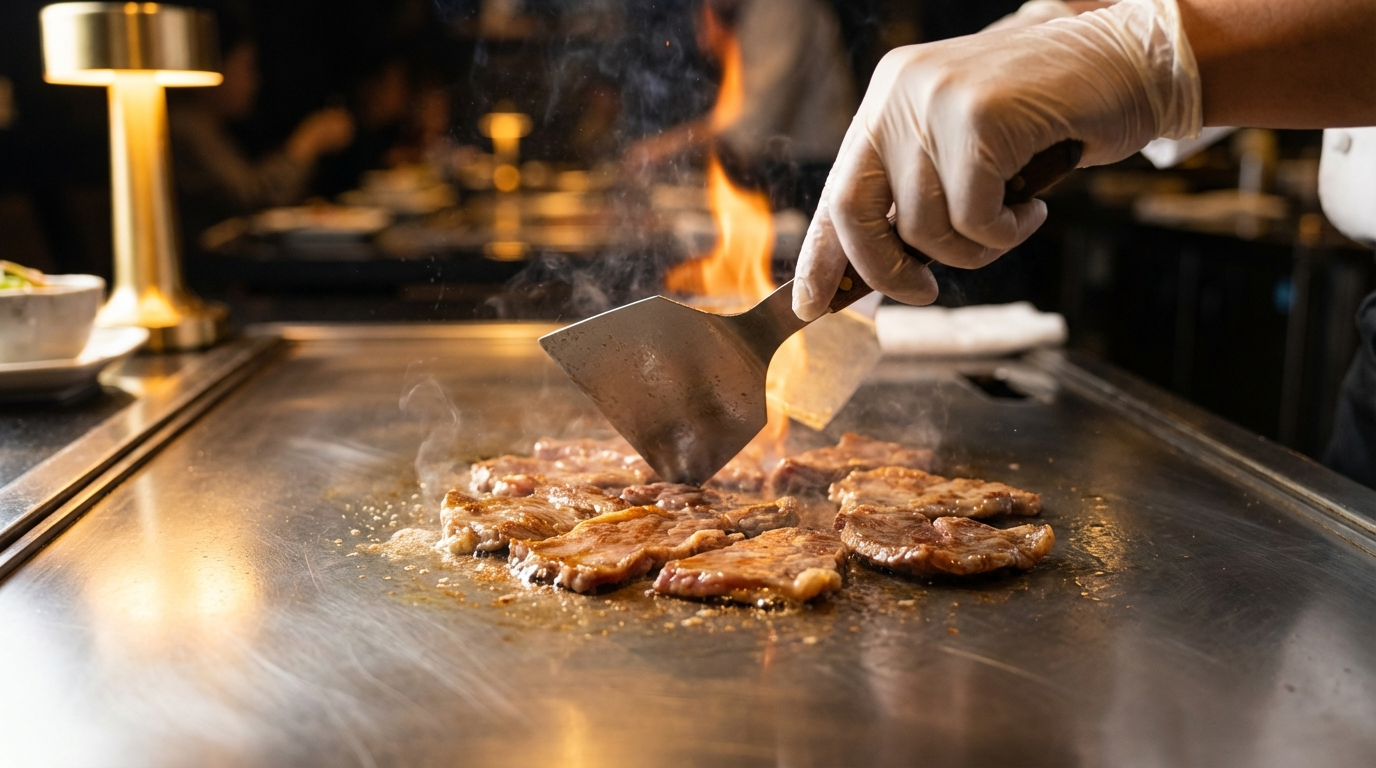
The technique that separates great teppanyaki from merely cooking steak on a flat surface comes down to temperature management and restraint.
Surface Temperature
Heat the griddle to 450-500°F (230-260°C) before the beef touches it. At teppanyaki restaurants, the steel surface is typically ¾ to 1 inch thick, which stores enormous thermal energy. When wagyu hits this surface, the Maillard reaction begins instantly — there is no waiting period for the pan to recover heat.
For home cooking, preheat your griddle or cast iron for at least 10 minutes. The surface should smoke lightly when you brush it with a tiny amount of neutral oil. If the oil doesn't smoke immediately, the surface is not ready.
The Three-Zone Method
Professional teppanyaki chefs mentally divide their griddle into three zones:
- Hot zone (center) — 480-500°F for initial searing
- Medium zone (mid-ring) — 350-400°F for finishing and resting
- Cool zone (edges) — 250-300°F for holding cooked pieces and vegetables
This zonation allows the chef to move beef from intense sear to gentle finish without removing it from the surface. The residual fat from searing coats the cooler zones, keeping finished pieces warm and lubricated.
Cooking Sequence for Wagyu
Step 1: Season simply. Wagyu destined for teppanyaki gets only salt — coarse sea salt, applied just before cooking. Pepper and other seasonings go on after cooking or are provided as condiments. The reasoning is practical: pepper and garlic burn on the 500°F surface. Salt draws moisture to the surface, which accelerates browning.
Step 2: Sear the first side. Place the seasoned wagyu on the hottest zone. Do not move it. For a 1-inch sirloin, the first side takes 90 seconds to 2 minutes. You'll see fat beginning to render and pool around the base of the steak. The edges will turn from red to grey about ⅓ of the way up.
Step 3: Flip once. Use a flat spatula — never tongs or a fork. Press gently to ensure full surface contact with the griddle. The second side cooks faster because the internal temperature has already started climbing. Give it 60 to 90 seconds.
Step 4: Move to the medium zone. Slide the steak to a cooler area of the griddle and let it rest for 60 seconds. The internal temperature will continue rising 5-8°F from carryover cooking.
Step 5: Cut and serve. This is the theatrical moment. Using a sharp knife (never a serrated blade), cut the steak into bite-sized pieces directly on the griddle surface. Arrange them on a warm plate with the cut face up so diners can see the interior doneness. Serve 3-4 pieces at a time, keeping the rest warm on the cool zone.
Target Doneness
For wagyu teppanyaki, the ideal internal temperature is rare to medium-rare:
- Rare (レア): 120-125°F — translucent red center, maximum fat texture contrast
- Medium-rare (ミディアムレア): 130-135°F — the sweet spot for most A5 cuts, fat is beginning to soften
- Medium (ミディアム): 140-145°F — appropriate for lean cuts like tenderloin where you want slightly more fat rendering
Most teppanyaki chefs in Japan cook wagyu to rare. The marbling is so heavy that the fat provides richness even without heat-activated rendering. Cooking beyond medium diminishes the textural contrast that makes teppanyaki special.
Essential Teppanyaki Sauces and Condiments
The sauces are not optional — they are architecturally essential to the teppanyaki experience. Each one serves a specific purpose, cutting richness, adding contrast, or resetting your palate between bites.
Ponzu (ポン酢)
The most important teppanyaki condiment. Ponzu is a citrus-soy sauce made from yuzu juice, soy sauce, rice vinegar, and dashi. Its bright acidity cuts through wagyu's richness instantly. A single piece of A5 beef dipped in ponzu transforms from overwhelmingly rich to perfectly balanced. Make your own by combining ¼ cup fresh yuzu juice (or a mix of lemon and lime), ¼ cup soy sauce, 2 tablespoons rice vinegar, and 1 tablespoon mirin.
Garlic Chips (ニンニクチップ)
Thinly sliced garlic fried to golden crispness on the teppan before the beef goes on. The rendered beef fat absorbs garlic flavor, which transfers to everything cooked afterward. Garlic chips are served as a crunchy topping for each bite of wagyu — the textural contrast between crispy garlic and soft beef is addictive.
Wasabi (わさび)
Fresh wasabi, not the horseradish paste. A tiny dab of real wasabi on a piece of teppanyaki wagyu creates a heat that dissipates in seconds, momentarily clearing the palate of fat. In premium teppanyaki restaurants, the chef grates fresh wasabi root tableside.
Mustard (和がらし) and Seasoned Salts
Japanese karashi mustard — sharper and more pungent than Western yellow mustard — is used sparingly on leaner cuts like tenderloin. Many teppanyaki restaurants also offer 3-4 finishing salts: plain sea salt, matcha salt, yuzu salt, and black truffle salt. These let diners customize each bite and prevent flavor fatigue across a multi-course wagyu meal.
Building a Teppanyaki Setup at Home
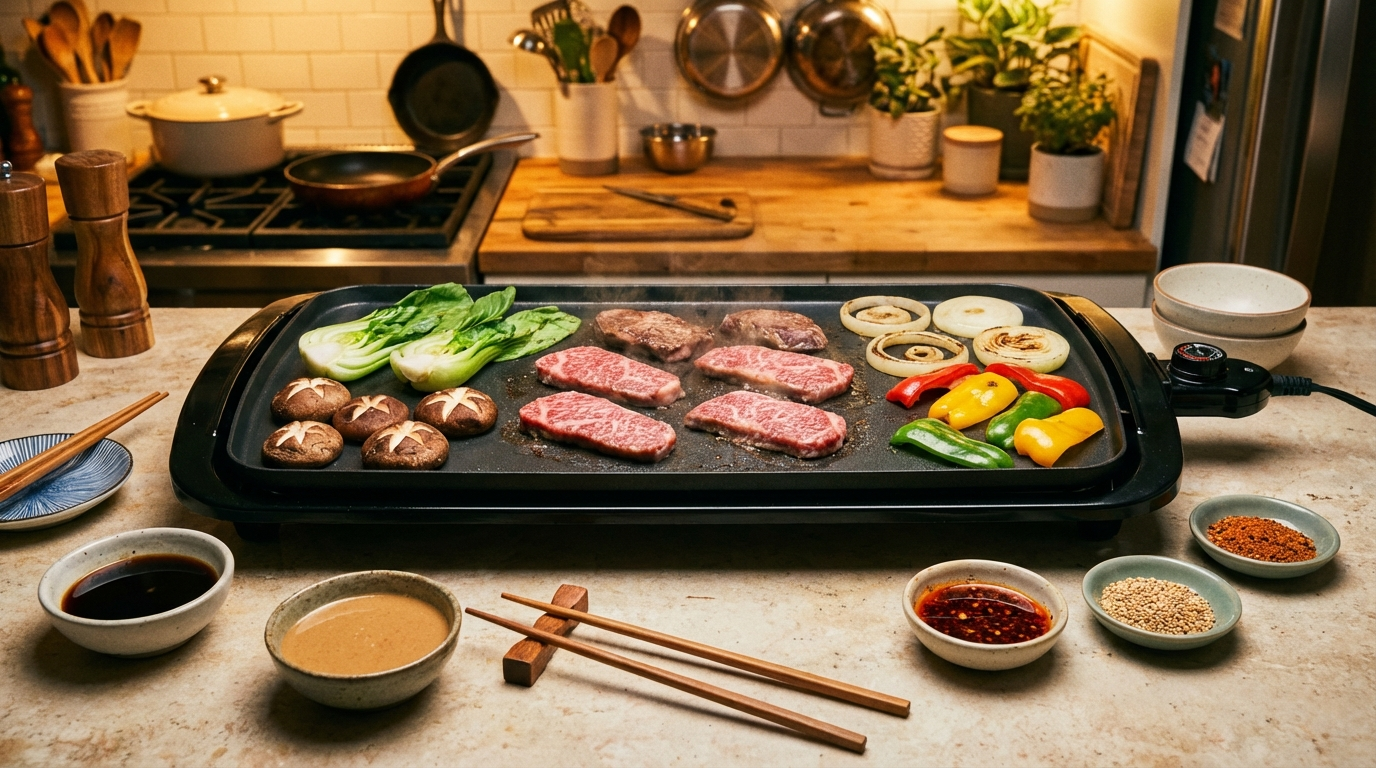
You don't need a built-in teppanyaki counter to cook wagyu this way. A well-chosen flat cooking surface and the right accessories get you 90% of the restaurant experience.
The Griddle
Your most important investment. Three options ranked by performance:
Option 1: Heavy cast iron griddle plate. A flat, ¾-inch-thick cast iron plate (like a Baking Steel or Lodge cast iron griddle) placed over two burners gives you the closest home analog to a professional teppan. The thermal mass is critical — it holds temperature when cold beef hits the surface.
Option 2: Electric teppanyaki griddle. Dedicated electric teppanyaki plates from Zojirushi or similar Japanese brands work well for moderate portions. They lack the thermal mass of cast iron but offer precise temperature control and easy cleanup.
Option 3: Carbon steel plancha. A thick carbon steel plate develops excellent seasoning over time and heats more evenly than thin stainless steel. Look for at least ⅜-inch thickness.
Essential Accessories
- Two flat spatulas — one for cooking, one for cutting. Offset handles prevent burned knuckles
- Squeeze bottles — for oil and water (a few drops of water on the teppan creates steam for finishing vegetables)
- Small sauce dishes — individual portions of ponzu, wasabi, salts
- A sharp, thin-bladed knife — for cutting the finished steak into bites on the surface
The Complete Teppanyaki Meal Sequence
An authentic teppanyaki dinner follows a specific order, each course building on the flavors of the previous one:
- Garlic chips — fried first to infuse the cooking surface with flavor
- Vegetables — bean sprouts, sliced onions, mushrooms cooked in garlic-infused fat
- Seafood — shrimp or scallops, if serving (cooked before beef to prevent flavor cross-contamination)
- Wagyu — the main event, cooked in the accumulated rendered fats
- Garlic fried rice — cooked last, using all the flavors built up on the griddle surface
For a home dinner focused on wagyu, you can simplify to garlic chips, a quick vegetable sauté, the wagyu, and fried rice to finish.
Wagyu Teppanyaki Plating and Serving
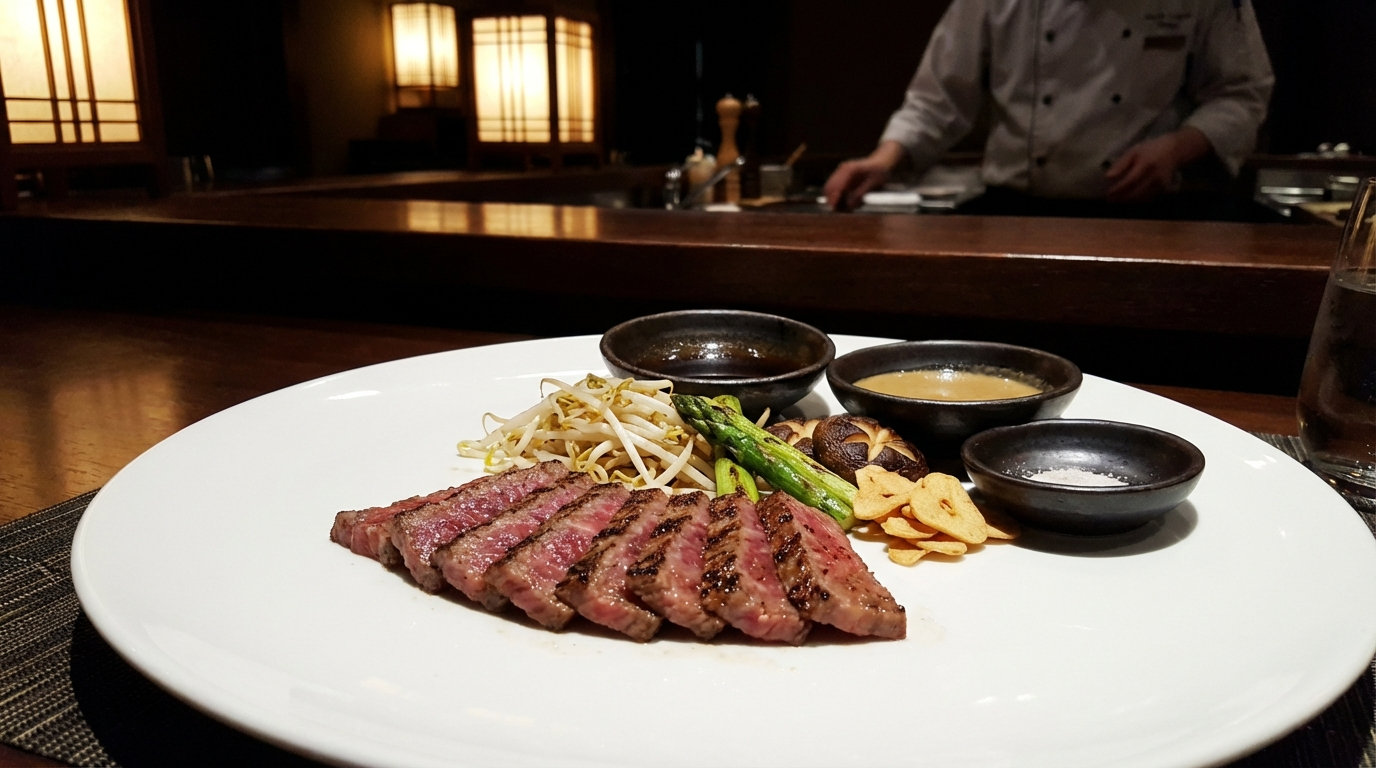
Presentation matters because it controls pacing. Teppanyaki is meant to be eaten slowly, a few bites at a time, not all at once.
Cut the seared wagyu into pieces roughly 1 inch square. Arrange 3-4 pieces on a warm plate with cut faces up — this lets diners see the interior and appreciate the contrast between the caramelized crust and the rare center. Place a small mound of garlic chips to the side and leave room for the diner to add their own salt or sauce.
Serve the next batch only when the first is nearly finished. This pacing replicates the restaurant experience and prevents the beef from cooling. Each portion should arrive at the table within 30 seconds of leaving the griddle.
Portion Sizing
For a wagyu teppanyaki dinner, plan:
- A5 grade: 4-6 ounces per person (the intense marbling makes this sufficient)
- A3-A4 grade: 6-8 ounces per person
- American/Australian wagyu: 8-10 ounces per person
These portions seem small by Western standards, but combined with the vegetable courses and fried rice, the total meal is substantial. The richness of A5 beef means most diners are satisfied — even relieved — with smaller portions.
Common Teppanyaki Mistakes to Avoid
Overcrowding the surface. Every piece of beef needs full contact with the hot steel. If pieces are touching, they steam instead of searing. Cook in batches if necessary.
Moving the beef too often. Place it, leave it, flip it once. Every time you move the steak, you interrupt the Maillard reaction and add 30 seconds to the cook time.
Skipping the rest. Even on the griddle, the beef needs 60 seconds on the cooler zone before cutting. Cutting immediately releases juices that would otherwise reabsorb.
Using too much oil. Wagyu renders its own cooking fat. Start with the barest film of oil — just enough to prevent sticking for the first 10 seconds until the beef fat takes over.
Cooking past medium. Wagyu teppanyaki cooked well-done is a waste of the cut's potential. The marbling needs the temperature contrast between hot exterior and cool interior to deliver the full sensory experience.
Forgetting the garlic rice. The fried rice course isn't filler — it's the reason the griddle accumulates flavors all meal long. Skipping it wastes the best cooking medium you'll create all night.
Frequently Asked Questions
What is the best cut of wagyu for teppanyaki?
Sirloin (strip loin) is the traditional teppanyaki standard in Japan. Its consistent marbling distributes heat evenly and develops a uniform crust without over-rendering. Cut it 1 to 1¼ inches thick for the best results.
What temperature should a teppanyaki griddle be for wagyu?
Heat the griddle to 450-500°F (230-260°C) before placing the beef. The surface should smoke lightly when brushed with a tiny amount of oil. Professional teppanyaki griddles use ¾ to 1-inch thick steel for maximum heat retention.
How is teppanyaki different from yakiniku?
Teppanyaki uses thicker cuts (¾ to 1½ inches) cooked by a chef on a flat steel surface, while yakiniku uses paper-thin slices grilled by diners on an open grate. Teppanyaki focuses on controlled searing and sequential service; yakiniku is interactive and communal.
What sauces go with wagyu teppanyaki?
Ponzu (citrus-soy sauce) is essential for cutting the richness of wagyu fat. Other traditional accompaniments include garlic chips, fresh wasabi, karashi mustard, and a variety of finishing salts such as matcha salt and yuzu salt.
Can you do teppanyaki at home without special equipment?
Yes. A heavy cast iron griddle plate (¾-inch thick) placed over two stovetop burners replicates about 90% of a professional teppanyaki surface. The key is thermal mass — thicker cooking surfaces hold heat better when cold beef is placed on them.
More Expert Guides
Wagyu Ribeye Steak: The Complete Guide to Buying, Cooking, and Enjoying
Wagyu ribeye is the crown jewel of steak cuts — extraordinary marbling wrapped around the most flavorful primal on the animal. Here's how to buy, cook, and serve it without wasting a single bite.
12 min readHalal Wagyu Beef: Everything You Need to Know Before You Buy
Halal wagyu combines the extraordinary marbling of wagyu genetics with Islamic slaughter standards. Here is how to find it, verify certification, and choose the right cuts.
13 min readWagyu Filet Mignon: The Complete Guide to the Most Tender Cut
Wagyu filet mignon combines the beef world's most tender muscle with its most intensely marbled breed. Learn how to select the right grade, what to expect at each price point, and the cooking methods that do this extraordinary cut justice.