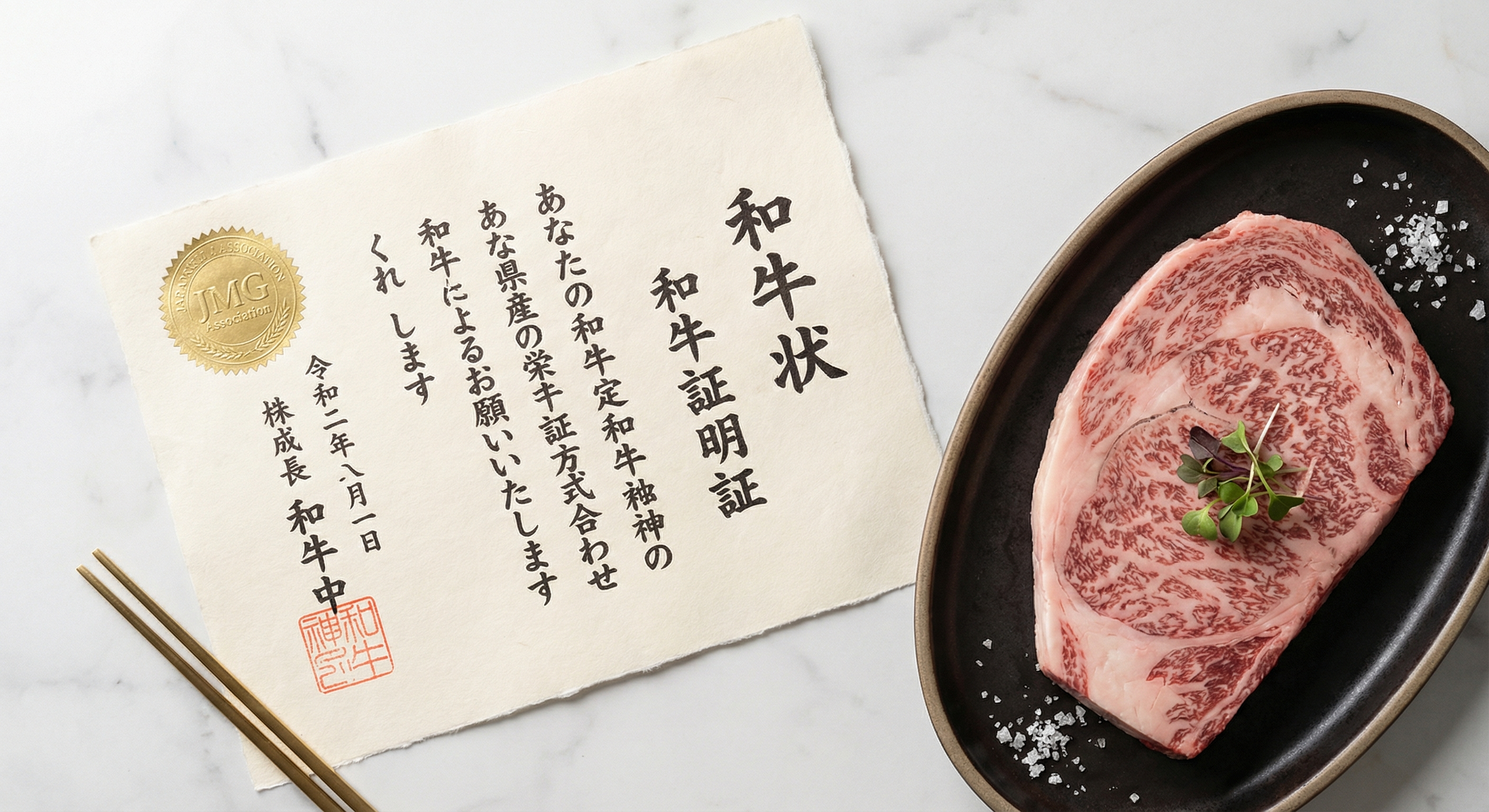
When you buy Japanese wagyu, you're not just purchasing beef—you're buying into a comprehensive certification system that traces each animal from birth through processing. Understanding this system protects you from counterfeit products and ensures you're getting what you paid for.
## The JMG Association: Wagyu's Central Authority
The Japan Meat Grading Association (JMGA, or JMG) is the official body responsible for grading all Japanese wagyu. Every certified wagyu carcass passes through JMG inspection at government-approved slaughterhouses. Graders evaluate two core metrics:
**Yield grade (A-C):** Measures the usable meat-to-carcass ratio. "A" grade indicates the highest yield, meaning more saleable cuts per animal. This is purely a butchery efficiency metric—it doesn't measure taste or marbling.
**Quality grade (1-5):** Evaluates four factors: marbling (BMS score), meat color and brightness, fat color and luster, and firmness/texture. Grade 5 represents the highest quality, with BMS 8-12 required for A5 certification.
The official JMG stamp appears on every graded carcass—a red ink mark displaying the yield and quality grades (e.g., "A5"). Without this mark, the beef cannot legally be sold as graded wagyu in Japan.
## DNA Traceability: From Calf to Plate
Since 2003, Japan has required mandatory individual identification for all cattle. Every wagyu calf receives a 10-digit traceability number at birth, recorded in the national Cattle Traceability System database. This isn't a voluntary program—it's federal law under the Act on Special Measures Concerning Management and Relay of Information for Individual Identification of Cattle.
Here's what the system tracks:
- **Birth farm and location:** Where the calf was born and raised
- **Parent lineage:** Dam and sire identification for bloodline verification
- **Movement history:** Every farm transfer or sale
- **Slaughter facility and date:** Where and when processing occurred
- **Processing plant:** Where the carcass was fabricated into cuts
Restaurants and retailers selling authentic Japanese wagyu can (and often must) provide this traceability number. You can verify it yourself at
the NLBC database—enter the 10-digit code to see the animal's complete history in Japanese. Many vendors now print this number directly on packaging or menu descriptions.
DNA testing backs up the paper trail. The Japanese government maintains genetic profiles for registered breeding cattle, allowing laboratories to confirm parentage and breed purity. While not required for every sale, DNA verification is standard practice for exported wagyu and high-value transactions.
## Certificates of Authenticity: What to Look For
Legitimate Japanese wagyu shipments include official documentation—usually a Certificate of Authenticity from the JMG Association or the exporter. These documents aren't standardized forms, but authentic certificates share common elements:
**Official seals and stamps:** Look for the red circular seal (印鑑 *inkan*) from the JMG Association or the exporting facility. Japanese business stamps are legally binding—if it's missing or looks photocopied, be skeptical.
**Traceability number:** The 10-digit individual identification code should be printed clearly. Cross-reference this with the NLBC database.
**Yield and quality grades:** Must specify both (e.g., "A5"). Certificates listing only "Grade 5" or "BMS 12" without the yield grade may not be official JMG documentation.
**Slaughter and processing dates:** Helps verify the beef's age and handling timeline. Japanese wagyu is typically processed within 28-36 months of age for optimal marbling.
**Prefecture and farm information:** Authentic certificates often list the specific prefecture (e.g., Hyogo for Kobe beef, Miyazaki for Miyazaki wagyu) and sometimes the farm name.
**English translation (for exports):** Many certificates intended for international markets include English text alongside Japanese, but the Japanese text is the legal version.
Forged certificates do exist. If you're spending thousands on imported wagyu, request the certificate before purchase and verify the traceability number online. Reputable importers and high-end butchers provide this documentation without hesitation.
## Prefecture-Specific Certifications
Beyond JMG grading, certain prefectures enforce additional certification for regional wagyu brands. These are voluntary programs that set higher standards than federal requirements:
**Kobe Beef:** Must be born, raised, and processed in Hyogo Prefecture; graded A4 or A5 with BMS 6+; sourced from pure Tajima bloodline cattle. The Kobe Beef Marketing & Distribution Promotion Association issues bronze medallion certificates with individual nose-print identification (yes, cattle nose prints are unique like fingerprints).
**Matsusaka Beef:** Requires virgin female cattle (never bred) raised in Matsusaka City or surrounding municipalities for at least 900 days. The Matsusaka Meat Regional Council manages certification, often featuring gold holographic seals.
**Omi Beef:** One of Japan's oldest brands, requiring cattle from Shiga Prefecture raised for at least 14 months in the region. Omi Beef Association certificates include detailed lineage documentation.
**Miyazaki Beef:** Must be born and raised in Miyazaki Prefecture for at least 14 months with A4 or A5 grading. The Miyazaki Cattle Farmers Association certifies and regulates the brand, often using blue holographic seals on packaging.
These regional certifications exist because place-of-origin matters in Japanese food culture—similar to Champagne or Parmigiano-Reggiano in Europe. If you're buying a branded wagyu like Kobe or Matsusaka, ask for the prefecture-specific certificate in addition to standard JMG documentation.
## How to Verify Wagyu Authenticity When Buying
If you're purchasing Japanese wagyu—whether online, from a butcher, or at a restaurant—here's your verification checklist:
1. **Ask for the traceability number:** Any retailer selling authentic Japanese wagyu can provide the 10-digit ID. Verify it at the NLBC database (link above). If they can't produce it, walk away.
2. **Check the JMG grade:** The beef should be clearly labeled A4 or A5 (or occasionally B4/B5). Single-letter grades like "Grade 5" without the yield grade are red flags.
3. **Request documentation:** For high-value purchases ($200+), ask to see the certificate of authenticity before completing the transaction. Authentic certificates include official seals, not just printed text.
4. **Inspect the marbling:** A5 wagyu requires BMS 8-12—intense, evenly distributed marbling that looks almost white. If the marbling is sparse or uneven, it may not be A5 regardless of what the label claims.
5. **Verify the importer (if buying in the US/EU):** Japanese wagyu exports are tightly controlled. Check if the retailer lists their importer. Major US importers include Holy Grail Steak Co., Crowd Cow, and Snake River Farms (for American wagyu, not Japanese). Reputable importers provide full documentation chains.
6. **Be wary of suspiciously low prices:** Authentic Japanese A5 wagyu retails for $150-$250/lb in the US (as of 2026). If you find "A5 wagyu" for $50/lb, it's either American wagyu (a crossbreed, not Japanese), mislabeled, or counterfeit.
7. **Ask about prefecture origin:** If the beef is marketed as Kobe, Matsusaka, or another premium brand, request the prefecture certification. These brands command higher prices precisely because of their additional standards—if the seller can't prove it, you're overpaying.
## The Role of Carcass Photography
Many importers and high-end butchers provide **carcass photographs** with purchases—images of the graded carcass showing the JMG stamp before fabrication. This is not a standard requirement, but it's increasingly common for transparency.
These photos serve as proof of grade authenticity. You'll see the red JMG stamp on the carcass alongside the hanging tag with the traceability number. If a retailer offers carcass photos, it's a strong indicator they're sourcing legitimate Japanese wagyu through proper channels.
## Common Certification Myths
**Myth: "Certified Kobe Beef" restaurants in the US are everywhere.**
Reality: As of 2026, only about 40-50 US restaurants are authorized Kobe Beef licensees according to the Kobe Beef Marketing Association. Many restaurants use "Kobe-style" or "Kobe beef" (lowercase) to market American wagyu—which is legal but misleading.
**Myth: All A5 wagyu is the same.**
Reality: A5 is a quality floor, not a ceiling. BMS 8, 9, 10, 11, and 12 all qualify as A5, but BMS 12 has nearly twice the marbling of BMS 8. Ask for the specific BMS score if you're comparing premium cuts.
**Myth: The certificate guarantees the beef was frozen/handled correctly.**
Reality: Certification only verifies origin, breed, and grading. Shipping, storage, and aging are separate concerns. Check the retailer's handling reputation, not just the certificate.
**Myth: You can taste-test for authenticity.**
Reality: Highly marbled American wagyu crossbreeds can taste similar to A4 Japanese wagyu. Without documentation, even experienced chefs can struggle to distinguish them by flavor alone. DNA testing and paperwork are the only definitive verification methods.
## What If You Suspect Fraud?
If you believe you purchased mislabeled or counterfeit wagyu:
- **Report to the retailer first:** Reputable sellers will investigate and often refund or replace suspicious products. Many high-end butchers guarantee authenticity.
- **File a complaint with the USDA (US):** The USDA Food Safety and Inspection Service oversees beef labeling. Fraudulent "Product of Japan" claims violate federal law.
- **Contact the importer:** If the retailer provided importer information, reach out directly. Legitimate importers take fraud seriously because it damages their brand.
- **Report to the JMG Association (for international cases):** While the JMG Association primarily serves Japanese markets, they track reports of counterfeit wagyu internationally and work with law enforcement when appropriate.
Japanese wagyu fraud is prosecuted aggressively in Japan—counterfeiters face fines and business closures. International enforcement is harder, but US and EU customs agencies have increased scrutiny on imported beef products in recent years.
## The Future of Wagyu Certification
Japan is testing blockchain-based traceability systems that would create immutable records of each animal's lifecycle. Several prefectures piloted programs in 2024-2025, allowing consumers to scan QR codes on packaging to view the full chain of custody—from birth farm to retail sale—on a tamper-proof ledger.
If adopted nationwide, blockchain traceability would essentially eliminate documentation fraud. Consumers could verify authenticity in seconds using their smartphones, without needing to navigate Japanese-language databases or authenticate ink stamps.
For now, the current system works—but only if you know how to use it. When spending premium prices on Japanese wagyu, demand the documentation and verify it yourself. The certification system exists to protect you. Use it.
## Related Guides
-
Understanding A5 Wagyu Grading
-
Wagyu BMS Score Explained
-
Kobe Beef vs. Wagyu: What's the Difference?
-
American Wagyu vs. Japanese Wagyu
-
Where to Buy Authentic Wagyu Beef Online