American Wagyu vs Japanese Wagyu: The Real Differences
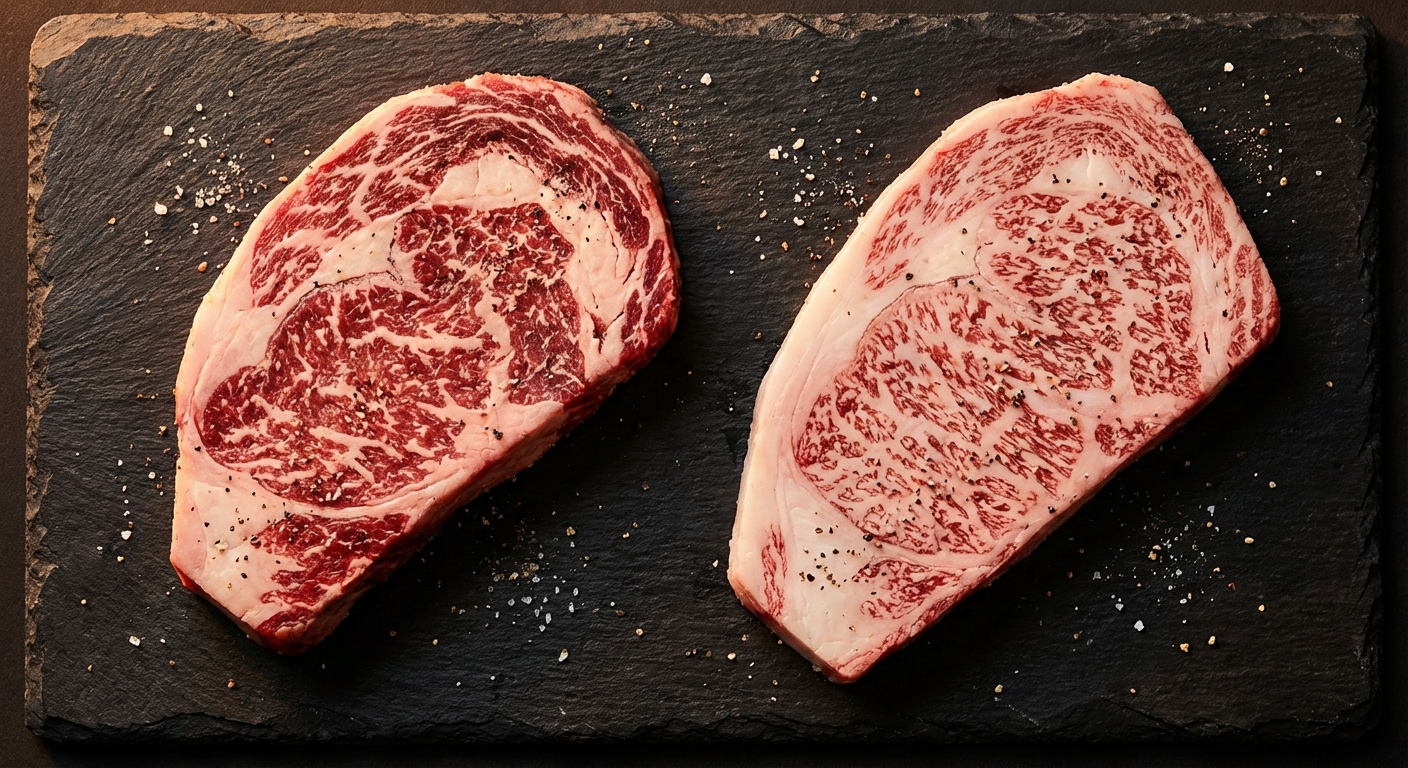
Walk into any high-end butcher shop or browse a premium online retailer and you'll see both "American Wagyu" and "Japanese Wagyu" on the shelf — often at wildly different price points. They share a name and some genetics, but these are fundamentally different products with different breeding programs, grading systems, flavor profiles, and ideal cooking methods.
Understanding what separates them isn't just academic. It determines whether you'll love the $120 steak you just ordered or feel disappointed that it wasn't what you expected.
The Genetics: Same Ancestors, Different Paths
All Wagyu traces back to four Japanese cattle breeds: Japanese Black (Kuroge Washu), Japanese Brown (Akage Washu), Japanese Shorthorn, and Japanese Polled. Of these, Japanese Black produces about 90% of all Wagyu beef — it's the breed responsible for the extreme marbling that made Wagyu famous.
In the late 1970s through the 1990s, a small number of Japanese Wagyu genetics — live cattle, embryos, and semen — were exported to the United States and Australia before Japan closed exports permanently in 1997. Those genetics became the foundation of the American Wagyu industry.
Fullblood vs Crossbred American Wagyu
This is where the first major distinction appears:
- Fullblood American Wagyu (100% genetics): Descended entirely from Japanese Wagyu bloodlines. These animals can produce marbling that rivals Japanese cattle, reaching BMS 7-10 or occasionally higher. They represent a small fraction of the American Wagyu market.
- F1 Crossbred (50% Wagyu, 50% Angus): The most common "American Wagyu" you'll encounter. These animals inherit some marbling predisposition from their Wagyu parent and the frame size and growth rate of Angus. BMS typically ranges from 4 to 6.
- F2-F4 Crosses (75-93% Wagyu): Higher-percentage crosses that bridge the gap between F1 and Fullblood. Increasingly common as American breeders upgrade their herds.
When a menu or retailer says "American Wagyu" without further qualification, it's almost always an F1 cross. Always ask about the percentage if you want to know what you're getting.
The Raising: Different Philosophies
Japanese Wagyu cattle live pampered lives by any standard. They're typically raised for 28-32 months — roughly 10-14 months longer than conventional American beef cattle. They eat carefully formulated grain-heavy diets designed to maximize intramuscular fat deposition. Individual cattle are tracked from birth through processing with a 10-digit ID number that consumers can trace online.
American Wagyu programs vary significantly. Some premium producers like Snake River Farms and Morgan Ranch raise their cattle on extended feeding programs (400+ days on grain) designed to maximize marbling. Others finish their cattle on standard 120-150 day feedlot programs no different from commodity beef.
The feeding duration matters enormously. Marbling develops over time, and cattle pulled off feed early simply won't reach their genetic potential — regardless of their Wagyu percentage.
The Grading: Two Completely Different Systems
This is one of the most confusing aspects of the American vs. Japanese Wagyu comparison. The two countries use entirely different grading scales that don't map neatly onto each other.
Japanese Grading (JMGA)
Japan's system evaluates four factors:
- Marbling (BMS 1-12): The Beef Marbling Standard scale, where higher is more marbled
- Meat color and brightness
- Firmness and texture
- Fat color, luster, and quality
The final quality grade (1-5) is determined by the lowest score across all four categories. A5 — the highest — requires a BMS of 8 or above. Combined with a yield grade (A, B, or C), you get the familiar A5, A4, B5 designations.
American Grading (USDA)
USDA grades focus primarily on marbling and maturity:
- USDA Prime: Roughly equivalent to BMS 5-7
- USDA Choice: Roughly BMS 3-5
- USDA Select: BMS 2-3
Here's the problem: the USDA system tops out where Japanese grading is just getting started. A heavily marbled American Wagyu steak at BMS 9 and a moderately marbled one at BMS 5 both receive the same USDA Prime grade. The USDA system simply wasn't designed to differentiate at the extreme end of the marbling spectrum.
This is why many American Wagyu producers use the Japanese BMS scale alongside — or instead of — USDA grades. When you see "American Wagyu BMS 9" on a label, that's the producer giving you more useful information than the USDA grade alone.
The Marbling: Quantifying the Difference
Let's put numbers on it:
- Japanese A5 Wagyu: BMS 8-12 (25-50%+ intramuscular fat)
- Fullblood American Wagyu: BMS 6-10 (15-35% intramuscular fat)
- F1 American Wagyu: BMS 4-6 (8-18% intramuscular fat)
- USDA Prime (non-Wagyu): BMS 5-6 (8-12% intramuscular fat)
At the top end, fullblood American Wagyu can overlap with the lower end of A5 Japanese. But the averages tell a different story — most American Wagyu you'll encounter sits comfortably in the USDA Prime range with moderately enhanced marbling. Good but not in the same universe as a BMS 11 or 12 from Miyazaki.
The Flavor: More Than Just Fat Content
Marbling scores don't tell the whole story. The flavor profiles of American and Japanese Wagyu differ in ways that go beyond fat percentage.
Japanese Wagyu Flavor Profile
- Intensely buttery, almost sweet
- Low "beefy" flavor compared to American cattle
- Melt-in-your-mouth texture — the fat literally dissolves at body temperature
- Rich umami depth
- Best in small 2-4 oz portions (richness becomes overwhelming in larger servings)
American Wagyu Flavor Profile
- Robust, classically "beefy" flavor (inherited from Angus genetics in crosses)
- Enhanced juiciness and tenderness compared to standard beef
- Satisfying fat content without the overwhelming richness of A5
- Works beautifully in standard 8-12 oz steak portions
- More familiar flavor profile — "the best steak you've ever had" rather than a completely new experience
Neither profile is objectively better. Japanese A5 is a luxury ingredient — small bites of something transcendent. American Wagyu is an elevated version of the American steakhouse experience. They scratch different itches.
The Price: What You'll Actually Pay
As of 2026, here's what you can expect to pay for a well-marbled ribeye:
- Japanese A5 Wagyu (imported): $100-$200+ per pound
- Fullblood American Wagyu (BMS 9+): $60-$120 per pound
- F1 American Wagyu: $30-$60 per pound
- USDA Prime (non-Wagyu): $25-$45 per pound
But remember the portion size difference. A proper serving of Japanese A5 is 3-4 oz ($25-$50 per serving), while an American Wagyu steak dinner is 10-12 oz ($20-$45 per serving). The per-serving gap is much narrower than the per-pound gap suggests.
Cooking Differences
The fat content gap between these two products demands different cooking approaches.
Japanese A5 Wagyu
- Slice thin (¼-½ inch) for searing
- Use a screaming-hot cast iron or carbon steel pan — no added fat
- Sear briefly: 45-60 seconds per side maximum
- Never grill — the extreme fat causes dangerous flare-ups
- Season with nothing more than flaky salt
- Serve immediately in small portions
American Wagyu
- Cut to standard steak thickness (1-1.5 inches)
- Reverse sear, pan sear, or grill — all methods work
- Cook like your best USDA Prime steak but watch for faster cooking due to higher fat content
- Pairs well with compound butters, sauces, and classic steakhouse sides
- Internal temperature: 130°F (medium-rare) for optimal fat rendering
How to Spot Misleading Labels
The American Wagyu market has a transparency problem. Here are red flags to watch for:
- "Wagyu-style" or "Wagyu-inspired": Meaningless marketing terms. The beef may contain no Wagyu genetics at all.
- "Wagyu" with no percentage or BMS disclosed: Could be anything from F1 (50%) to Fullblood. Ask before buying.
- Suspiciously cheap "Wagyu": If it's priced like USDA Choice, it's probably performing like USDA Choice. Genetics without proper feeding don't produce premium marbling.
- "Kobe-style" American Wagyu: Real Kobe beef comes only from Hyogo Prefecture, Japan. American cattle cannot be Kobe, period.
Reputable American Wagyu producers — Snake River Farms, Mishima Reserve, and Morgan Ranch among them — disclose genetics, BMS scores, and raising practices. If a producer won't tell you these details, shop elsewhere.
When to Choose Each
Choose Japanese A5 Wagyu When:
- You want a once-in-a-while luxury experience
- Serving small, curated portions (tasting menus, special occasions)
- You appreciate delicate, buttery flavors over beefy punch
- You want the authentic Japanese product with full traceability
Choose American Wagyu When:
- You want an exceptional steak dinner with standard portions
- Grilling or outdoor cooking is the plan
- You prefer robust, beefy flavor with enhanced marbling
- Feeding a group where individual A5 portions would break the budget
- Making burgers, roasts, or other dishes where A5 would be wasted
The Bottom Line
American Wagyu and Japanese Wagyu aren't competing products — they're different categories that happen to share a name. Japanese A5 is a luxury ingredient used in small quantities for maximum impact. American Wagyu is premium beef that elevates everyday steak dinners.
The smartest approach is to stop comparing them and start appreciating each for what it does best. Keep a fullblood American Wagyu ribeye in mind for your next dinner party. Save the A5 strip from Miyazaki for the night when nothing less than extraordinary will do.
Both deserve a place in your kitchen. Neither needs to replace the other.
Frequently Asked Questions
Is American Wagyu real Wagyu?
Yes — American Wagyu cattle carry genuine Japanese Wagyu genetics exported before Japan closed exports in 1997. However, most American Wagyu is crossbred (typically 50% Wagyu, 50% Angus), which produces a different marbling level and flavor profile than purebred Japanese Wagyu. Fullblood American Wagyu (100% genetics) is closer to the Japanese product but still differs due to feed, environment, and raising practices.
Why is Japanese Wagyu so much more expensive than American Wagyu?
Several factors compound: Japanese cattle are raised 28-32 months on expensive grain diets (vs. 18-24 months for most American Wagyu), production is limited (~500K head annually in Japan), strict export regulations limit supply, and import duties add cost. The extreme marbling consistency of Japanese A5 also reflects generations of selective breeding that American programs are still developing.
Can American Wagyu reach A5 marbling levels?
Fullblood American Wagyu (100% Japanese genetics) can reach BMS 9-10, which overlaps with the lower end of A5 (BMS 8-12). However, it rarely matches BMS 11-12 specimens from top Japanese prefectures. F1 crossbred American Wagyu typically tops out at BMS 5-6, well below A5 territory.
What does F1 mean for American Wagyu?
F1 refers to a first-generation cross — one parent is purebred Wagyu, the other is typically Angus. The resulting animal is 50% Wagyu genetics. F2 is 75% (F1 bred back to purebred Wagyu), F3 is 87.5%, and F4 is 93.75%. Higher percentages generally correlate with more marbling potential.
Which is better for grilling: American or Japanese Wagyu?
American Wagyu is far better suited for grilling. Its moderate fat content (BMS 4-7) renders beautifully over direct heat without causing excessive flare-ups. Japanese A5 Wagyu (BMS 8-12) should never be grilled — the extreme fat content causes dangerous flare-ups and the fat doesn't render properly over open flame. Use a flat, hot surface like cast iron for A5.
How can I tell if American Wagyu is high quality?
Look for three things: disclosed Wagyu percentage (Fullblood, F1, etc.), a BMS score or marbling photo, and information about the feeding program (days on feed). Reputable producers like Snake River Farms, Mishima Reserve, and Morgan Ranch provide all of this. Avoid products labeled simply "Wagyu" with no details — they could be minimally marbled crossbreeds.
More Expert Guides
What Is Wagyu Beef? The Complete Guide to Grades, Origins & Quality
Discover wagyu beef origins, the difference between Japanese A5 and American wagyu, how BMS grading works, why marbling matters, proper cooking techniques, and what you should pay in 2026.
12 min readA5 Wagyu: Your Complete Buying & Authentication Guide (2026)
A5 wagyu represents the pinnacle of beef quality, but not all A5 is created equal. Learn how to authenticate real Japanese A5, decode BMS scores, find fair prices, and cook it perfectly at home.
14 min readA5 Wagyu Prefectures: Regional Guide to Japan's Best Beef
Discover the regional differences in Japanese A5 wagyu across 12 key prefectures. Learn which prefecture produces the flavor profile you'll love most.