Kobe Beef vs Wagyu: What's the Real Difference?
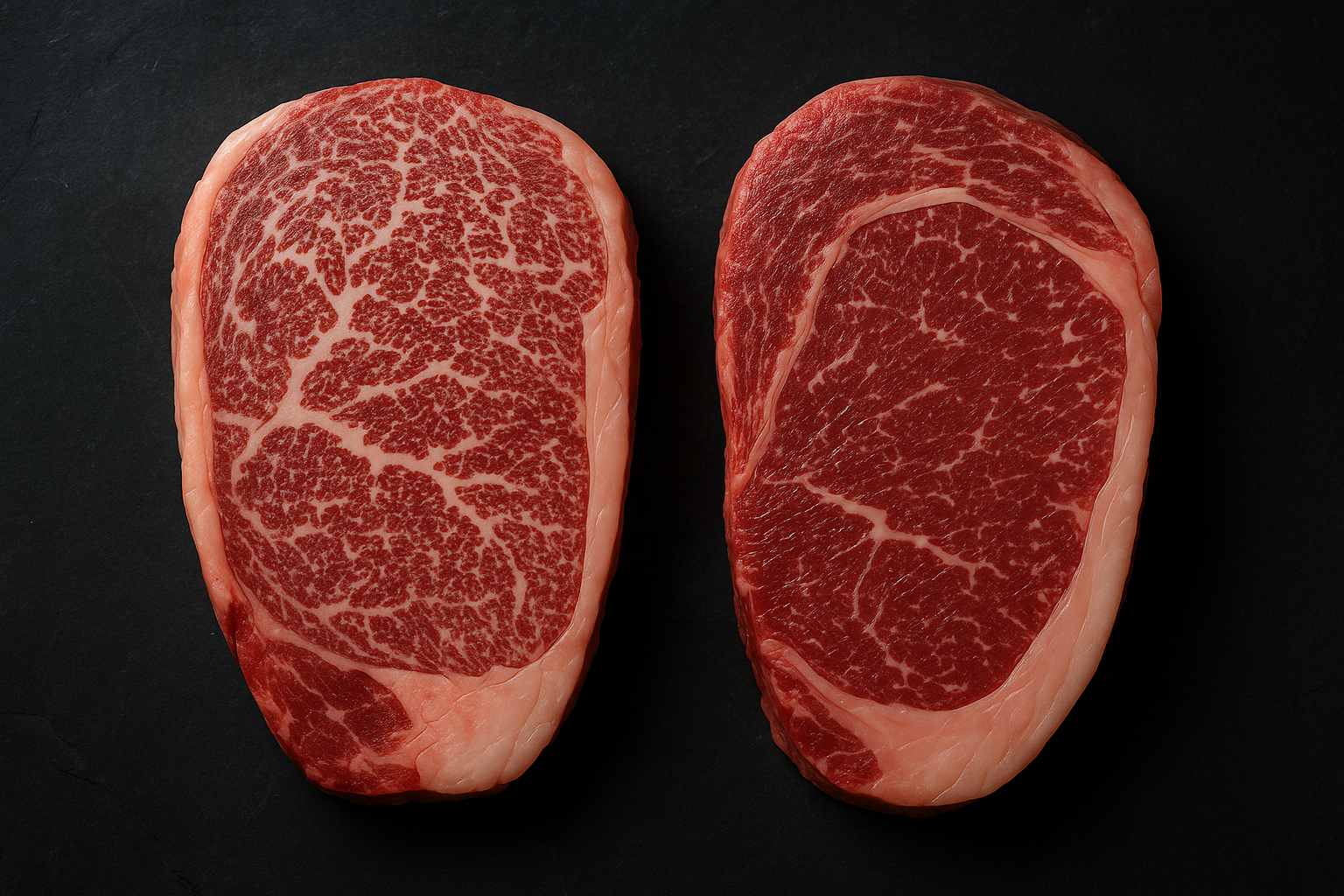
Walk into any high-end steakhouse and you'll see "Wagyu" and "Kobe" thrown around like interchangeable labels. They're not. One is a broad category of cattle; the other is a tightly controlled regional designation with strict certification. Understanding the difference saves you from overpaying for mislabeled beef — and helps you appreciate the real thing when you find it.
Wagyu: The Umbrella Term
Wagyu literally translates to "Japanese cow" (wa = Japanese, gyu = cow). It refers to four specific breeds of cattle originally developed in Japan:
- Japanese Black (Kuroge) — accounts for roughly 90% of all Wagyu production. This is the breed behind the extreme marbling Wagyu is famous for.
- Japanese Brown (Akage) — leaner than Black, with a lighter, more delicate flavor. Sometimes called "Red Wagyu."
- Japanese Shorthorn (Nihon Tankaku) — rare, raised primarily in northern Honshu. Known for a rich, savory taste with less marbling.
- Japanese Polled (Mukaku) — the rarest breed, nearly extinct, with fewer than 200 animals registered.
When most people say "Wagyu," they mean Japanese Black cattle — and more specifically, the intensely marbled beef those animals produce.
Wagyu Outside Japan
Here's where confusion begins. Wagyu genetics were exported to Australia, the United States, and other countries starting in the 1990s. Today, "American Wagyu" and "Australian Wagyu" are legitimate products, but they're usually crossbreeds — Wagyu bulls crossed with Angus or Holstein cows.
The result is good beef. Often very good. But it's not the same product as fullblood Japanese Wagyu. The marbling, fat composition, and flavor profile differ significantly. A crossbred American Wagyu steak might score BMS 5–7 on the Japanese marbling scale. Fullblood Japanese Wagyu routinely scores BMS 8–12.
Kobe Beef: Wagyu With a Passport
Kobe beef is Wagyu — specifically, it's beef from Tajima-gyu cattle (a strain of Japanese Black) raised in Hyogo Prefecture, Japan. But not every Tajima cow in Hyogo produces Kobe beef. The certification requirements are among the strictest in the food world:
- Breed: Must be purebred Tajima-gyu, born and raised in Hyogo Prefecture.
- Processing: Must be slaughtered and processed at approved facilities in Kobe, Nishinomiya, Sanda, Kakogawa, or Himeji.
- Marbling: Must achieve a BMS (Beef Marbling Standard) score of 6 or higher.
- Yield grade: Must score A or B on the Japanese yield scale.
- Carcass weight: Must fall between 260 and 470 kg.
- Meat quality: Must score 4 or 5 on the overall meat quality scale.
Only about 3,000 to 5,000 cattle per year meet all these criteria. That scarcity is real — and it's the primary reason authentic Kobe beef commands the prices it does.
The Kobe Beef Marketing Board
Every certified Kobe beef carcass receives a 10-digit ID number traceable back to the individual animal. The Kobe Beef Marketing and Distribution Promotion Association maintains a public database where you can verify any Kobe beef purchase. If a restaurant can't provide this number, what you're eating isn't certified Kobe.
Head-to-Head: How They Compare
Marbling and Texture
Both Kobe and high-grade Wagyu feature extraordinary marbling — the web of intramuscular fat that gives the meat its buttery texture. However, Kobe beef specifically comes from the Tajima strain, which produces marbling with a finer, more even distribution than many other Wagyu strains.
The fat in Japanese Wagyu (including Kobe) has a higher percentage of monounsaturated fatty acids, particularly oleic acid. This gives the fat a lower melting point — it literally dissolves on your tongue at body temperature. The sensation is unlike any other beef.
Flavor Profile
- Kobe beef tends toward a refined, almost sweet flavor with a clean finish. The Tajima strain's consistent fat distribution creates an exceptionally uniform eating experience.
- Other Japanese Wagyu (Miyazaki, Matsusaka, Omi) can be equally marbled but may have slightly different flavor characteristics depending on the strain, feed, and terroir.
- American/Australian Wagyu delivers more traditional "beefy" flavor with enhanced marbling compared to conventional cattle. The balance of lean-to-fat tends to be more accessible to Western palates.
Price Comparison (2026 Market)
| Cut | Authentic Kobe (Japan) | A5 Japanese Wagyu (Non-Kobe) | American Wagyu |
|---|---|---|---|
| Ribeye (per lb) | $250–$400+ | $150–$280 | $50–$100 |
| Striploin (per lb) | $200–$350 | $120–$220 | $40–$80 |
| Tenderloin (per lb) | $300–$500+ | $180–$320 | $60–$120 |
These prices reflect retail and high-end restaurant sourcing. Authentic Kobe commands a 30–80% premium over equivalent-grade non-Kobe Japanese Wagyu, driven entirely by scarcity and brand prestige.
The Fake Kobe Problem
This is the uncomfortable truth: most "Kobe beef" served in the United States isn't real Kobe. For years, Kobe beef wasn't even legally exported to the US. Exports to America only resumed in 2012, and the volume remains tiny — a few thousand pounds per year for the entire country.
Red Flags to Watch For
- Kobe beef burger — Authentic Kobe is never ground into hamburgers. At $300+ per pound, no one is making patties.
- Kobe sliders at a sports bar — If it costs less than $50 per serving, it's not Kobe.
- No certificate or ID number — Every Kobe sale should be traceable. Ask for documentation.
- "Kobe-style" or "Kobe-inspired" — These terms are marketing language for non-Kobe Wagyu or Wagyu-cross beef.
Where to Find the Real Thing
In the US, only a handful of importers are authorized to bring in certified Kobe beef. Restaurants serving authentic Kobe typically list the certificate number on the menu or will produce it on request. Expect to pay $150+ for a small portion (4–6 oz is standard — you don't eat a 16 oz Kobe ribeye).
Other Premium Japanese Wagyu Regions
Kobe gets the headlines, but Japan has several other prestigious Wagyu designations, each with their own certification standards:
- Matsusaka beef (Mie Prefecture) — Often called the "queen of Wagyu." Only virgin female cattle qualify. Prized for exceptional fat quality and a slightly sweeter flavor than Kobe.
- Omi beef (Shiga Prefecture) — Japan's oldest branded beef, with over 400 years of history. Known for fine-grained marbling and a delicate, lingering aftertaste.
- Miyazaki beef — Won the "Wagyu Olympics" (National Competitive Exhibition of Wagyu) multiple times. Recognized internationally as among the finest Japanese beef.
- Sendai beef (Miyagi Prefecture) — A rising star in the Japanese Wagyu world, gaining recognition for consistent quality and rich flavor.
Any of these can rival Kobe in quality. In blind tastings, experienced tasters often can't distinguish between top-grade Kobe and top-grade Miyazaki or Matsusaka. The brand premium on Kobe is real, but it's driven as much by name recognition as by objective quality differences.
Which Should You Buy?
Your decision depends on what you're after:
Choose authentic Kobe if:
- You want the prestige and traceability of a certified product
- You're willing to pay the premium for guaranteed provenance
- You're buying for a special occasion where the story matters
Choose A5 Japanese Wagyu (non-Kobe) if:
- You want the same tier of marbling and flavor at a lower price
- You're open to exploring different regional varieties
- You prioritize value without sacrificing quality
Choose American or Australian Wagyu if:
- You want enhanced marbling in a more familiar beef format
- You prefer a stronger "beefy" flavor balanced with Wagyu richness
- You're cooking at home and want more forgiving portion sizes
Cooking Considerations
Regardless of which you choose, high-grade Wagyu (including Kobe) requires different cooking approaches than conventional beef:
- Small portions — 3 to 6 ounces per person. The fat content is intensely rich.
- High heat, short time — Sear quickly on a scorching hot pan or grill. You want crust without rendering out too much fat.
- Minimal seasoning — Salt only. The beef speaks for itself.
- Skip the thermometer for thin cuts — With high-BMS Wagyu, internal temperature matters less than achieving surface crust. The fat keeps it juicy even past medium.
The Bottom Line
Every Kobe beef is Wagyu, but not every Wagyu is Kobe. Kobe is a premium, certified subset of Japanese Black Wagyu with strict regional and quality requirements. The distinction matters — both for your wallet and your palate.
If you see "Kobe" on a menu at an approachable price, be skeptical. If you're shopping for exceptional Wagyu at home, don't limit yourself to the Kobe label. Some of the best Wagyu in the world comes from regions most Americans have never heard of — at prices that, while still significant, deliver extraordinary value compared to the Kobe premium.
The real question isn't "Kobe or Wagyu?" — it's "How much do I value certification and provenance versus pure eating quality?" Answer that, and the right choice becomes obvious.
Frequently Asked Questions
Is Kobe beef the same as Wagyu?
Kobe beef is a type of Wagyu, but not all Wagyu is Kobe. Kobe is specifically Tajima-gyu cattle from Hyogo Prefecture, Japan, that meets strict certification requirements for marbling (BMS 6+), yield grade, carcass weight, and meat quality.
Why is Kobe beef so expensive?
Authentic Kobe beef is expensive due to extreme scarcity — only 3,000 to 5,000 cattle per year qualify. The strict breeding, regional, and quality requirements limit supply, while global demand and brand prestige drive prices to $250–$500+ per pound for premium cuts.
How can I tell if Kobe beef is real?
Every certified Kobe beef carcass has a 10-digit ID number traceable through the Kobe Beef Marketing Association's database. Ask for the certificate number. If a restaurant can't provide it, or if the price seems too good to be true (under $50/serving), it's likely not authentic Kobe.
Is Kobe beef better than other A5 Wagyu?
Not necessarily. In blind tastings, experts often can't distinguish Kobe from other top-grade Japanese Wagyu like Miyazaki, Matsusaka, or Omi beef. Kobe commands a premium due to brand recognition and scarcity, but other regions produce equally exceptional beef at lower prices.
Can you buy real Kobe beef in the United States?
Yes, but in very limited quantities. Kobe beef exports to the US resumed in 2012. Only a handful of authorized importers bring in a few thousand pounds per year. Expect to find it only at top-tier restaurants and specialty retailers, with prices starting at $150+ for a small portion.
More Expert Guides
What Is Wagyu Beef? The Complete Guide to Grades, Origins & Quality
Discover wagyu beef origins, the difference between Japanese A5 and American wagyu, how BMS grading works, why marbling matters, proper cooking techniques, and what you should pay in 2026.
12 min readA5 Wagyu: Your Complete Buying & Authentication Guide (2026)
A5 wagyu represents the pinnacle of beef quality, but not all A5 is created equal. Learn how to authenticate real Japanese A5, decode BMS scores, find fair prices, and cook it perfectly at home.
14 min readA5 Wagyu Prefectures: Regional Guide to Japan's Best Beef
Discover the regional differences in Japanese A5 wagyu across 12 key prefectures. Learn which prefecture produces the flavor profile you'll love most.