Wagyu vs Prime Beef: The Complete Comparison Guide
If you've ever stood at a butcher counter or browsed an online meat shop wondering whether to spring for Wagyu or stick with a beautiful USDA Prime steak, you're asking the right question. Both represent the upper echelon of beef quality — but they are fundamentally different products with different strengths, different ideal uses, and very different price tags.
After twenty years evaluating beef across Japanese grading houses and American packing plants, I can tell you this: the Wagyu vs. Prime debate isn't about which is "better." It's about understanding what each one offers so you can make the right choice for the occasion, the dish, and your palate.
The Fundamentals: What Makes Them Different
Before we compare specifics, let's establish what we're actually comparing. When people say "Wagyu," they usually mean Japanese A5 Wagyu — purebred Japanese Black cattle raised in Japan and graded under the JMGA system. When they say "Prime," they mean USDA Prime — the top 8-9% of American beef, typically from Angus or Angus-cross cattle.
American Wagyu sits in between — cattle with Japanese genetics raised in the U.S. — but for this comparison, we'll focus on the two endpoints: authentic Japanese Wagyu and USDA Prime.
Marbling: The Most Visible Difference
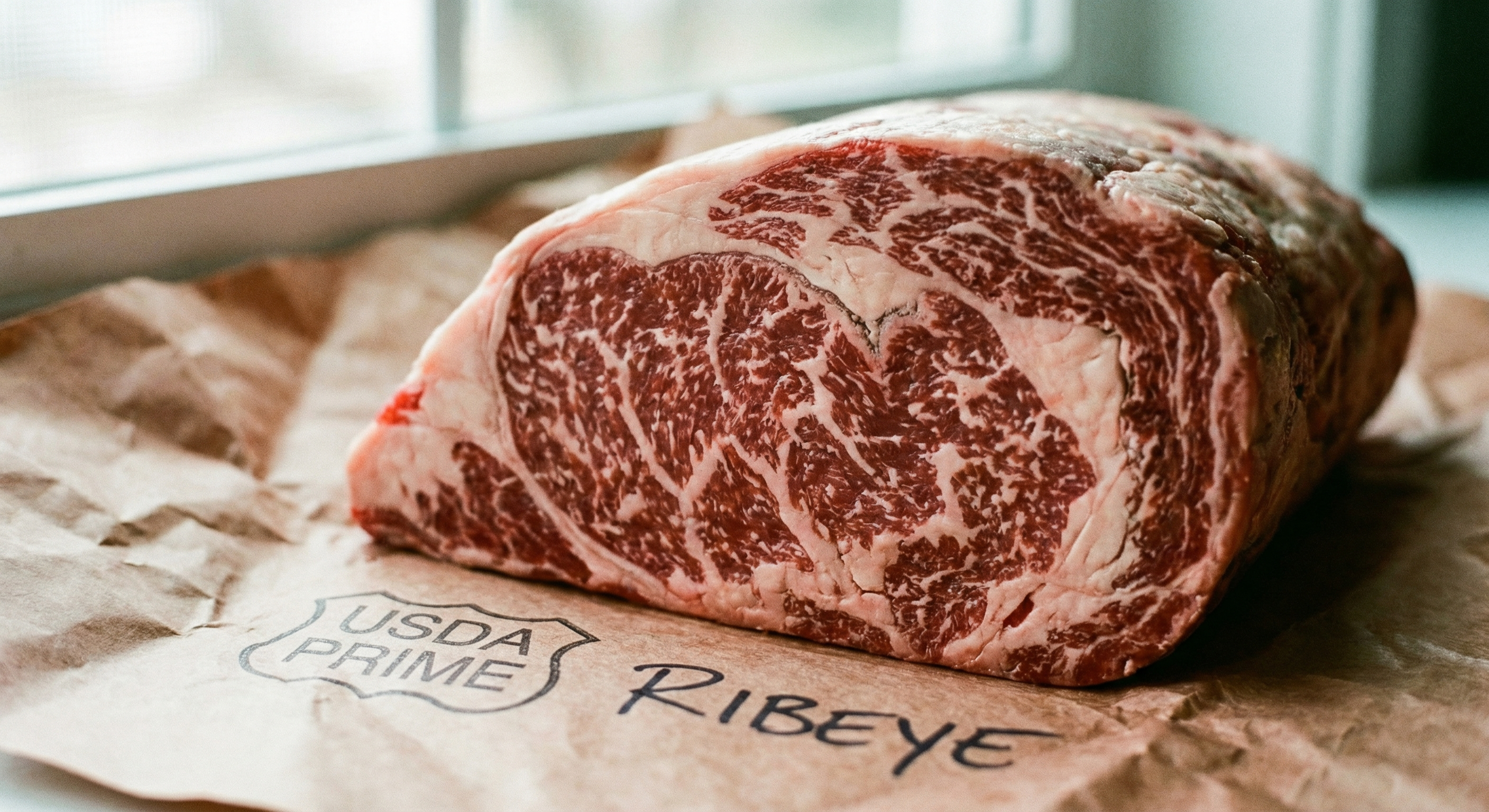
Marbling is the intramuscular fat woven throughout the lean meat, and it's the single biggest differentiator between Wagyu and Prime.
USDA Prime Marbling
USDA Prime beef has "abundant" marbling by American standards — roughly 6-8% intramuscular fat. When you look at a cross-section of a Prime ribeye, you'll see distinct white flecks and streaks distributed through bright red lean meat. It's visually appealing and clearly a premium product.
On Japan's BMS (Beef Marbling Standard) scale, USDA Prime typically scores BMS 5-6 out of 12. That puts it solidly in the "above average" category — excellent beef by any global measure, but well below the top of the Japanese scale.
Japanese A5 Wagyu Marbling
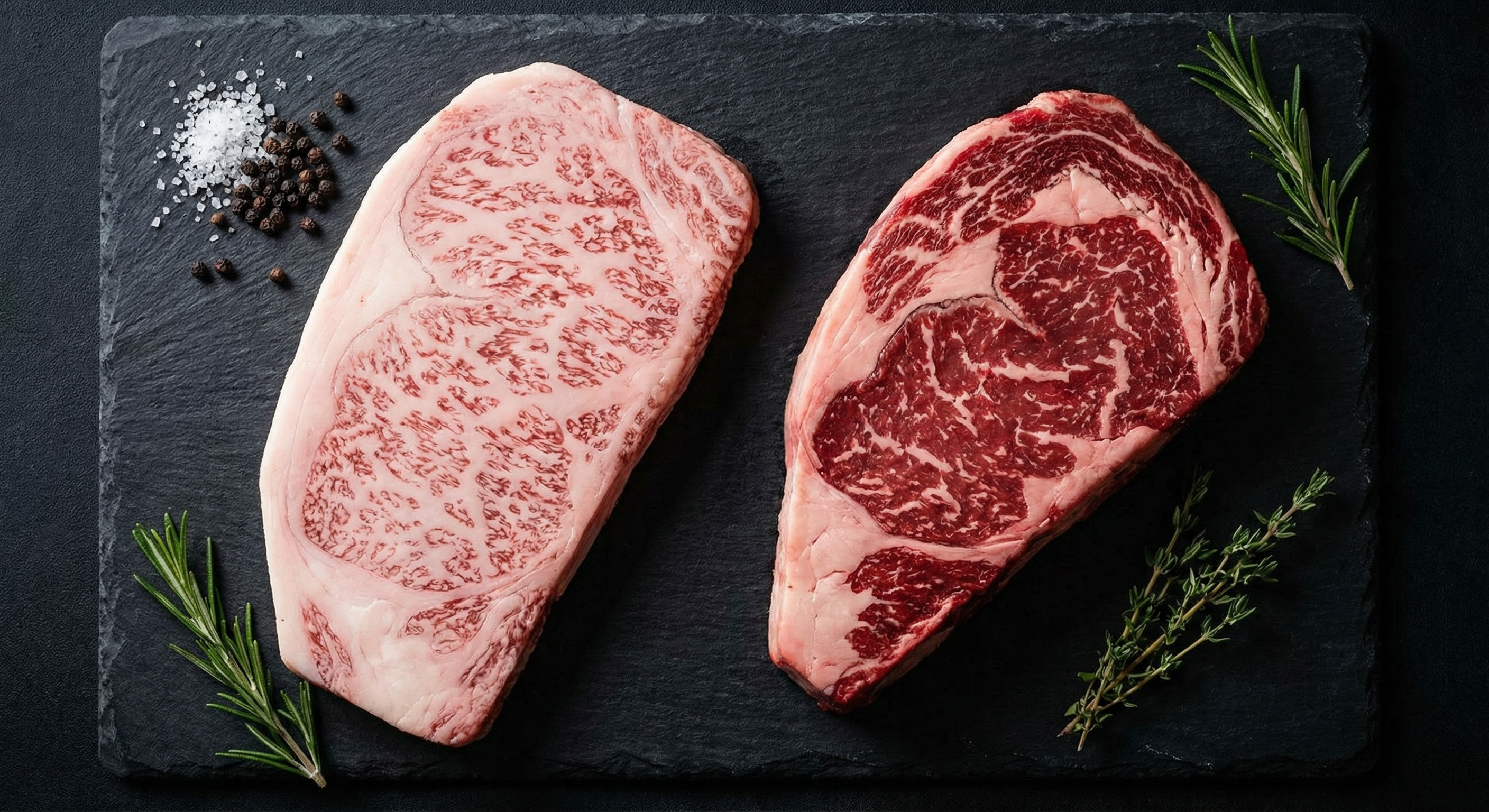
A5 Wagyu requires a minimum BMS of 8, and most retail A5 is BMS 9-12. At these levels, the marbling isn't just "abundant" — it's transformative. A BMS 10+ ribeye cross-section appears more white than red, with intramuscular fat comprising 40-50% or more of the muscle.
The visual difference is striking. Place a USDA Prime steak next to an A5 Wagyu steak, and they barely look like the same product. The Prime shows red meat with white accents; the A5 shows a web of fat so dense that the lean muscle appears as thin red threads.
Marbling Comparison Table
| Metric | USDA Prime | Japanese A5 Wagyu |
|---|---|---|
| Intramuscular fat % | 6-8% | 25-50%+ |
| BMS equivalent | 5-6 | 8-12 |
| Visual appearance | Red meat with white flecks | White matrix with red threads |
| Marbling pattern | Scattered deposits | Fine, weblike (shimofuri) |
Grading Systems: Two Different Languages
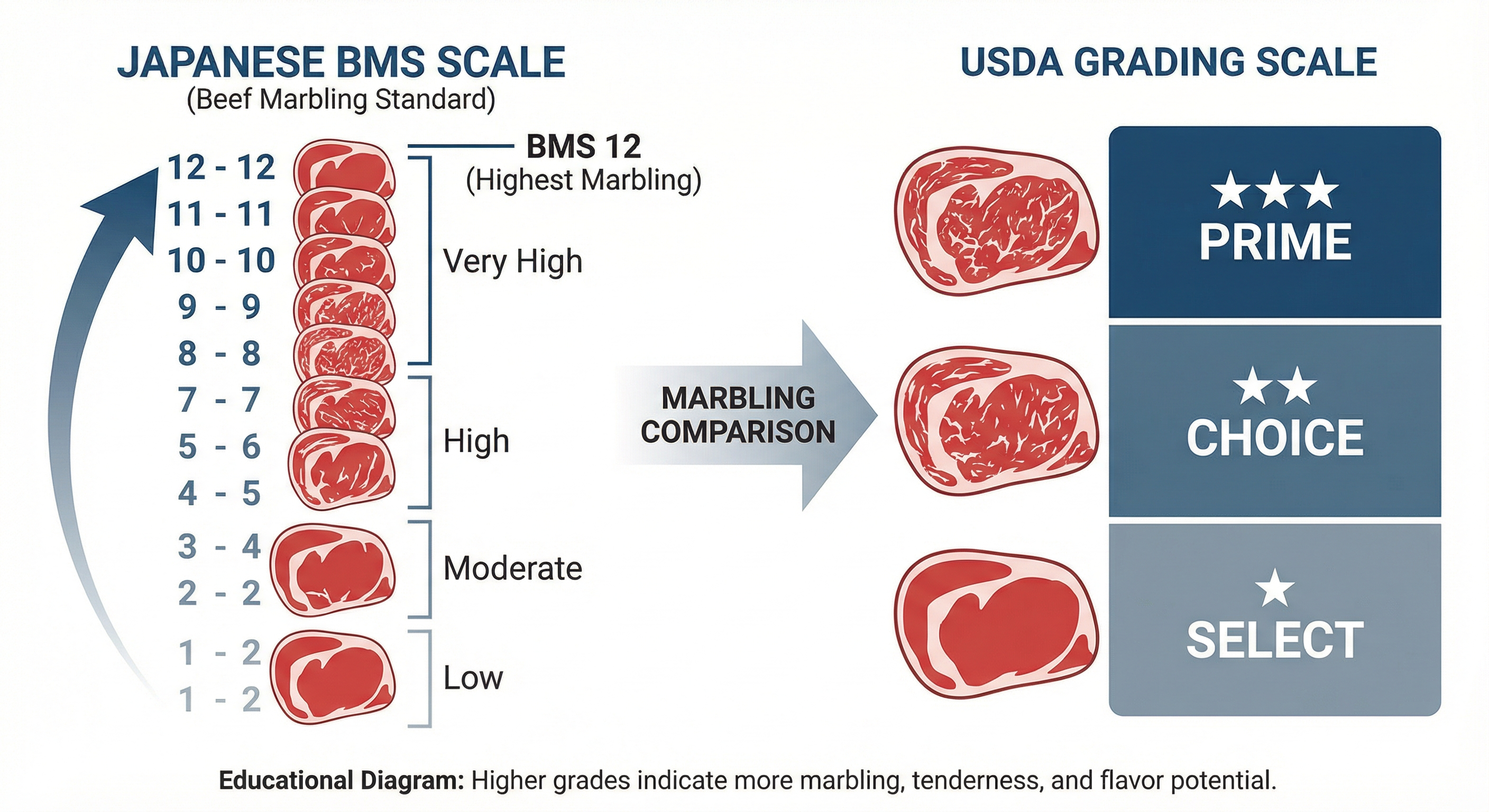
One major source of confusion is that the U.S. and Japan use completely different grading systems. Comparing them requires translation — and the translation reveals how much higher the Japanese system reaches.
USDA Grading
The USDA grades beef into three consumer categories based primarily on marbling at the ribeye cross-section:
- Select: Slight marbling. Lean, can be tough if overcooked.
- Choice: Small to moderate marbling. The American standard for "good beef." About 50-60% of graded beef.
- Prime: Abundant marbling. The top tier. Only 8-9% of graded American beef qualifies.
The USDA system works well for American cattle, but it effectively caps out at marbling levels that Japanese Wagyu far exceeds. If you graded A5 Wagyu under the USDA system, it would simply be called "Prime" — a dramatic understatement of its actual quality.
Japanese (JMGA) Grading
Japan's system is more granular. The grade combines a yield letter (A/B/C) with a quality number (1-5). The quality number is determined by the lowest score across four factors: BMS (marbling), meat color, fat color, and firmness/texture.
The BMS scale runs 1-12, giving far more resolution than the USDA system. Here's how they roughly correspond:
| USDA Grade | BMS Equivalent | Japanese Quality Grade |
|---|---|---|
| Select | 1-2 | 1 |
| Choice (low) | 3 | 2 |
| Choice (upper) | 4-5 | 3 |
| Prime | 5-6 | 3-4 |
| Beyond USDA scale | 7-12 | 4-5 |
The entire A5 range (BMS 8-12) sits above where the USDA system stops measuring. This isn't a slight difference — it's a completely different tier of beef that the American grading framework wasn't designed to evaluate.
→ Deep dive: The Japanese Wagyu Grading System Explained
→ Deep dive: BMS Scale Explained — Understanding Wagyu Marbling Scores
Flavor Profile: Rich vs. Intense
This is where the comparison gets personal, because flavor preference is subjective. But there are objective differences in how these two types of beef taste.
USDA Prime Flavor
Prime beef delivers what most Americans think of as the ideal steak experience: robust, beefy, savory. The marbling adds richness and juiciness, but the dominant flavor is still "beef" — that deep, mineral, umami-forward taste that's amplified by a good sear and Maillard reaction.
A well-prepared Prime ribeye or strip is deeply satisfying in 8-16 oz portions. The fat enhances without overwhelming. It pairs beautifully with classic steakhouse sides, bold red wines, and assertive sauces. This is steak as Americans have perfected it.
Japanese A5 Wagyu Flavor
A5 Wagyu is a fundamentally different eating experience. The dominant sensation isn't "beefy" — it's buttery, sweet, and intensely umami. The high oleic acid content (the same fatty acid that makes olive oil heart-healthy) gives the fat a lower melting point (~77°F) and a cleaner, almost floral quality.
When properly prepared, A5 Wagyu literally melts on your tongue. The texture is closer to foie gras or high-quality tuna sashimi than to conventional steak. The flavor is so concentrated that 3-4 ounces is a complete serving — eating an 8 oz A5 steak would be like eating an entire stick of the world's best butter.
Flavor Comparison
| Characteristic | USDA Prime | Japanese A5 Wagyu |
|---|---|---|
| Dominant flavor | Beefy, savory, mineral | Buttery, sweet, umami |
| Fat character | Rich, enhancing | Silky, melting, dominant |
| Ideal portion | 8-16 oz | 3-4 oz |
| Mouthfeel | Juicy, tender | Dissolving, custard-like |
| Aftertaste | Clean, lingering savory | Sweet, coating, persistent |
Texture and Tenderness
Both Wagyu and Prime are tender compared to lower grades, but the mechanism and the result are different.
USDA Prime achieves tenderness through moderate marbling and proper aging. A well-aged Prime steak has a satisfying bite — tender but with structure. You can feel the muscle fibers yield under your teeth in a way that's pleasant and "steaky." Dry-aged Prime adds another dimension, concentrating flavor and creating a slightly firmer, nuttier eating experience.
A5 Wagyu achieves tenderness through sheer fat saturation. The intramuscular fat has essentially disrupted the muscle fiber structure so completely that the meat offers almost no resistance. It doesn't "yield" — it dissolves. The texture is unprecedented if you've only eaten conventional beef. Some first-timers find it almost disconcerting how quickly the meat breaks down on the tongue.
Neither texture is objectively "better" — they serve different pleasures. If you want the satisfaction of cutting into a thick, juicy steak and savoring each bite, Prime delivers that beautifully. If you want a transcendent, almost ethereal meat experience, A5 Wagyu is unmatched.
Price: The Elephant in the Room
Let's be direct about cost, because the price gap between Wagyu and Prime is significant:
| Cut | USDA Prime (per lb) | Japanese A5 Wagyu (per lb) | Premium |
|---|---|---|---|
| Ribeye | $25-$45 | $120-$200+ | 4-8x |
| Strip/Striploin | $22-$40 | $100-$180 | 4-7x |
| Tenderloin | $30-$50 | $130-$220 | 4-6x |
| Ground | $8-$12 | $25-$40 | 3x |
Understanding the Price Gap
Why does Wagyu cost 4-8x more? Several compounding factors:
- Genetics: Japanese Wagyu genetics have been selectively bred for generations. The breeding stock alone represents enormous investment.
- Raising time: Japanese Wagyu is raised 28-32 months vs. 18-22 months for American cattle — 50% longer on expensive feed.
- Feed costs: Proprietary grain blends in Japan cost significantly more than standard American feedlot rations.
- Scale: Japan produces ~500,000 head of graded Wagyu annually vs. millions of Prime-eligible cattle in the U.S.
- Export costs: International shipping, import duties, cold-chain logistics, and regulatory compliance add substantially.
Cost Per Serving
The per-pound price tells only part of the story. Because A5 Wagyu is served in much smaller portions, the per-serving cost gap narrows:
- Prime steak dinner (12 oz serving): $17-$34 in meat cost
- A5 Wagyu experience (4 oz serving): $30-$55 in meat cost
At the per-serving level, A5 Wagyu is roughly 1.5-2x the cost of Prime — still a premium, but less dramatic than the per-pound comparison suggests.
When to Choose USDA Prime
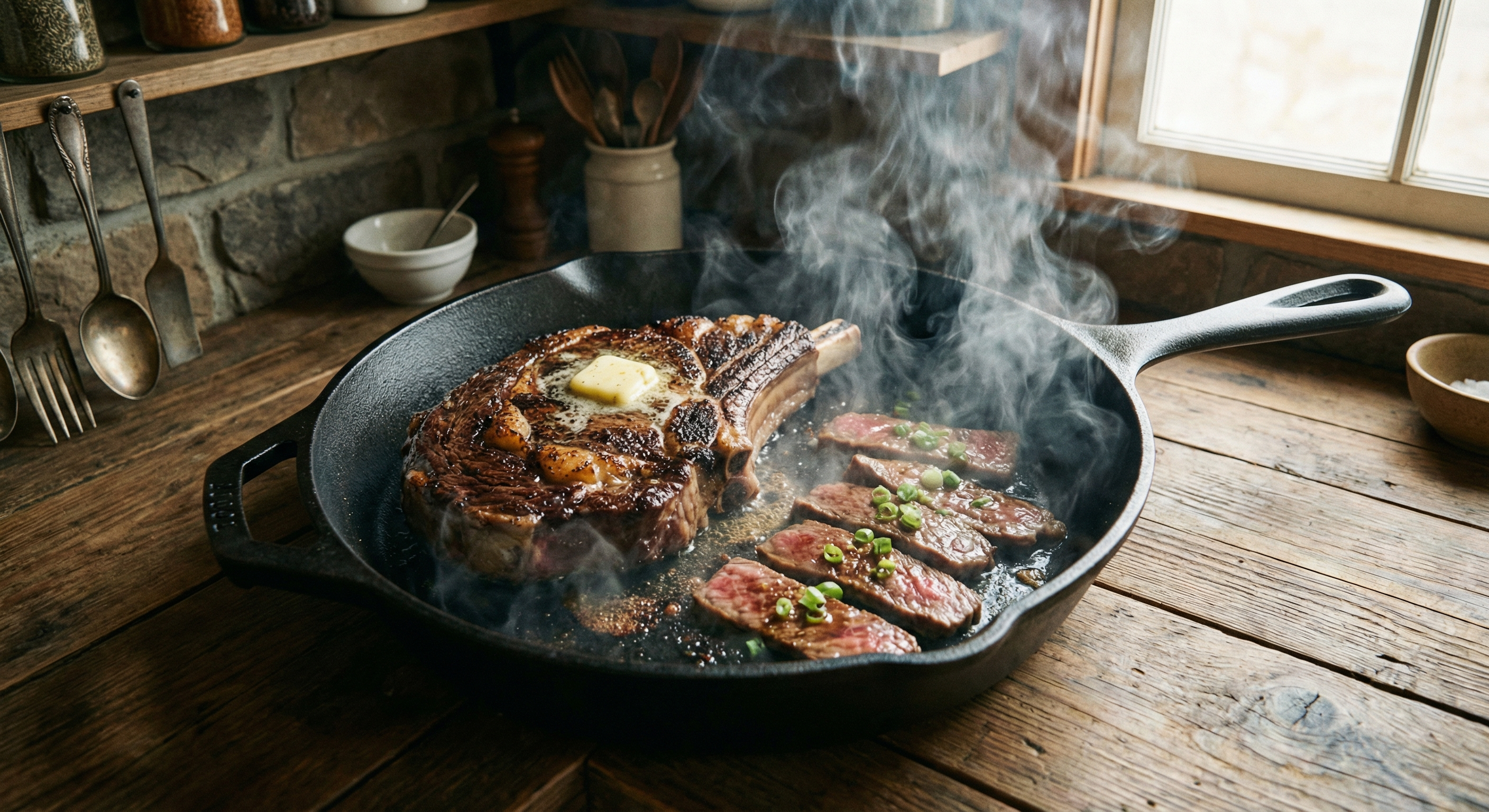
Prime beef is the right choice more often than most Wagyu enthusiasts want to admit. Here's when to reach for Prime:
- Classic steak dinner: When you want a full-sized, satisfying steak with a good sear and that deep beefy flavor, Prime is perfect. It's what American steakhouse culture was built on.
- Grilling: Prime's moderate fat content makes it ideal for grilling. A5 Wagyu can cause dangerous flare-ups on a grill — the fat content is simply too high.
- Larger gatherings: Feeding 8 people A5 Wagyu gets expensive fast. Prime lets everyone enjoy a generous, impressive steak without breaking the budget.
- Bold preparations: Marinades, rubs, chimichurri, peppercorn crust — Prime's robust beef flavor stands up to assertive seasonings. A5 Wagyu should be eaten plain to appreciate its nuance.
- Dry aging: Prime beef dry-ages beautifully, developing concentrated, nutty flavors over 30-60 days. Dry-aging A5 Wagyu is uncommon and arguably unnecessary.
- Everyday luxury: A Prime steak once a week is an achievable indulgence. A5 Wagyu once a week is a serious budget commitment.
When to Choose Wagyu
Japanese A5 Wagyu shines in specific contexts where its unique qualities can be fully appreciated:
- Special occasions: Anniversaries, birthdays, celebrations — when you want a culinary experience that's genuinely extraordinary and memorable.
- Tasting experiences: Serving thin slices across 2-4 people, savoring each piece. This is how most Wagyu is consumed in Japan, and it's the ideal format.
- Japanese preparations: Yakiniku, teppanyaki, shabu-shabu, sukiyaki — these techniques were developed specifically for high-marbling beef and showcase A5 Wagyu at its best.
- Impressing guests: There's no steak experience quite like serving authentic A5 Wagyu to someone who's never tried it. The "first bite" reaction is genuinely unforgettable.
- Small, focused meals: A 4 oz portion of A5 Wagyu with rice, pickles, and a simple salad is a complete, deeply satisfying meal.
- When you want something truly different: If you eat Prime regularly, A5 Wagyu isn't "better Prime" — it's a completely different food experience. That novelty has real value.
The American Wagyu Middle Ground
If you're torn between Prime and Japanese A5, American Wagyu deserves consideration. These cattle carry Japanese Wagyu genetics but are raised in the U.S., producing beef that bridges the gap:
- Fullblood American Wagyu (100% genetics): BMS 7-10 equivalent. Significantly more marbled than Prime, approaching lower-end A5 quality. $40-$80/lb. Can be eaten in regular steak-sized portions.
- F1 Cross (50% Wagyu, 50% Angus): BMS 4-6 equivalent. Noticeably richer than Prime with a silkier texture. $20-$40/lb. The best value upgrade from conventional premium beef.
For many home cooks, American Wagyu is the practical sweet spot: more marbling and richness than Prime, more affordable than Japanese A5, and versatile enough for standard American cooking methods.
→ Explore American Wagyu at The Meatery
Cooking Differences
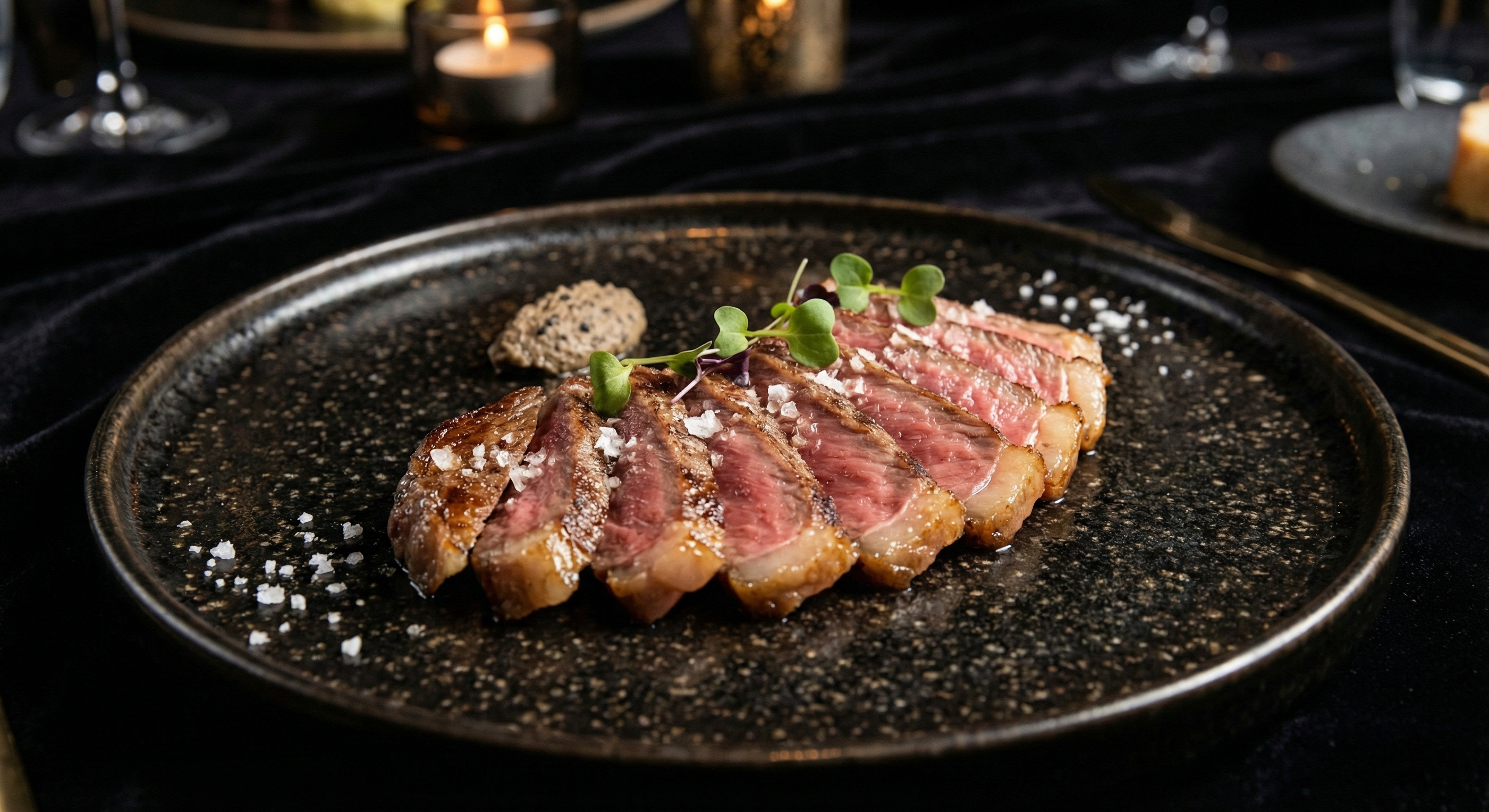
The cooking approach for each is meaningfully different:
Cooking USDA Prime
- Temperature: Medium-rare to medium (130-140°F internal) is the sweet spot
- Method: Reverse sear, cast iron, grill — all work beautifully
- Oil/fat: A tablespoon of high-smoke-point oil or butter in the pan
- Thickness: 1-1.5 inches ideal for achieving a good crust while maintaining a pink center
- Resting: 5-8 minutes under loose foil
- Seasoning: Salt and pepper minimum; rubs, herbs, and compound butters all welcome
Cooking Japanese A5 Wagyu
- Temperature: Rare to medium-rare (115-125°F internal). Higher temps cause excessive fat rendering.
- Method: Screaming-hot cast iron or carbon steel. No grill (too much fat drip).
- Oil/fat: None. The marbling provides all the lubrication you need.
- Thickness: 1/4-1/2 inch slices for best results. Thick-cut A5 is harder to execute well.
- Resting: Minimal — 1-2 minutes. Serve quickly before the fat re-solidifies.
- Seasoning: Salt only. Maybe a touch of wasabi. Nothing more.
→ Full guide: How to Cook Wagyu Steak
Nutritional Comparison
Both are nutrient-dense foods, but the fat content creates meaningful nutritional differences:
| Per 4 oz serving (raw) | USDA Prime Ribeye | A5 Wagyu Ribeye |
|---|---|---|
| Calories | ~310 | ~500-600 |
| Total fat | ~24g | ~45-55g |
| Protein | ~22g | ~14-18g |
| Oleic acid (% of fat) | ~35% | ~50-55% |
A5 Wagyu contains more total fat but a higher percentage of monounsaturated oleic acid — the same heart-healthy fat found in olive oil. Some research suggests that Wagyu's fat profile may be less detrimental to cardiovascular health than its total fat content would imply, though the science is still evolving.
The practical takeaway: Wagyu's smaller portion sizes partially offset its higher fat content. A 4 oz serving of A5 Wagyu and a 10 oz serving of Prime deliver roughly comparable total fat.
Availability and Sourcing
USDA Prime is widely available at quality butcher shops, Costco, high-end grocery stores, and online retailers. Finding good Prime is relatively easy in most American cities.
Authentic Japanese A5 Wagyu requires more careful sourcing. Look for sellers who provide:
- Individual animal ID numbers (10-digit traceability codes)
- Specific BMS scores (not just "A5")
- Prefecture of origin
- Proper cold-chain shipping
For verified Japanese A5 Wagyu with full traceability, The Meatery's Japanese A5 Wagyu collection offers authenticated product with individual animal documentation, BMS scores, and prefecture information. Their American Wagyu selection provides an excellent middle-ground option as well.
The Verdict: It's Not a Competition
Here's what I tell everyone who asks me "which is better?": that's the wrong question.
USDA Prime is the finest expression of American beef tradition — a thick, juicy, deeply flavorful steak that satisfies in a way few foods can. It's versatile, relatively accessible, and ideal for the way most Americans like to eat steak.
Japanese A5 Wagyu is a culinary experience that exists in its own category. It's not "better Prime" — it's a completely different product that happens to also come from a cow. It demands different preparation, different portion sizes, and different expectations.
The ideal approach? Keep both in your repertoire. Prime for your Tuesday night steak dinner, weekend grill sessions, and hosting friends. A5 Wagyu for those moments when you want something transcendent — a birthday, an anniversary, or simply a Tuesday when you decide that life is short and you deserve to taste something extraordinary.
Both are worth every penny. Neither needs to replace the other.
Frequently Asked Questions
Is Wagyu better than USDA Prime?
Neither is objectively "better" — they serve different purposes. Wagyu offers extreme marbling, a buttery melt-in-your-mouth texture, and is best in small 3-4 oz portions. USDA Prime delivers classic beefy flavor, satisfying texture, and works beautifully in standard 8-16 oz steak portions. Most steak lovers benefit from having both in their repertoire.
Why is Wagyu so much more expensive than Prime?
Several compounding factors: Wagyu cattle are raised 28-32 months (vs. 18-22 for American cattle), fed expensive proprietary grain blends, produced in limited quantities (~500K head annually in Japan vs. millions of Prime-eligible cattle in the U.S.), and incur significant export/import costs. However, because Wagyu is served in smaller portions, the per-serving cost gap is narrower than the per-pound gap.
Can you grill Wagyu like a regular steak?
Grilling is not recommended for A5 Wagyu — the extremely high fat content causes dangerous flare-ups. A5 Wagyu is best cooked on a flat, hot surface (cast iron or carbon steel) with no added oil, seared briefly at high heat. USDA Prime, with its moderate fat content, is ideal for grilling.
What is the marbling difference between Wagyu and Prime?
USDA Prime typically has 6-8% intramuscular fat (BMS 5-6 on the Japanese scale). Japanese A5 Wagyu has 25-50%+ intramuscular fat (BMS 8-12). The entire A5 Wagyu range exceeds what the USDA grading system was designed to measure.
Is American Wagyu the same as Japanese Wagyu?
No. American Wagyu comes from cattle with Japanese Wagyu genetics raised in the U.S. Fullblood American Wagyu (100% genetics) can reach BMS 7-10 — impressive but typically below Japanese A5. F1 crosses (50% Wagyu, 50% Angus) score BMS 4-6. Both are excellent but distinct from authentic Japanese A5.
How much Wagyu should I buy per person vs Prime?
For USDA Prime, plan 8-16 oz per person for a main course. For Japanese A5 Wagyu, 3-4 oz per person is a complete serving — the richness is so intense that larger portions become overwhelming. American Wagyu falls in between at 6-8 oz per person.
More Expert Guides
What Is Wagyu Beef? The Complete Guide to Grades, Origins & Quality
Discover wagyu beef origins, the difference between Japanese A5 and American wagyu, how BMS grading works, why marbling matters, proper cooking techniques, and what you should pay in 2026.
12 min readA5 Wagyu: Your Complete Buying & Authentication Guide (2026)
A5 wagyu represents the pinnacle of beef quality, but not all A5 is created equal. Learn how to authenticate real Japanese A5, decode BMS scores, find fair prices, and cook it perfectly at home.
14 min readA5 Wagyu Prefectures: Regional Guide to Japan's Best Beef
Discover the regional differences in Japanese A5 wagyu across 12 key prefectures. Learn which prefecture produces the flavor profile you'll love most.