The Japanese Wagyu Grading System Explained
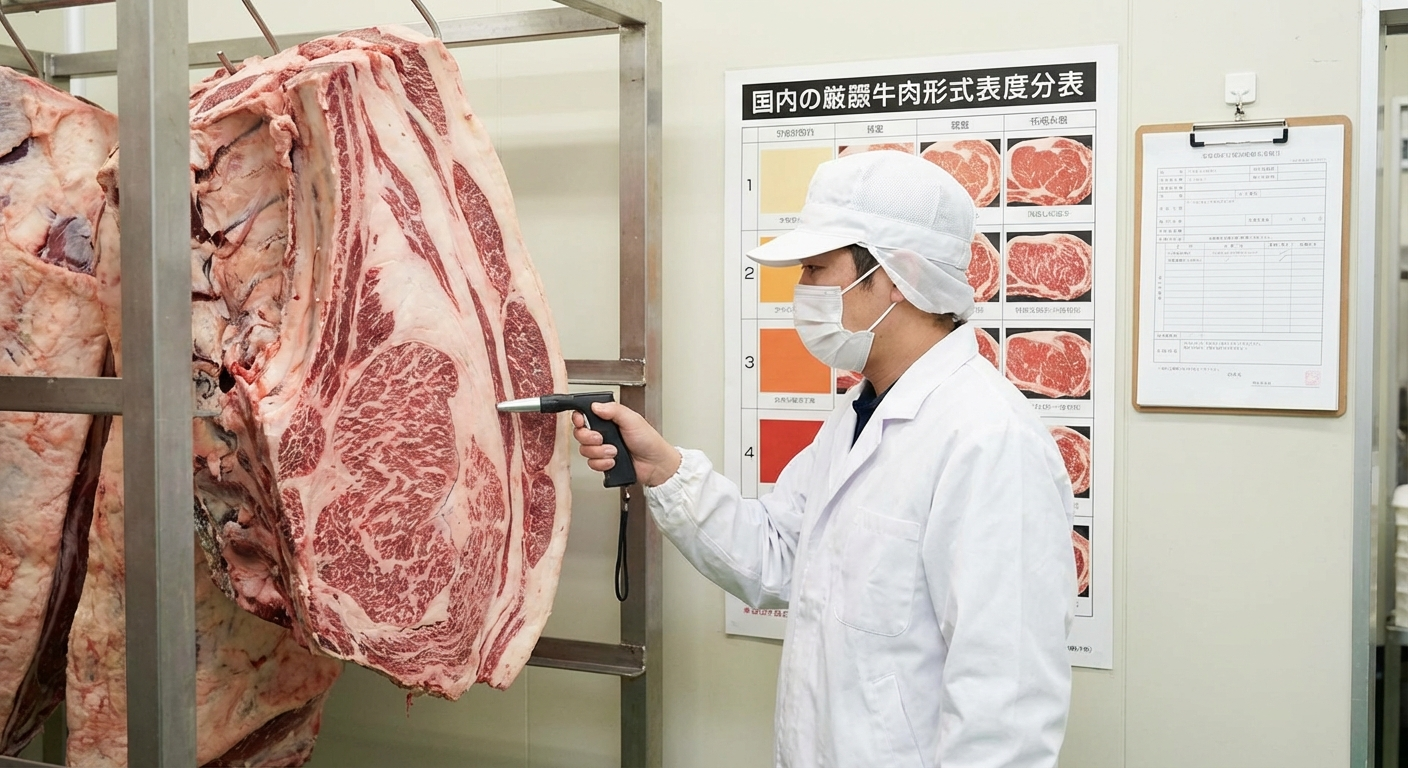
The Japanese Meat Grading Association (JMGA) operates the most comprehensive beef grading system on Earth. Every beef carcass sold through Japan's distribution system is evaluated, scored, and documented to a degree that makes the USDA system look like a rough sketch.
I've stood in Japanese grading houses watching certified graders work. The precision is remarkable — and understanding their system is the single most valuable skill for anyone buying Japanese Wagyu. Let me walk you through it.
The Two-Part Grade
Every Japanese beef grade has two components: a letter and a number. The letter is the yield grade; the number is the quality grade.
Yield Grade (A, B, or C)
The yield grade estimates the percentage of usable retail cuts from the carcass:
- A: Above-standard yield (72%+ estimated cutability)
- B: Standard yield (69-72%)
- C: Below-standard yield (below 69%)
The yield grade is calculated from a formula using four measurements taken at the ribeye cross-section between the 6th and 7th ribs: ribeye area, rib thickness, subcutaneous fat thickness, and cold carcass weight.
For consumers buying individual steaks or portions, the yield grade has minimal practical significance. An A5 steak and a B5 steak from carcasses with identical quality scores will eat the same — the B just means the animal carried more exterior fat or had a smaller ribeye relative to its frame. The quality grade is what matters at the plate.
Quality Grade (1 through 5)
The quality grade is determined by evaluating four characteristics at the ribeye cross-section. Here's the crucial rule: the overall quality grade equals the lowest individual score. A carcass with BMS 12, perfect color, perfect texture, but substandard fat color would get a quality grade of 4 or lower — dragged down by the weakest score.
1. Marbling (BMS 1-12)
The Beef Marbling Standard is the most scrutinized component. The grader compares the ribeye cross-section against standardized reference photographs:
| BMS Score | Quality Grade | Description |
|---|---|---|
| 1 | 1 | Trace or practically devoid of marbling |
| 2 | 1 | Slight marbling |
| 3-4 | 2-3 | Small to modest marbling |
| 5-7 | 3-4 | Moderate to slightly abundant marbling |
| 8-12 | 5 | Moderately abundant to extremely abundant marbling |
For A5 certification, BMS must be 8 or higher. But within that A5 range, BMS 8 and BMS 12 are dramatically different products. I cannot stress this enough: always ask for the specific BMS number.
2. Meat Color and Brightness (BCS 1-7)
The lean meat color is compared against the Beef Color Standard (BCS), a set of standardized color tiles. The ideal range is BCS 3-5 — a bright, cherry-red color indicating proper pH, adequate chilling, and absence of stress-related issues.
Darker meat (BCS 6-7, known as "dark cutting") indicates the animal was stressed before slaughter, which depletes muscle glycogen and raises the ultimate pH. This produces tough, dry beef regardless of marbling. Very pale meat (BCS 1-2) can indicate PSE (pale, soft, exudative) conditions.
3. Firmness and Texture (1-5)
The grader evaluates the muscle's firmness (resistance to pressure) and texture (grain fineness). Grade 5 requires firm, fine-grained muscle — indicating proper chilling, good protein structure, and the kind of meat that will cook evenly and have a satisfying bite.
Soft, coarse-textured muscle (grade 1-2) often indicates rapid chilling issues, poor handling, or breed characteristics that produce lower-quality protein structure.
4. Fat Color and Quality (BFS 1-7)
The intramuscular and subcutaneous fat is compared against the Beef Fat Standard (BFS) tiles. Ideal fat is white to slightly cream-colored (BFS 1-4). Yellowed fat (BFS 5-7) scores lower and indicates high beta-carotene content — usually from cattle that spent time on pasture before the finishing phase.
Fat color might seem like a minor detail, but in Japan, white fat is strongly preferred. It's associated with grain-finished cattle (the standard for premium Wagyu) and produces a cleaner visual presentation. This cultural preference means that yellow-fatted carcasses grade lower even if their marbling and other characteristics are excellent.
The Grading Process in Practice
After slaughter, the carcass is chilled for 24-48 hours, then split and a cross-section is exposed between the 6th and 7th ribs. A JMGA-certified grader examines this surface under standardized lighting conditions.
The grading takes approximately 2-3 minutes per carcass. Each grader is trained for years and must pass rigorous certification exams. The results are documented on an official certificate that includes all individual scores, the final grade, the animal's individual ID number, and the grader's identification.
This certificate is the proof of authenticity. When buying Japanese Wagyu at retail, legitimate sellers like The Meatery will reference the certificate data and provide the 10-digit individual ID number that can be verified on Japan's national traceability website.
What the System Gets Right
The JMGA system is superior to USDA grading in several ways:
- Granularity: BMS 1-12 provides far more resolution than USDA's broad categories (Select, Choice, Prime). The difference between BMS 8 and BMS 12 is enormous — the Japanese system captures it; the USDA system would call them both "beyond Prime."
- Multi-dimensional: Evaluating marbling, color, texture, AND fat color ensures overall quality, not just fat content.
- Documentation: Every score is recorded and linked to individual animal traceability. The paper trail is impeccable.
What the System Misses
No grading system is perfect:
- Marbling fineness: BMS measures quantity but not the shimofuri pattern quality. Fine, weblike marbling and coarse, clumpy marbling can receive the same BMS score.
- Fat composition: Oleic acid content significantly affects eating quality but isn't part of the standard grade. Some prefectures are adding this separately.
- Flavor: There's no sensory evaluation. Grading is entirely visual, yet flavor varies significantly by prefecture, bloodline, and feeding regimen.
- Single-point evaluation: The grade is based on one cross-section (between ribs 6-7). Marbling can vary throughout the carcass.
Reading a Japanese Beef Certificate
When you buy from a reputable source, you should see data that includes:
- Individual animal ID number (10 digits)
- Yield grade (A/B/C) and quality grade (1-5)
- BMS score
- Meat color score (BCS)
- Fat color score (BFS)
- Firmness/texture score
- Prefecture of origin
- Processing date
If a seller provides all of this, you're almost certainly dealing with authentic product. If they can't provide anything beyond "A5 Wagyu" — be cautious.
Frequently Asked Questions
How many grades are in the Japanese beef system?
The system produces 15 possible grades (A1 through A5, B1 through B5, C1 through C5). In practice, premium Wagyu is A3 through A5, with A5 being the highest. B5 is rare but exists — it means top quality meat from a lower-yielding carcass.
Is A4 Wagyu good?
A4 is excellent — it means BMS 5-7 with high scores in color, texture, and fat quality. Many Japanese connoisseurs actually prefer A4 for everyday eating because the marbling is rich without being overwhelming. A4 represents exceptional value compared to A5.
Can USDA grade Japanese Wagyu?
USDA can grade imported beef, but the system caps at Prime (roughly BMS 5-6 equivalent). Japanese A5 Wagyu would simply grade "Prime" under USDA, which dramatically undersells its quality. The Japanese system is far more precise for this category of beef.
More Expert Guides
Hida Beef: The Complete Guide to Gifu Prefecture's Legendary Wagyu
Hida beef is one of Japan's most prestigious regional wagyu brands, raised in the mountain valleys of Gifu Prefecture. Often overshadowed by Kobe in Western markets, Hida-gyu is revered in Japan for its delicate sweetness and fine-grained marbling. Here's what makes it special.
12 min readA4 vs A5 Wagyu: The Complete Comparison Guide
A4 and A5 are both elite Japanese wagyu grades, but they deliver meaningfully different eating experiences. This guide breaks down exactly how they differ in marbling, flavor, texture, price, and when each grade is the better choice.
16 min readWagyu Sous Vide: The Complete Guide to Precision-Cooked Wagyu Beef
Learn how to sous vide wagyu beef for flawless results every time. Covers ideal temperatures for each cut, timing charts, vacuum sealing tips, finishing sear methods, and why precision cooking is the best way to honor expensive wagyu.