Wagyu Beef Explained: Science, Grading, Quality & Value Guide
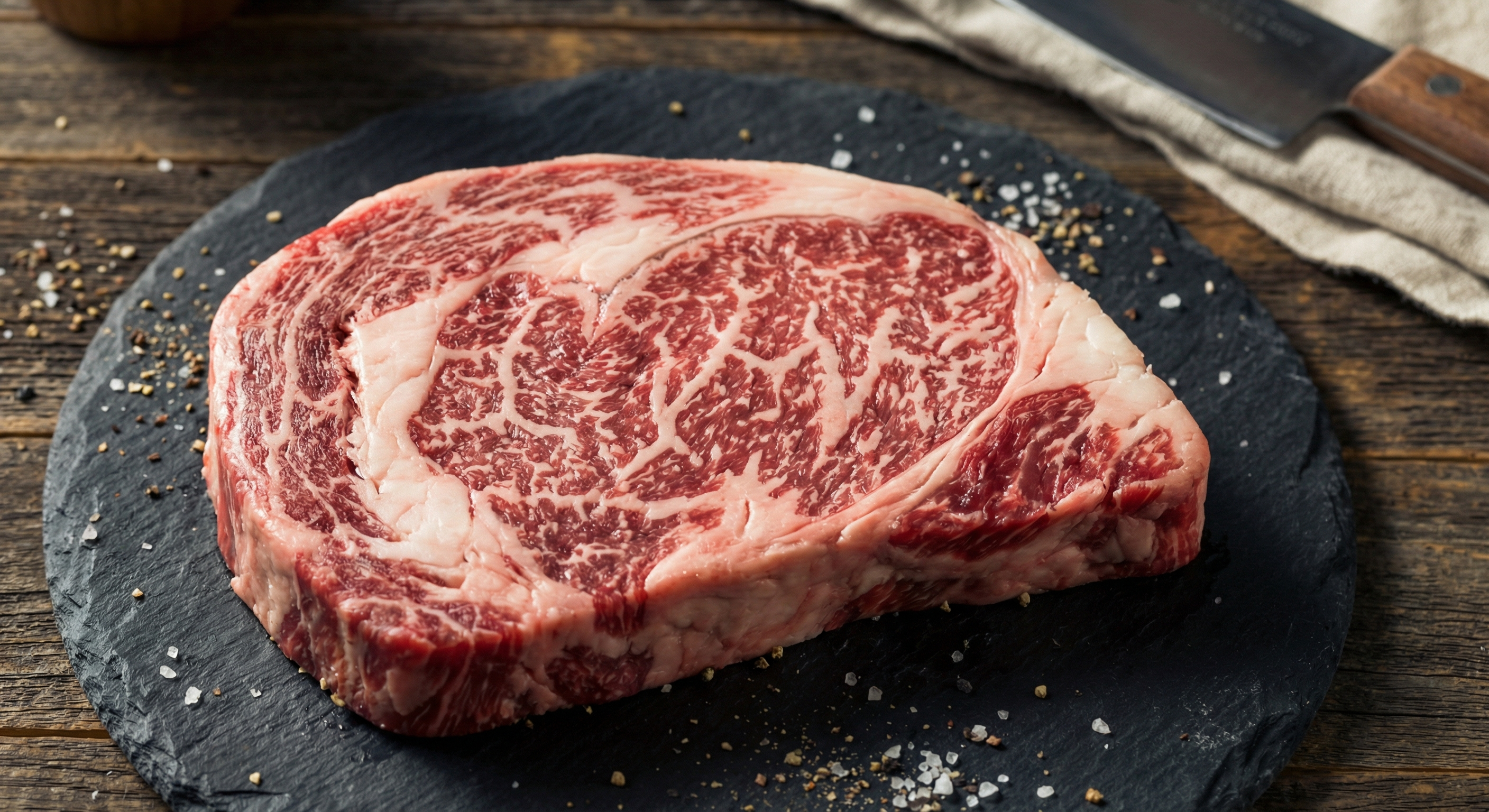
Wagyu beef commands $200-400 per pound for Japanese A5 cuts while American wagyu sits at $50-120/lb and conventional ribeye costs $18-25/lb. That's a 10-20x premium. Is it justified by biological reality, or is it marketing theater? After 15 years grading wagyu carcasses across Japanese auction houses and evaluating American breeding programs, I can tell you: it's both. The best Japanese A5 legitimately represents the peak of beef production, but the term "wagyu" has been diluted to the point where you're often paying luxury prices for mid-tier beef.
When I first walked into Tokyo's Shibaura meat market in 2011, I watched a BMS 12 Matsusaka ribeye sell for ¥42,000/kg ($180/lb wholesale). The buyer cut a cross-section on the spot — the marbling was so dense it looked like white lace over red fabric. That same week, I evaluated "American wagyu" at a California ranch: BMS equivalent of 5, barely above USDA Prime, being marketed at $85/lb retail. Both labeled "wagyu," both legal, both targeting premium buyers. One was transformative. The other was a solid steak with a 4x markup.
This guide breaks down the science behind wagyu's marbling, what Japanese grading actually measures, why American and Australian wagyu differ fundamentally from Japanese, where the price premiums are justified, and how to identify authentic quality. By the end, you'll understand wagyu beef at a molecular level and know exactly what you're buying.
What Is Wagyu Beef? Genetics & Breed History
Wagyu literally means "Japanese cow" (和牛: wa = Japanese, gyu = cow/cattle). But it's not a generic term for Japanese beef — it specifically refers to four genetically distinct heritage breeds that were isolated in Japan for centuries and selectively bred for work capacity, then later for meat quality:
The Four Wagyu Breeds
- Japanese Black (Kuroge Washu — 黒毛和種): 95% of all wagyu beef comes from this breed. Genetically predisposed to extreme intramuscular fat marbling, moderate growth rate, docile temperament. This is the breed behind Kobe, Miyazaki, and Matsusaka beef.
- Japanese Brown (Akage Washu — 褐毛和種): 5% of production. Leaner than Japanese Black, faster growth, slightly larger frame. Known for rich beef flavor with moderate marbling (BMS 4-7 range). Primary production in Kumamoto and Kochi prefectures.
- Japanese Shorthorn (Nihon Tankaku Washu — 日本短角和種): Less than 1% of production. Lean, grass-fed beef with strong beefy flavor and minimal marbling. Primarily raised in northern Japan (Iwate, Hokkaido). Think of this as the "grass-fed artisan" option — more similar to European beef traditions.
- Japanese Polled (Mukaku Washu — 無角和種): Extremely rare, less than 0.1% of production. Naturally hornless, moderate marbling, raised almost exclusively in Yamaguchi prefecture. Mostly a heritage preservation breed at this point.
When you see "wagyu" marketed in restaurants or butcher shops, you're almost certainly looking at Japanese Black genetics. According to the Japan Wagyu Registry, over 2.8 million Japanese Black cattle were registered in 2024, compared to just 180,000 Japanese Brown.
The Genetic Foundation: Why Wagyu Marbles Differently
What makes Japanese Black cattle genetically unique isn't just a capacity for marbling — many breeds can achieve moderate intramuscular fat with intensive feeding. It's the distribution pattern, composition, and melting point of that fat. Research from Texas A&M's Muscle Biology Lab identified several genetic markers specific to Japanese Black cattle that regulate fat deposition:
- FASN gene (Fatty Acid Synthase): Controls synthesis of monounsaturated fatty acids (MUFAs). Japanese Black cattle have allele variants that produce higher concentrations of oleic acid — the same heart-healthy fat in olive oil and avocados.
- SCD gene (Stearoyl-CoA Desaturase): Converts saturated fat to unsaturated fat. Japanese Black cattle have heightened SCD expression, resulting in fat that's softer, lower melting point, and more evenly distributed through muscle tissue.
- Adipocyte precursor cell concentration: Japanese Black cattle have more intramuscular adipocyte (fat cell) precursors embedded between muscle fibers. Under intensive grain feeding, these cells expand with fat, creating the signature marbling pattern.
In my experience grading carcasses, you can visually identify Japanese Black genetics immediately. The marbling doesn't just appear as isolated pockets or thick seams (like you see in USDA Prime beef) — it's lace-like, evenly distributed, and present even in typically lean cuts like the eye round or inside round. A BMS 10+ ribeye cross-section looks more like marble stone than muscle tissue.
The Science of Marbling: Why Wagyu Tastes Different
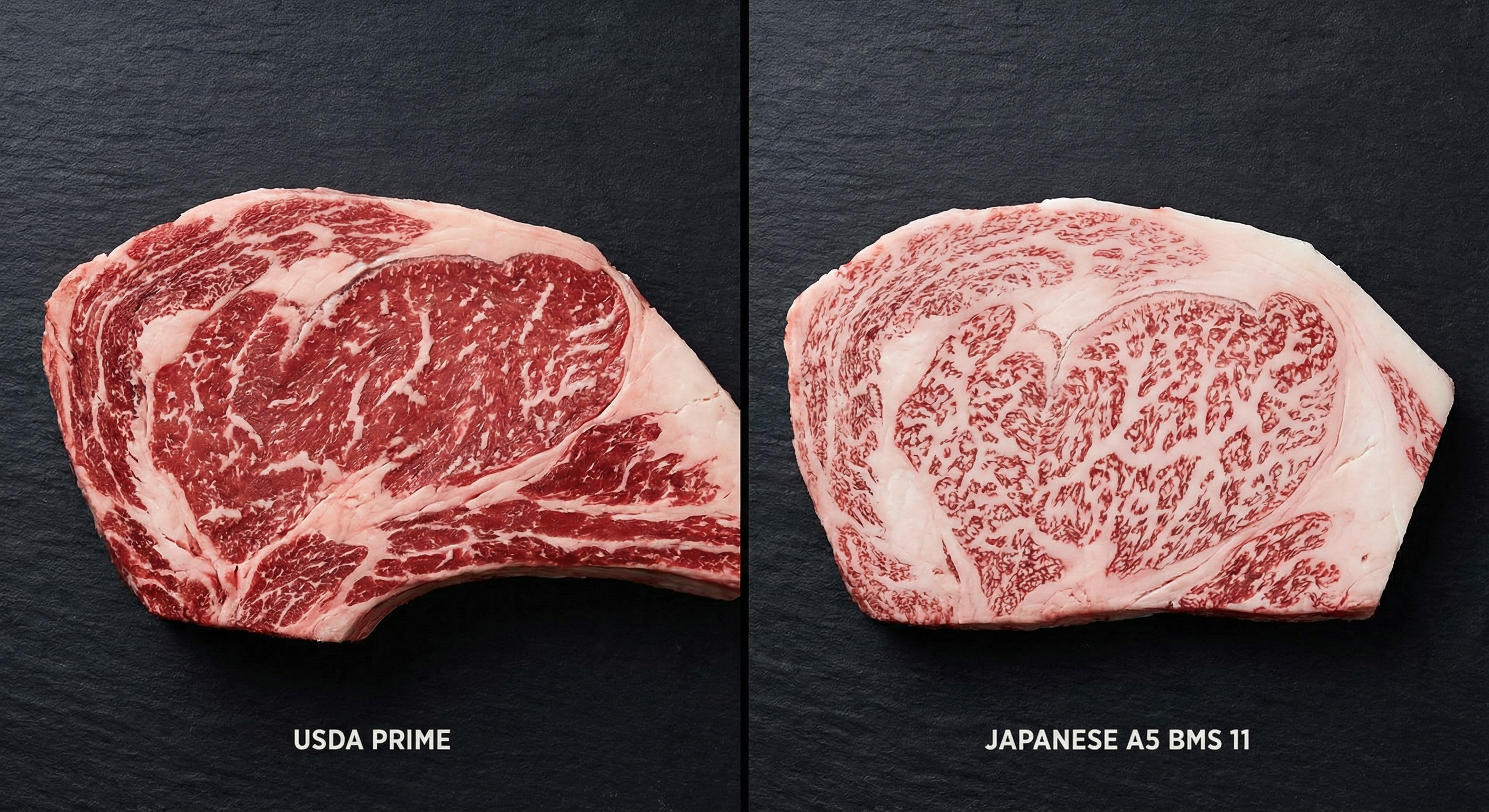
Marbling isn't just about fat quantity — it's about fat quality, melting point, and distribution geometry. Japanese A5 wagyu differs from conventional beef at three levels:
1. Fat Composition: Monounsaturated vs. Saturated Fats
Conventional beef fat is approximately 40-45% saturated fat and 50-55% unsaturated fat. Japanese Black wagyu flips this ratio: according to USDA Meat Animal Research Center analysis, authentic A5 wagyu contains 60-65% monounsaturated fatty acids (primarily oleic acid), with saturated fats dropping to 30-35%.
Why this matters for flavor and texture:
- Lower melting point: Wagyu fat melts at approximately 77°F (25°C), compared to 113°F (45°C) for conventional beef fat. This is why wagyu literally begins rendering at room temperature and creates an unctuously soft mouthfeel.
- Buttery, sweet flavor profile: Oleic acid has a mild, slightly sweet taste. Combined with umami compounds from extended grain feeding, this creates wagyu's signature "buttery" flavor that doesn't taste greasy or heavy.
- Less waxy mouthfeel: Saturated fats coat the palate with a waxy sensation (think of cold bacon fat). Wagyu's high MUFA content produces a cleaner, more pleasant finish.
When I teach grading workshops, I have participants taste room-temperature wagyu fat alongside conventional beef fat. The difference is visceral: conventional fat is firm, waxy, slightly gamey. Wagyu fat is soft, almost creamy, with a clean finish. That's the MUFA difference in action.
2. Marbling Distribution: Intramuscular vs. Intermuscular Fat
USDA Prime beef achieves "moderately abundant" marbling, but most of that fat concentrates in thick seams or isolated pockets. Japanese A5 wagyu distributes fat evenly throughout the muscle tissue in fine, thread-like patterns. This isn't cosmetic — it's functional.
When you cook a USDA Prime ribeye, the thick fat seams render first, leaving some areas greasy while other sections remain lean. A5 wagyu's microscopic fat distribution means every bite has consistent fat-to-lean ratio. You're not alternating between fatty bites and lean bites — every forkful is uniform.
This distribution also explains why wagyu remains tender at higher doneness levels. Conventional steaks dry out past medium because muscle fibers contract and expel moisture. Wagyu's intramuscular fat acts as a moisture barrier — even at medium-well, the meat stays surprisingly tender because fat continues lubricating the muscle fibers.
3. The BMS Scale: Measuring Marbling Density
Japan's Beef Marbling Standard (BMS) is the most precise marbling measurement system in the world. Graders evaluate the cross-sectional surface of the ribeye (between the 6th and 7th rib) against 12 standardized photographic references, scoring from BMS 1 (minimal marbling) to BMS 12 (extreme marbling).
| BMS Score | Visual Marbling % | USDA Equivalent | Quality Grade Eligibility |
|---|---|---|---|
| 1-2 | ≤10% | Select to low Choice | Grade 2-3 |
| 3-4 | 15-25% | Choice | Grade 3-4 |
| 5-7 | 30-45% | High Choice to Prime | Grade 4 |
| 8-9 | 50-60% | Prime+ (no USDA equivalent) | Grade 5 (A5) |
| 10-12 | 65-80% | No USDA equivalent | Grade 5 (A5) |
Here's the critical detail most buyers miss: A5 certification requires only BMS 8 minimum. That means an A5 BMS 8 ribeye and an A5 BMS 12 ribeye both carry the same "A5" label, despite having vastly different marbling density and eating experiences. When buying Japanese wagyu, always ask for the specific BMS score. Anything below BMS 9 is technically A5 but represents the lower threshold of the grade.
In my 15 years sourcing, I've only encountered BMS 12 beef three times — twice from Miyazaki and once from Matsusaka. The visual marbling was so dense the ribeye looked 70% white, 30% red. Cutting into it felt like slicing through room-temperature butter. At that level, you're not eating steak anymore — you're eating a beef-flavored fat emulsion held together by minimal muscle fiber. It's extraordinary, but it's also borderline excessive. BMS 10-11 is the sweet spot for most American palates.
Japanese vs. American vs. Australian Wagyu: Not the Same Product
The term "wagyu" legally applies to beef from Japanese Black cattle genetics, regardless of where those cattle are raised. But genetics alone don't determine eating quality — feeding protocols, finishing duration, and breeding purity create massive quality differences:
Japanese Wagyu (100% Kuroge Washu)
- Genetics: Purebred Japanese Black cattle with verified pedigree registration (all breeding records publicly traceable).
- Feeding protocol: Grain-fed for 600-800 days on highly specialized diets (often including rice bran, beer mash, or sake lees). According to the Japanese Ministry of Agriculture, the minimum finishing period for A5-eligible beef is 28 months.
- Marbling range: BMS 8-12 for A5 certification, with BMS 10-12 reserved for premium regional brands (Kobe, Miyazaki, Matsusaka, Omi).
- Retail price: $200-400/lb for A5 ribeye, $250-500/lb for premium regional brands.
American Wagyu (F1-F4 Crossbred)
- Genetics: Most American "wagyu" is F1 crossbred (50% Japanese Black, 50% Angus). Some producers breed to F2-F4 generations (75-93.75% Japanese Black genetics). True fullblood American wagyu (100% Japanese Black) exists but represents less than 5% of U.S. wagyu production.
- Feeding protocol: Grain-fed for 300-500 days, significantly shorter than Japanese programs. Feed composition varies widely — some use Japanese-style diets, others use standard feedlot corn rations.
- Marbling range: BMS equivalent 4-8, with most American wagyu falling in the BMS 5-6 range (USDA Prime equivalent or slightly above).
- Retail price: $50-120/lb depending on marbling grade and producer reputation.
The critical distinction: F1 crossbred wagyu has half the genetic predisposition for marbling and significantly shorter finishing times. In my experience evaluating American wagyu programs, even the best F1 beef tops out around BMS 7-8, and most producers target BMS 5-6 because feeding cattle for 600+ days is economically unviable in the U.S. cost structure. You're getting a legitimately good steak — better than USDA Prime — but not the transformative experience of BMS 10+ Japanese A5.
Australian Wagyu (F1-F3 Crossbred + Fullblood)
- Genetics: Australia has the largest fullblood Japanese Black herd outside Japan (over 300,000 registered cattle). Most Australian wagyu is F1-F3 crossbred, but fullblood programs produce legitimate high-marbling beef.
- Feeding protocol: 300-500 days grain finishing, similar to American programs. Some premium producers (Blackmore, Westholme) use Japanese-style feeding and hit BMS 9+ scores consistently.
- Marbling range: BMS 4-10, with fullblood Australian wagyu reaching BMS 9-11 in premium programs.
- Retail price: $60-180/lb depending on marbling grade, genetics, and brand.
Australian wagyu occupies a middle ground: better than most American wagyu due to stronger fullblood programs, but still below Japanese A5 in consistency. The best Australian fullblood wagyu (BMS 9-10) rivals Japanese A5 at 40-50% lower price, making it the value play for experienced buyers.
Decoding A5 Certification: What It Actually Guarantees
A5 is the highest quality grade in Japan's beef grading system, but it's widely misunderstood. Let's break down what it actually measures:
The Two-Part Grading System
Letter grade (A, B, C): Measures yield — the percentage of usable meat from the carcass. "A" means ≥72% yield, "B" is 69-72%, "C" is <69%. This matters to wholesalers buying whole carcasses, but has zero impact on eating quality. An A5 steak and a B5 steak from otherwise identical cattle taste identical.
Number grade (1-5): Measures quality based on four criteria:
- BMS (Beef Marbling Standard): Scored 1-12, measuring intramuscular fat. To achieve Grade 5, beef must score BMS 8 or higher.
- Meat color and brightness: Scored 1-7, with 3-5 being ideal (bright cherry-red).
- Firmness and texture: Scored 1-5, measuring muscle fiber density.
- Fat color and luster: Scored 1-5, with white to creamy being ideal.
To earn A5 certification, beef must score: BMS 8+, meat color 3-5, firmness 4-5, fat color 1-4. If any single criterion falls below threshold, the grade drops (e.g., A4, B5).
The BMS 8-12 Range: Why "A5" Isn't Uniform
This is where buyer confusion happens. A5 only requires BMS 8 minimum, but BMS scores go up to 12. That's a 60% range within the same grade label. In practical terms:
- BMS 8-9 A5: Excellent marbling, significantly above USDA Prime, but at the lower end of A5 range. Still extraordinary by American standards. Retail $180-220/lb.
- BMS 10-11 A5: Exceptional marbling, lace-like fat distribution, extremely tender. This is what most people envision when they think "A5 wagyu." Retail $220-300/lb.
- BMS 12 A5: Extreme marbling, borderline excessive, almost dessert-like richness. Very rare, reserved for competition and luxury markets. Retail $300-500/lb.
When buying Japanese A5, always ask for the specific BMS score. A retailer selling "A5 wagyu" without specifying BMS is almost certainly moving BMS 8-9 beef (which is still excellent, but you should know what you're paying for). Premium vendors transparently list BMS scores and often provide photos of the actual ribeye cross-section.
How to Identify Authentic Quality: Buyer Red Flags
After 15 years in this industry, I've seen every wagyu fraud tactic imaginable. Here's how to protect yourself:
Red Flag #1: "Kobe-Style" or "Kobe-Inspired" Labeling
Kobe beef is a specific regional brand — it must come from Tajima-gyu cattle (a bloodline of Japanese Black), raised in Hyogo Prefecture, meet minimum BMS 6 and specific quality criteria, and be certified by the Kobe Beef Marketing & Distribution Promotion Association. According to their export data, only 5,000-6,000 Kobe-certified carcasses are produced annually, and roughly 10-15% of that is exported to the U.S.
If a restaurant menu says "Kobe-style wagyu," they're not serving Kobe beef — they're serving American or Australian wagyu (often F1 crossbred) marketed to evoke Kobe's reputation. It's technically legal but intentionally misleading. Authentic Kobe beef comes with a certificate showing the cattle's nose print ID and production history. If they can't show you that documentation, it's not Kobe.
Red Flag #2: "A5 Wagyu" Below $180/lb
Wholesale prices for authentic Japanese A5 ribeye are approximately $120-180/lb depending on BMS score and prefecture. Retail markups typically add 50-100%. If someone is selling "A5 wagyu" for $120/lb retail, the math doesn't work unless:
- They're selling lower-grade cuts (chuck, round, brisket) instead of premium steaks
- It's Australian fullblood wagyu (BMS 9-10) marketed as "A5-equivalent" but not Japanese-sourced
- It's American wagyu fraudulently labeled as A5
None of these are necessarily bad beef, but they're not what's being advertised. A legitimate A5 ribeye or striploin retails for $200-400/lb. If the price seems too good, ask for documentation.
Red Flag #3: No BMS Score Listed
Vendors selling authentic Japanese A5 proudly list BMS scores because it's a selling point — BMS 11-12 commands premium pricing. If a seller advertises "Japanese A5 wagyu" without specifying BMS, they're likely moving BMS 8 beef (the minimum A5 threshold) or mixing BMS scores across inventory. This isn't fraud, but it's opaque pricing. Always ask: "What BMS score is this?"
Red Flag #4: Overly Lean "Wagyu"
Authentic Japanese A5 (BMS 8+) looks more white than red. If the marbling appears similar to USDA Prime (thick seams with lean sections), you're looking at either American wagyu, Australian crossbred, or Japanese A3-A4 beef. Not inherently bad, but not A5.
I once consulted for a high-end steakhouse that was buying "Japanese A5" from a distributor. When I inspected the ribeyes, the marbling looked like BMS 5-6 (high USDA Prime equivalent). Turns out the distributor was sourcing Japanese A3 beef and relabeling it as A5. The restaurant had been paying A5 prices for mid-tier Japanese beef for two years. Lesson: trust your eyes, not the label.
Is Wagyu Beef Worth the Price? A Value Analysis
Let's address the elephant in the room: is a $300 A5 ribeye objectively 15x better than a $20 USDA Prime ribeye? I've spent 15 years asking myself this question, and the honest answer is: it depends on what you value.
Where the Premium Is Justified
- Transformative eating experience: BMS 10+ Japanese A5 is genuinely unlike anything else in the beef world. The texture, flavor complexity, and richness are on a different plane. If you're a beef enthusiast, it's a bucket-list experience worth having at least once.
- Consistency: A5 certification guarantees a minimum quality floor (BMS 8+). You're not gambling on grading variance like you do with USDA Prime, where marbling can range dramatically within the same grade.
- Ethical and production standards: Japanese wagyu production involves verified pedigrees, transparent traceability, and feeding protocols that prioritize meat quality over growth speed. You're paying for craftsmanship, not just commodity beef.
Where the Premium Is Questionable
- Diminishing returns above BMS 10: The difference between BMS 8 and BMS 11 is significant. The difference between BMS 11 and BMS 12 is subtle and mostly academic. If you're paying a 40% premium for BMS 12, you're likely overpaying.
- Cut selection matters more than grade: An A5 ribeye is extraordinary. An A5 eye round is still a lean, tough cut — the marbling helps, but it won't transform the fundamental texture. Save A5 prices for premium cuts (ribeye, striploin, tenderloin).
- American/Australian fullblood wagyu offers better value: If you're getting 85% of the A5 experience at 50% of the price, that's a smarter buy for regular consumption. Reserve Japanese A5 for special occasions.
My personal recommendation: try authentic Japanese A5 once to understand the ceiling of beef quality. Then, for regular enjoyment, buy Australian fullblood BMS 9-10 or American fullblood BMS 7-8. You'll get 80-90% of the experience at a fraction of the cost.
How to Buy Wagyu: Trusted Sources & What to Ask
Buying wagyu online or from specialty butchers requires due diligence. Here's what I look for:
Questions to Ask Your Vendor
- "What's the specific BMS score?" — For Japanese A5, this should be 8-12. For American/Australian, ask for BMS equivalent or USDA grading.
- "Is this fullblood or crossbred?" — Fullblood is 100% Japanese Black genetics. F1 is 50%, F2 is 75%, F3 is 87.5%, F4 is 93.75%. Higher percentage = more authentic wagyu characteristics.
- "What prefecture/producer?" — For Japanese A5, premium prefectures (Miyazaki, Hyogo/Kobe, Mie/Matsusaka) command higher prices for good reason.
- "Can you show me the cross-section or provide photos?" — Legitimate vendors provide ribeye cross-section photos showing actual marbling.
- "What's the feeding protocol?" — Grain-fed duration (600+ days for Japanese, 300-500 for American/Australian) directly impacts marbling development.
Where to Buy Online
I don't personally sell beef, but here are vendors I've evaluated professionally:
- Crowd Cow: Largest online wagyu selection, transparent BMS scoring, ships frozen.
- Holy Grail Steak Co.: Premium Japanese A5 focus, consistently high BMS scores (10-11), excellent customer photos.
- The Meatery: Specializes in Australian fullblood and American wagyu, good value-to-quality ratio. For readers looking at American and Australian options with transparent sourcing, explore their wagyu collection.
- Snake River Farms: American wagyu producer, F1 and fullblood options, farm-to-table traceability.
Avoid Amazon and generic online meat retailers — too many fraudulent listings and poor cold-chain management. Stick with specialty vendors who focus on wagyu and provide transparent sourcing information.
FAQs: Common Wagyu Questions Answered
Is wagyu beef healthier than regular beef?
Wagyu contains significantly higher concentrations of monounsaturated fatty acids (MUFAs), particularly oleic acid, which is associated with improved cholesterol profiles. However, wagyu is still extremely calorie-dense — a 4 oz serving of A5 ribeye contains 600-800 calories, mostly from fat. It's "healthier" fat composition, but you're still consuming large amounts of fat. Enjoy it as an occasional indulgence, not a health food.
Why does wagyu fat melt at room temperature?
Wagyu's high MUFA content (60-65%) lowers the melting point to approximately 77°F (25°C). Conventional beef fat is 40-45% saturated, which has a melting point around 113°F (45°C). This is why wagyu feels soft and creamy at room temperature while conventional beef fat is firm and waxy.
Can I cook wagyu like a regular steak?
You can, but you shouldn't. High-marbling wagyu (BMS 8+) has so much intramuscular fat that traditional grilling or searing will cause excessive flare-ups and leave you with a greasy steak. Instead: sear briefly at high heat (60-90 seconds per side), finish in low oven (250°F), target medium-rare (125-130°F internal). Or cook it shabu-shabu or yakiniku style — thin-sliced and quickly seared. For detailed techniques, see our complete wagyu cooking guide.
What's the difference between Kobe, Matsusaka, and Miyazaki beef?
These are regional brands within Japan, all using Japanese Black cattle but with different breeding lines, feeding protocols, and certification standards. Kobe: Tajima-gyu cattle, Hyogo prefecture, minimum BMS 6, strictest certification. Matsusaka: Virgin female cattle only, Mie prefecture, often achieves BMS 10-12, considered the most marbled. Miyazaki: Won the Prime Minister's Award multiple times, consistently high BMS scores, excellent value relative to Kobe/Matsusaka. All three are legitimate premium brands — choose based on availability and price. For more detail, read our Japanese wagyu prefectures guide.
Is there such thing as wagyu chicken or wagyu pork?
No. "Wagyu" legally refers to Japanese cattle breeds. "Wagyu-style" pork or chicken is pure marketing — some producers feed pork or poultry similar grain-based diets and use the term to suggest premium quality, but there's no genetic, regulatory, or industry standard. It's like calling a tomato "ribeye-style" because it's red. Ignore it.
Why is American wagyu so much cheaper than Japanese A5?
Four reasons: (1) American wagyu is mostly F1 crossbred (50% Japanese Black genetics), not fullblood, so it achieves lower marbling levels (BMS 5-7 vs 8-12). (2) Feeding duration is 300-500 days in the U.S. vs 600-800 in Japan, reducing marbling development. (3) U.S. beef production operates at much larger scale with lower labor and land costs. (4) Japanese A5 carries brand premium — buyers pay for the origin, certification, and luxury positioning, not just the beef. American wagyu offers 70-80% of the eating experience at 30-40% of the price, making it a better value for regular consumption.
Final Verdict: Understanding Wagyu to Buy Smarter
After 15 years sourcing, grading, and eating wagyu across three continents, here's my honest take: Japanese A5 (BMS 10+) is the peak of beef production — the marbling density, fat composition, and eating experience are genuinely unmatched. But the wagyu category is now so diluted that "wagyu" alone tells you almost nothing about what you're buying.
Ask these three questions every time:
- What's the BMS score (or BMS equivalent)? Below BMS 8, you're in USDA Prime territory with a luxury upcharge. BMS 9-12 is where wagyu becomes transformative.
- Is it fullblood or crossbred? Fullblood (100% Japanese Black genetics) approaches authentic Japanese characteristics. F1-F2 crossbred is solidly premium but fundamentally different.
- What's the feeding duration? 600+ days = Japanese-style marbling development. 300-500 days = good beef, but not the same depth of flavor and texture.
For your first wagyu experience, buy authentic Japanese A5 BMS 10+ ribeye from a reputable vendor, cook it properly (brief high-heat sear, low oven finish, medium-rare), and eat it with minimal seasoning (salt only). That's the benchmark. Everything else is a variation on the theme — often delicious, sometimes great value, but not the same thing. Once you've tasted the ceiling, you'll know exactly what you're paying for every time you see "wagyu" on a menu or butcher case.
For ongoing enjoyment, Australian fullblood BMS 9-10 or American fullblood BMS 7-8 offer the best value-to-quality ratio. Save Japanese A5 for special occasions. And if someone is selling "Kobe-style" anything without documentation, walk away — you're being sold a story, not beef.
Frequently Asked Questions
What is wagyu beef and why is it so expensive?
Wagyu refers to four heritage Japanese cattle breeds genetically predisposed to extreme intramuscular fat marbling. Authentic Japanese A5 wagyu (BMS 8-12) costs $200-400/lb due to: (1) genetics — centuries of selective breeding for marbling, (2) feeding — grain-fed 600-800 days vs 200-300 for conventional beef, (3) grading — only the top 5-10% of Japanese beef achieves A5 certification, (4) limited supply — strict production standards and export quotas. The fat composition (60-65% monounsaturated fatty acids) creates a unique texture and flavor profile unmatched by conventional beef.
What does A5 wagyu mean and is it the best?
A5 is the highest quality grade in Japan's beef grading system. The "A" measures yield (≥72% usable meat) and the "5" measures quality based on marbling (BMS 8+ minimum), meat color, firmness, and fat color. However, A5 encompasses a wide range — BMS 8-12 all qualify as A5, but BMS 12 has 50% more marbling than BMS 8. When buying A5, always ask for the specific BMS score. BMS 10-11 is the sweet spot for most American palates — extraordinary marbling without being excessively rich.
Is American wagyu the same as Japanese wagyu?
No. Most American wagyu is F1 crossbred (50% Japanese Black, 50% Angus), grain-fed 300-500 days, and achieves BMS equivalent 5-7. Japanese A5 is fullblood Japanese Black cattle (100% Kuroge Washu), grain-fed 600-800 days, and achieves BMS 8-12. American wagyu is legitimately premium beef — better than USDA Prime — but it doesn't replicate the extreme marbling, buttery texture, or flavor complexity of Japanese A5. Think of American wagyu as "Prime+" rather than true A5 equivalent. Australian fullblood programs (100% Japanese Black genetics) come closest to Japanese quality at a lower price point.
How can I tell if wagyu is authentic?
Ask for: (1) Specific BMS score (8-12 for Japanese A5, 5-9 for American/Australian), (2) Fullblood vs crossbred genetics (100% Japanese Black is fullblood, F1 is 50%, F2 is 75%), (3) Prefecture or producer documentation (Japanese beef comes with traceable ID), (4) Photos of the actual ribeye cross-section showing marbling. Red flags: "Kobe-style" without certification, A5 claims below $180/lb, no BMS score listed, marbling that looks like USDA Prime instead of lace-like distribution. If the vendor can't answer these questions, walk away.
Should I buy Japanese A5 or American wagyu?
Japanese A5 (BMS 10+) is the peak beef experience — if you're a beef enthusiast, try it once to understand the ceiling. But for regular consumption, Australian fullblood BMS 9-10 or American fullblood BMS 7-8 offers 80% of the experience at 40% of the price. My recommendation: Buy Japanese A5 for special occasions, Australian fullblood for monthly indulgence, American wagyu for weekly premium steaks. Avoid F1 crossbred marketed at A5 prices — it's good beef, but you're overpaying for genetics that can't achieve authentic A5 characteristics.
More Expert Guides
What Is Wagyu Beef? The Complete Guide to Grades, Origins & Quality
Discover wagyu beef origins, the difference between Japanese A5 and American wagyu, how BMS grading works, why marbling matters, proper cooking techniques, and what you should pay in 2026.
12 min readA5 Wagyu: Your Complete Buying & Authentication Guide (2026)
A5 wagyu represents the pinnacle of beef quality, but not all A5 is created equal. Learn how to authenticate real Japanese A5, decode BMS scores, find fair prices, and cook it perfectly at home.
14 min readA5 Wagyu Prefectures: Regional Guide to Japan's Best Beef
Discover the regional differences in Japanese A5 wagyu across 12 key prefectures. Learn which prefecture produces the flavor profile you'll love most.