A5 Wagyu Cross Section: What Premium Marbling Really Looks Like
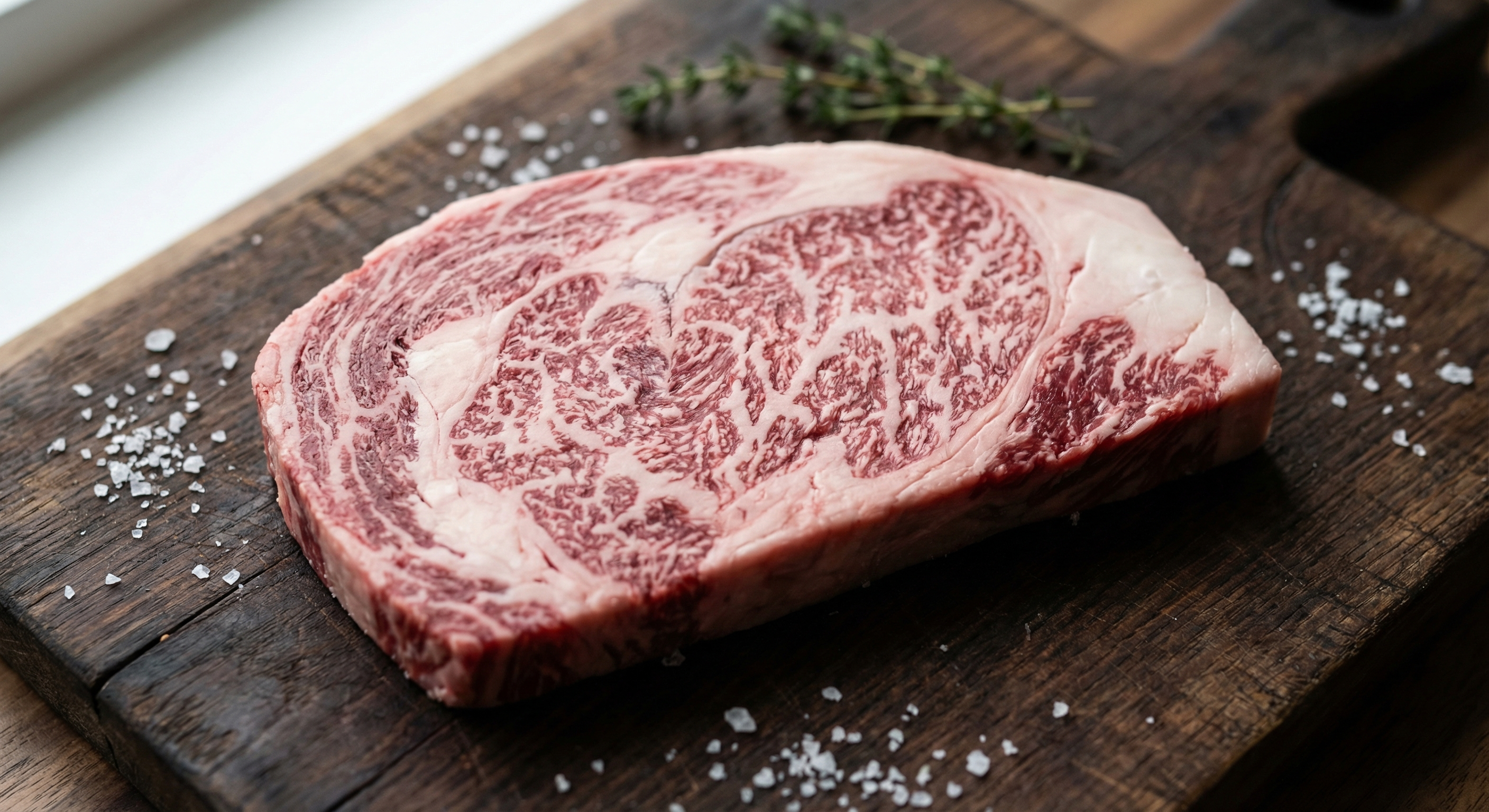
When you slice through a piece of authentic A5 Japanese Wagyu beef, the cross section reveals something extraordinary — an intricate web of white fat threaded so finely through deep red muscle that the meat appears almost pink. This cross-sectional view is not just beautiful; it is the single most important visual indicator of quality that Japanese graders, butchers, and discerning buyers use to evaluate Wagyu. Having spent years studying carcass evaluations at Japanese auction houses, I can tell you that understanding what you see in a Wagyu cross section separates informed buyers from those simply paying premium prices.
What Is a Wagyu Cross Section?
A Wagyu cross section refers to the exposed surface of beef when a cut is made perpendicular to the muscle fibers. In professional Japanese beef grading, the definitive cross section is taken at the 6th-7th rib interface of the longissimus dorsi muscle — the ribeye. This specific location was chosen by the Japanese Meat Grading Association (JMGA) because it provides the most representative view of the carcass's overall marbling quality.
When you look at this cross section, you're seeing three key elements: the lean muscle tissue (appearing deep red), the intramuscular fat or marbling (appearing white), and the intermuscular fat and connective tissue that separates muscle groups. For grading purposes, only the intramuscular fat within the ribeye muscle matters — this is what determines the Beef Marbling Standard (BMS) score that drives A5 classification.
The reason cross sections matter so much is that marbling is three-dimensional. A surface view of a steak only shows you one plane of fat distribution. But the pattern visible in a properly cut cross section reveals the density, fineness, and uniformity of marbling throughout the entire muscle structure. Two steaks can look similar on the surface but tell completely different stories in cross section.
Anatomy of an A5 Cross Section
An A5 Wagyu cross section — specifically one scoring BMS 8 or higher — displays several distinctive characteristics that distinguish it from lower-grade beef. Understanding these visual markers helps you evaluate quality whether you are shopping at a specialty retailer, browsing authentic Japanese A5 Wagyu online, or inspecting product at a Japanese market.
The Shimofuri Pattern
The hallmark of premium Wagyu cross sections is shimofuri — the Japanese term for the frost-like marbling pattern where fine veins of fat create a web throughout the muscle. In A5 beef, shimofuri is so extensive that individual muscle fibers are barely visible to the naked eye. The fat deposits are fine rather than coarse, distributed uniformly rather than concentrated in pockets, and create a lace-like network that almost appears woven into the meat.
Lower-grade beef might show marbling, but it tends to appear as larger, scattered flecks or streaks. The distinction in A5 cross sections is the fineness — each fat deposit is thin, delicate, and connected to neighboring deposits in a continuous pattern. This is why Japanese graders use the term "sashi" (literally "inserted" or "stitched") to describe marbling — at its finest, the fat looks as though it has been carefully stitched into the muscle fabric.
Color Balance
In an A5 cross section with BMS 10-12, the visual ratio between red meat and white fat shifts dramatically. Where a standard beef cross section appears predominantly red with white accents, a top-tier A5 cross section can appear almost pink — the extensive marbling blends with the muscle tissue to create an overall lighter appearance. The meat color itself should be a bright, cherry red (described as "bright" on the Beef Color Standard scale), while the fat should be pure white to slightly cream-colored with a glossy luster.
If you see fat that appears yellowish in a cross section, this typically indicates an older animal or one raised on a grass-heavy diet. While not necessarily a quality defect, yellow fat will score lower on the Japanese Fat Color Standard and can prevent a carcass from achieving A5 grade regardless of its marbling score.
Cross Sections by Cut: What to Expect
While the official grading cross section is taken at the ribeye, different cuts of A5 Wagyu show distinctly different marbling patterns when viewed in cross section. Understanding these variations helps you choose the right cut for your intended preparation.
Ribeye (Riburosu)
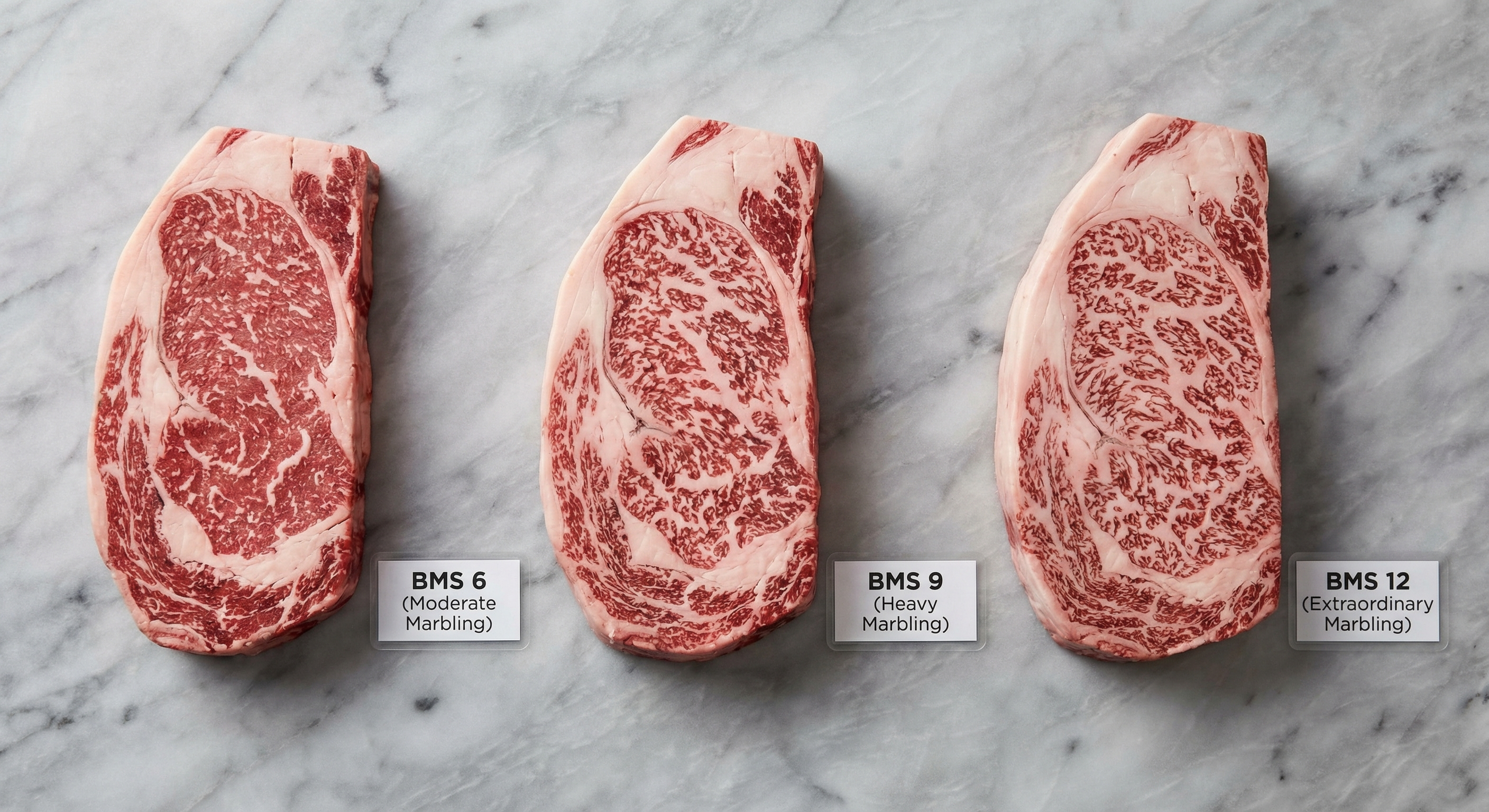
The ribeye cross section is the gold standard for marbling evaluation and typically shows the most dramatic shimofuri pattern. The large, single muscle eye of the ribeye provides an uninterrupted canvas where marbling can express fully. In A5 ribeye, you will see the densest concentration of fine marbling, particularly in the center of the eye where the fat web is tightest. The spinalis dorsi cap (the curved outer section) shows equally impressive marbling with a slightly different texture — often appearing more streaked than webbed. When browsing A5 Wagyu ribeye steaks, look for cross sections where the marbling extends uniformly from center to edge without bare or lean patches.
Striploin (Saaroinn)
The striploin cross section reveals a different marbling character. Because the longissimus dorsi muscle transitions as it moves toward the loin, striploin cross sections typically show slightly less marbling density than ribeye but with more defined, linear fat lines running parallel to the muscle fibers. The result is a more "streaked" appearance compared to the ribeye's web-like pattern. Many Japanese beef connoisseurs actually prefer striploin cross sections because the marbling, while less dense, tends to be more uniform — every bite delivers consistent flavor rather than alternating between intensely marbled and slightly leaner zones.
Tenderloin/Filet (Hire)
The tenderloin cross section is the most subtle of the premium cuts. Even in A5 carcasses, the tenderloin's naturally lean character means its cross section shows less visible marbling than ribeye or striploin. However, what marbling exists in an A5 tenderloin is extraordinarily fine — appearing as a delicate frost rather than distinct veins. The cross section is smaller and rounder, with the marbling concentrated in the center of the muscle. Do not judge a tenderloin by the same visual standards as a ribeye; even modest marbling in this cut delivers exceptional tenderness and flavor.
Brisket and Chuck
These working muscles show marbling patterns that differ significantly from loin cuts. A5 Wagyu brisket cross sections reveal marbling that follows the grain of the muscle more closely, creating longer, more directional fat lines rather than the web pattern seen in ribeye. The flat and point sections of the brisket show different densities, with the point being significantly more marbled. Chuck cross sections display complex patterns because multiple muscle groups converge, each with its own marbling character.
How Japanese Graders Read Cross Sections
Professional graders at the JMGA evaluate cross sections using a systematic approach that considers four quality factors, each with its own standardized scale. Understanding this process reveals why certain cross sections grade higher than others.
Marbling (BMS 1-12)
The BMS score is the most heavily weighted factor. Graders compare the cross section against standardized reference photographs showing each level of marbling from 1 to 12. They evaluate not just the amount of fat but its distribution pattern. A cross section with heavy but unevenly distributed marbling might score lower than one with slightly less total fat that is perfectly uniform. The fineness of individual fat deposits also matters — coarse marbling composed of large fat pockets scores lower than the same volume of fat distributed in fine, delicate veins.
Meat Color and Brightness (BCS 1-7)
The Beef Color Standard evaluates the lean portion of the cross section on a 1-7 scale, where 3-5 is considered ideal. The meat should appear bright cherry red — not too dark (indicating age or stress) and not too pale (indicating potential issues with the animal's diet or health). Graders assess this under standardized lighting conditions because ambient light can dramatically affect how meat color appears.
Firmness and Texture
By pressing the cross section surface, graders evaluate the meat's firmness and texture on a 1-5 scale. A5-quality beef should be firm to the touch despite its high fat content — the marbling should be integrated into the muscle structure, not creating a soft, mushy texture. The surface should also appear smooth and fine-grained rather than coarse or fibrous.
Fat Color, Luster, and Quality (BFS 1-7)
The fat visible in the cross section is evaluated separately from the meat on the Beef Fat Standard scale. Scores of 1-4 are acceptable for top grades, with pure white, glossy fat scoring highest. The fat should appear to have a slight sheen or luster — dull, dry-looking fat indicates potential quality issues. This factor is why you see such emphasis on fat color when Japanese Wagyu is marketed; it directly impacts the grade.
Reading Cross Sections When Buying A5 Wagyu
Armed with grading knowledge, you can make more informed purchasing decisions by evaluating cross section photographs. Here is what to look for and what to avoid.
Signs of Exceptional Quality
- Fine, uniform marbling — fat deposits are thin, evenly spaced, and create a consistent web pattern across the entire cross section
- Bright cherry-red meat color — fresh, vibrant lean tissue that contrasts cleanly with white fat
- Pure white fat — no yellow tinge, with a slight glossy appearance
- Edge-to-edge distribution — marbling extends from the center of the muscle all the way to the edges, not concentrated in one area
- No large fat pockets — absence of coarse, concentrated fat deposits that would indicate uneven marbling
Red Flags in Cross Sections
- Patchy marbling — heavily marbled zones next to lean zones suggest inconsistent quality
- Coarse fat deposits — large, distinct fat pockets rather than fine veins indicate lower BMS despite potentially high total fat content
- Dark meat color — can indicate an older animal, stress before slaughter, or improper aging
- Yellow fat — suggests grass-finished rather than grain-finished feeding, which affects the flavor profile and grade
- Dry surface appearance — quality Wagyu cross sections should look moist and glossy, not dry or tacky
A5 Cross Section vs Other Grades
Comparing cross sections across quality grades makes the differences immediately apparent and helps you understand why A5 commands such a premium.
A USDA Choice cross section (roughly equivalent to BMS 3-4) shows lean red meat with scattered flecks of fat. The marbling is visible but sparse, creating an appearance that is predominantly red. You can easily distinguish individual muscle fibers, and the fat deposits are relatively large and widely spaced.
A USDA Prime cross section (roughly BMS 4-6) shows noticeably more marbling with white streaks becoming more prominent. The pattern begins to show some continuity, with fat deposits connecting to form short veins rather than isolated flecks. The overall appearance is still clearly red meat with white accents.
An A4 Wagyu cross section (BMS 5-7) displays the transition to true Wagyu character. The marbling becomes webbed rather than streaked, and the fat deposits are finer than in Prime beef. The meat begins to take on a lighter overall appearance as the extensive marbling blends with the lean tissue. This grade offers excellent eating quality and represents remarkable value compared to A5.
An A5 Wagyu cross section (BMS 8-12) is unmistakable. The marbling is so dense and fine that the cross section appears pink rather than red. Individual muscle fibers are nearly invisible beneath the intricate fat web. The shimofuri pattern creates an almost artistic appearance — experienced graders can identify specific prefectures and bloodlines by the marbling pattern alone. At BMS 11-12, the cross section is more white than red, with the lean tissue appearing as thin lines within a matrix of fine fat. This level of marbling delivers the legendary melt-in-your-mouth experience that makes A5 Wagyu unlike any other beef.
Whether you are exploring American Wagyu (typically BMS 4-7) or seeking authentic Japanese A5 Wagyu (BMS 8-12), comparing cross sections is the most reliable way to assess what you are actually getting.
Why Cross Section Photography Matters for Online Buyers
In an era where most premium Wagyu is purchased online rather than at a physical butcher counter, cross section photography has become the primary quality communication tool between sellers and buyers. Reputable vendors photograph the actual cross section of every cut — not stock images or representative photos — because experienced buyers demand this transparency.
When evaluating cross section photos online, consider that lighting, camera settings, and even the angle of the cut can affect how marbling appears. Look for vendors who photograph under consistent, neutral lighting and who show the cross section at a perpendicular angle to the muscle fibers. Side-lit photographs can exaggerate marbling by casting shadows in the fat deposits, making modest marbling appear more extensive than it actually is.
Also pay attention to the size of the cross section relative to the cut weight. A small cross section area from a thin steak may appear more densely marbled than a larger cross section from a thicker steak of identical quality, simply because the marbling is compressed into a smaller visual area. Evaluating marbling relative to the overall surface area gives you a more accurate assessment.
Frequently Asked Questions
Frequently Asked Questions
What does a real A5 Wagyu cross section look like?
A genuine A5 Wagyu cross section appears pink to almost white due to extensive fine marbling throughout the muscle. The intramuscular fat creates a delicate, web-like shimofuri pattern where individual muscle fibers are barely visible. The lean meat is bright cherry red and the fat is pure white with a glossy luster. The marbling is uniform from edge to edge with no bare patches.
How can you tell fake Wagyu from real A5 by looking at the cross section?
Real A5 Wagyu shows fine, uniformly distributed marbling in a web-like pattern throughout the entire cross section. Fake or mislabeled Wagyu typically shows coarser, less uniform fat deposits with visible lean zones between them. Genuine A5 also has bright cherry-red meat with pure white fat, whereas lower-quality beef passed off as Wagyu may show darker meat or yellowish fat.
Which Wagyu cut shows the best marbling in cross section?
The ribeye (riburosu) typically shows the most dramatic marbling in cross section because its large, single muscle eye allows the shimofuri pattern to express fully. This is why the official Japanese grading cross section is taken at the ribeye. However, striploin cross sections often show more uniform marbling, and each cut has its own characteristic pattern.
What BMS score do you need for A5 grade?
A5 grade requires a minimum BMS (Beef Marbling Standard) score of 8 on the 1-12 scale. However, A5 can range from BMS 8 to BMS 12, which represents a significant difference in marbling intensity. BMS 8 shows abundant marbling while BMS 12 is extraordinarily marbled with more visible fat than lean muscle in cross section. Asking for the specific BMS score gives you more precise quality information than the A5 grade alone.
More Expert Guides
Wagyu Picanha: The Brazilian Cut That Transforms Japanese Beef
Picanha is Brazil's most prized cut. Add wagyu-level marbling and you get one of the most flavorful, juicy steaks available — with a built-in fat cap that bastes the meat as it cooks.
14 min readWagyu vs Angus: Which Premium Beef Is Worth Your Money?
Wagyu and Angus are both premium beef breeds, but they deliver completely different eating experiences. Compare marbling, flavor, price, cooking methods, and nutrition to decide which belongs on your table.
14 min readWagyu Tataki: The Complete Guide to Japan's Flash-Seared Beef Delicacy
Learn how to prepare authentic wagyu tataki—from choosing the right cut and mastering the flash-sear to slicing, plating, and making the perfect ponzu. A complete guide to Japan's most elegant rare beef preparation.