Wagyu Sashi: The Japanese Art of Fine Marbling Explained
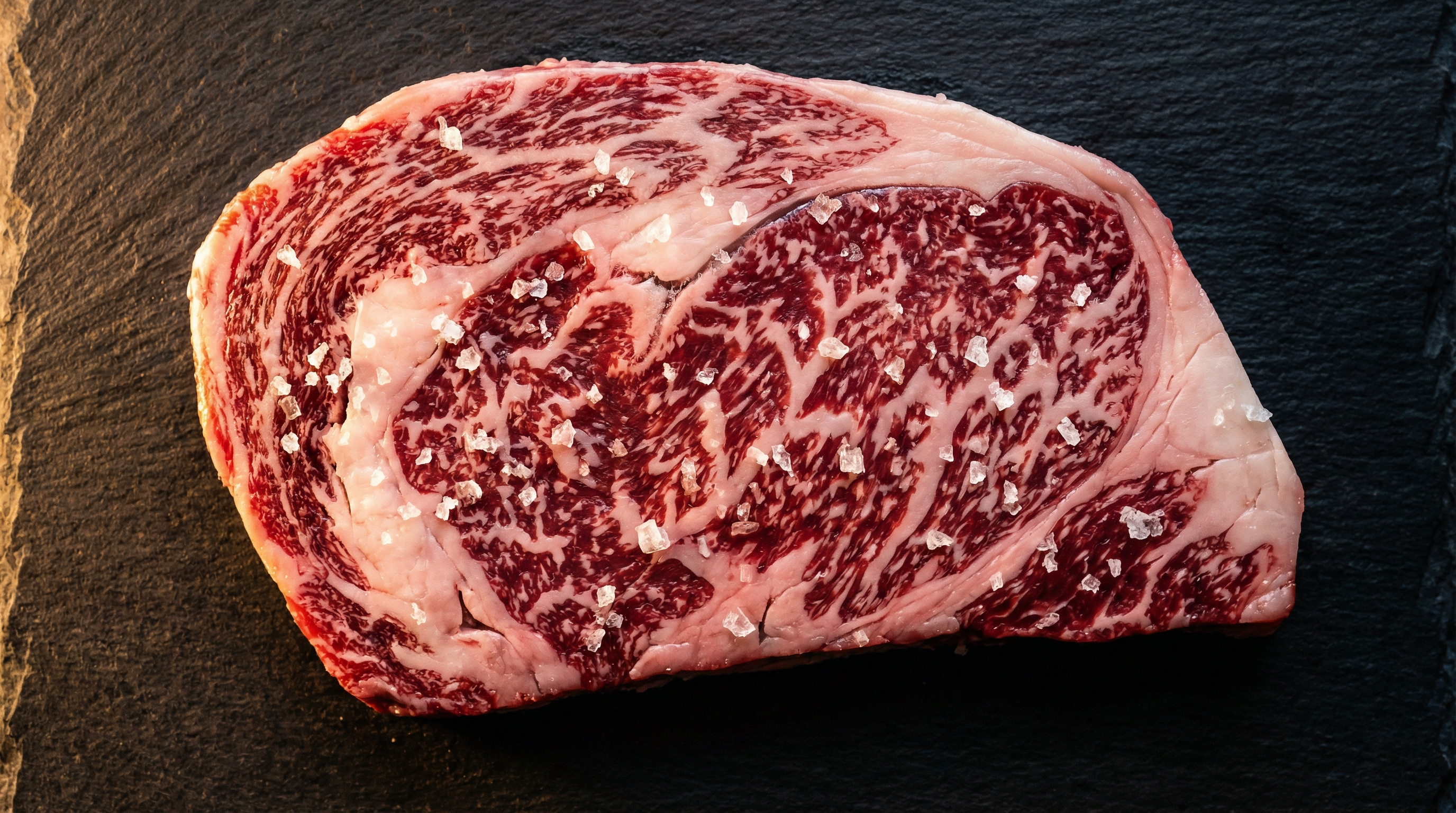
When Japanese beef professionals evaluate wagyu, they don't just talk about "marbling." They talk about sashi (サシ) — the fine, web-like threads of intramuscular fat that give wagyu its extraordinary tenderness, juiciness, and flavor. Understanding sashi is understanding what makes wagyu, wagyu.
This guide explains the meaning and science behind sashi, how it differs from ordinary marbling, and why Japanese graders consider sashi quality the single most important factor in determining a cut's grade.
What Does Sashi Mean?
Sashi (サシ) is the Japanese word for the fine streaks and webs of intramuscular fat visible within wagyu beef. The term comes from the Japanese verb sasu (差す), meaning "to insert" or "to thread through" — describing exactly how these delicate fat deposits weave between muscle fibers.
When Japanese consumers see beef with exceptional sashi, they call it shimofuri-niku (霜降り肉), which translates to "frosted meat." The name comes from the visual resemblance to frost crystals spreading across a surface — an apt description for the fine white fat network visible in a well-marbled wagyu cross-section.
This terminology matters because it reflects a fundamentally different way of thinking about fat in meat. Western grading systems treat marbling as a quantity measurement: more fat equals a higher grade. Japanese evaluation of sashi considers quantity, distribution, fineness, and pattern quality as separate characteristics that together determine the beef's true eating quality.
Sashi vs. Ordinary Marbling: The Critical Differences
All marbling is intramuscular fat, but not all intramuscular fat qualifies as good sashi. The distinction lies in three characteristics that Japanese graders evaluate carefully.
Fineness (Kimé)
The most prized sashi appears as extremely thin threads, sometimes barely visible to the naked eye, distributed uniformly through the muscle. This quality is called kimé (きめ) — literally "texture" or "grain." Fine-grained sashi melts at lower temperatures, creating that signature wagyu butteriness at first bite.
Coarse marbling — the kind where fat appears in thick veins or pockets — delivers less of this effect. The fat takes longer to render and creates an uneven eating experience where some bites feel greasy while others feel dry.
Distribution (Bunpu)
Ideal sashi spreads evenly across the entire cross-section of the muscle, from edge to center. Japanese graders use the term bunpu (分布) when assessing how uniformly the fat distributes.
A steak might contain the same total percentage of intramuscular fat as another, but if that fat concentrates in one area while leaving other sections lean, it receives a lower evaluation. Even distribution means every bite delivers the same luxurious texture.
Pattern Quality (Kata)
The best sashi forms interconnected web-like patterns rather than isolated dots or disconnected streaks. This web structure — evaluated as kata (型) or pattern — is crucial because it determines how the fat interacts with muscle fibers during cooking.
Web-pattern sashi bastes the meat from within as it cooks, keeping every muscle fiber lubricated. Disconnected fat deposits can't do this as effectively, leading to drier sections between the fat.
The Science Behind Sashi Formation
Sashi doesn't happen by accident. It's the result of genetics, feeding practices, and time — specifically, the extended finishing periods that differentiate wagyu production from conventional beef.
Genetic Foundation
Japanese Black cattle (Kuroge Washu) carry genetic markers that promote intramuscular fat deposition over subcutaneous fat. The key genes include SCD (stearoyl-CoA desaturase), which increases oleic acid production and determines how soft the fat feels, and FASN (fatty acid synthase), which influences total fat deposition.
These genetics explain why even with identical feeding programs, Japanese Black cattle develop finer, more evenly distributed marbling than other breeds. The fat deposits are predisposed to form in thin threads rather than thick veins.
Feeding and Finishing
Wagyu cattle in Japan typically undergo finishing periods of 28 to 32 months — roughly twice as long as conventional beef cattle. During this extended period, cattle receive carefully managed diets that shift from roughage-heavy to grain-heavy, encouraging slow, steady intramuscular fat deposition.
The gradual pace matters enormously. Rapid fat deposition tends to create larger, coarser fat deposits. Slow deposition gives the fat time to distribute evenly through the muscle in those fine threads that characterize premium sashi.
The Role of Oleic Acid
One reason sashi feels different from ordinary marbling is its fatty acid composition. Wagyu intramuscular fat contains significantly higher levels of oleic acid (C18:1) — the same monounsaturated fatty acid found in olive oil. Oleic acid concentrations in A5 wagyu can exceed 55% of total fatty acids, compared to roughly 35–40% in conventional beef.
This matters for sashi because oleic acid has a melting point of approximately 13°C (55°F) — well below body temperature. This is why high-quality sashi literally melts on your tongue. The fat doesn't need cooking heat to soften; your mouth temperature is enough.
It also explains wagyu's characteristic wagyu-kō (和牛香), the sweet, coconut-like aroma unique to well-marbled Japanese beef. This fragrance develops when oleic acid and other unsaturated fatty acids oxidize during cooking, and the finer the sashi distribution, the more evenly this aroma permeates the meat.
How Japanese Graders Evaluate Sashi
The Japan Meat Grading Association (JMGA) evaluates sashi as the primary component of its Beef Marbling Standard (BMS) score. Here's what happens during a grading session.
The Grading Cross-Section
Graders examine the longissimus dorsi (ribeye muscle) cut between the 6th and 7th ribs. This cross-section provides a representative sample of the animal's overall marbling quality. The cut surface is allowed to bloom for approximately 30 minutes before evaluation, letting the meat oxidize enough for the fat and lean to show clear contrast under standardized lighting conditions.
BMS and Sashi Quality
The BMS scale runs from 1 to 12, but the correlation with sashi quality isn't purely about fat quantity:
- BMS 1–3: Minimal sashi. Fat appears as occasional dots or thin traces. Lean sections dominate.
- BMS 4–5: Moderate sashi. Visible fat threads begin to form patterns, but lean areas remain clearly distinct.
- BMS 6–7: Abundant sashi. Fat webs become interconnected. The balance between lean and fat shifts noticeably.
- BMS 8–9: Dense sashi. Fine fat networks cover most of the cross-section. This is where the "frosted" appearance begins.
- BMS 10–12: Exceptional sashi. The fat network is so fine and dense that the meat appears almost uniformly pink-white. At BMS 12, distinguishing individual fat threads requires close inspection — they've merged into an extraordinarily fine web.
A cut can only achieve BMS 10+ when the sashi demonstrates all three qualities simultaneously: fineness, even distribution, and web-like pattern structure. Heavy marbling with coarse fat deposits tops out around BMS 7–8 regardless of total fat content.
Sashi and the Overall Wagyu Grade
Japan's wagyu grading system produces a final grade like A5 or B4 by combining two evaluations. The yield grade (A, B, or C) measures how much usable meat the carcass produces relative to its weight — this has nothing to do with sashi. The quality grade (1–5) is determined by whichever of four sub-scores is lowest: marbling (BMS), meat color and brightness, fat color and luster, and firmness and texture.
To achieve Quality Grade 5, the BMS must score 8 or above. Since BMS 8+ requires exceptional sashi by definition, the A5 grade inherently guarantees premium sashi quality. This is why experienced buyers in Japan focus on BMS scores rather than the letter-number grade alone. Two different A5-graded cuts — one at BMS 8 and another at BMS 12 — offer meaningfully different eating experiences, and their prices reflect that gap.
Recognizing Quality Sashi When Buying
Whether you're shopping at a Japanese butcher or ordering wagyu online, these visual cues help you assess sashi quality before purchasing.
What Premium Sashi Looks Like
- Fine, hair-thin white lines threading through the meat in every direction
- Even coverage from edge to center — no large lean patches or fat pools
- Web-like connectivity where fat threads intersect and form a mesh
- Soft, slightly glossy fat that looks creamy rather than waxy
- Pink overall appearance — the combination of red lean and fine white fat creates a blush tone
Red Flags to Avoid
- Thick white veins or chunks of fat within the muscle (coarse marbling, not sashi)
- Fat concentrated on one side or in the center while other areas are lean
- Waxy, hard-looking fat that appears bright white and firm (may indicate lower oleic acid content)
- Disconnected dots of fat without thread-like connections between them
Cooking to Honor the Sashi
The whole point of premium sashi is the eating experience, so cooking methods should preserve — not destroy — what makes it special.
Temperature Control
Because sashi melts at low temperatures, high-heat cooking methods risk rendering out too much fat before the lean portions finish cooking. For cuts with BMS 8+, sear briefly at very high heat (30–45 seconds per side) to develop crust, keep the interior rare to medium-rare (48–52°C / 118–125°F internal) so the sashi melts gradually in your mouth rather than in the pan, and avoid well-done temperatures entirely — by 70°C, much of the sashi has rendered out, defeating the purpose.
Portion Size
Premium sashi creates an intensely rich eating experience. In Japan, wagyu is traditionally served in smaller portions — 100 to 150 grams per person — because the high fat content satisfies quickly. This isn't just tradition; it's practical advice. A 400-gram A5 ribeye sounds appealing until the richness becomes overwhelming midway through.
Best Preparations for Showcasing Sashi
- Yakiniku (Japanese BBQ): Thin slices grilled briefly over charcoal. The thinness ensures the sashi melts evenly throughout each piece.
- Shabu-shabu: Paper-thin slices swished through hot broth. The sashi melts almost instantly, creating an incredibly silky texture.
- Sukiyaki: Thin slices simmered in sweet soy broth. The sashi enriches the cooking liquid while keeping the meat tender.
- Steak (teppanyaki style): Thicker cuts seared on a flat iron griddle. Best for BMS 6–8, where there's enough lean structure to support a steak format.
Sashi Across Wagyu Regions
Different Japanese wagyu brands produce subtly different sashi characteristics, influenced by local breeding lines and feeding practices.
Kobe Beef (Hyogo Prefecture) is known for exceptionally fine, evenly distributed sashi. The Tajima bloodline used for Kobe produces some of the most delicate marbling patterns in Japan.
Matsusaka Beef (Mie Prefecture) often exhibits dense, rich sashi with high oleic acid content. Matsusaka producers use extended finishing periods — some exceeding 35 months — that develop particularly luxurious fat quality.
Omi Beef (Shiga Prefecture), one of Japan's oldest wagyu traditions, tends toward balanced sashi — fine-grained but not overwhelming, making it versatile across cooking methods.
Miyazaki Beef (Miyazaki Prefecture) has been a dominant force in national competitions. Miyazaki cattle consistently produce uniform sashi across the entire carcass, not just in prime cuts.
Sashi in Non-Japanese Wagyu
Outside Japan, the term sashi is increasingly used to market wagyu-cross and fullblood wagyu from Australia, the United States, and other producing countries. The quality varies significantly.
Australian Fullblood Wagyu comes closest to Japanese sashi characteristics outside Japan. Australian producers like Blackmore and Westholme use extended finishing periods and Japanese-descended genetics to produce BMS 9+ marbling that genuinely displays fine sashi patterns.
American Wagyu, typically crossbred (Japanese genetics × Angus), produces good marbling but usually with coarser fat threads than purebred Japanese cattle. The sashi tends toward moderate fineness, roughly comparable to BMS 5–7 in Japanese terms.
F1 Crosses (first-generation wagyu crosses) produce variable sashi quality. Some develop surprisingly fine marbling; others show the coarser patterns characteristic of the non-wagyu parent breed.
The Future of Sashi Evaluation
Research continues to refine our understanding of what creates optimal sashi. Current areas of study include genomic selection for specific marbling patterns rather than just total fat content, feed optimization using metabolomics to fine-tune fatty acid profiles, non-invasive sashi evaluation using ultrasound imaging on live cattle, and consumer preference mapping to determine which sashi characteristics most strongly predict satisfaction across different cultures and cooking methods.
These advances promise a future where sashi quality can be predicted and optimized even more precisely — bringing the art of fine wagyu marbling into conversation with modern food science.
Final Thoughts
Sashi represents one of the most sophisticated concepts in meat quality evaluation — the idea that it's not just how much fat is in the meat, but how that fat is structured, distributed, and composed at a molecular level. When you see a cross-section of A5 wagyu with its frost-like web of fine white threads, you're looking at the result of centuries of breeding refinement, months of careful feeding, and a grading philosophy that treats fat quality as an art form.
Understanding sashi won't just make you a better wagyu buyer. It changes how you think about meat quality entirely — from a simple "more marbling is better" mindset to an appreciation for the intricate structure that makes every bite of premium wagyu a genuinely different eating experience.
Frequently Asked Questions
What does sashi mean in wagyu?
Sashi (サシ) is the Japanese word for the fine, web-like threads of intramuscular fat in wagyu beef. It comes from the verb sasu, meaning 'to insert' or 'to thread through,' describing how delicate fat deposits weave between muscle fibers.
How is sashi different from regular marbling?
While all marbling is intramuscular fat, sashi specifically refers to fine-grained, evenly distributed fat that forms web-like patterns. Regular marbling can include coarse fat veins and uneven distribution. Japanese evaluation assesses sashi on fineness (kimé), distribution (bunpu), and pattern quality (kata).
Why does wagyu sashi melt in your mouth?
Wagyu sashi contains high levels of oleic acid, the same monounsaturated fat found in olive oil. Oleic acid melts at approximately 13°C (55°F) — well below body temperature — so the fine fat threads in premium sashi literally melt on contact with your tongue.
What BMS score indicates premium sashi?
BMS 8 and above indicates premium sashi quality. At BMS 10-12, the sashi is so fine and dense that the meat appears almost uniformly pink-white, with fat threads forming an extraordinarily fine interconnected web throughout the muscle.
What is shimofuri-niku?
Shimofuri-niku (霜降り肉) means 'frosted meat' in Japanese. It describes wagyu beef with exceptional sashi marbling, named for the visual resemblance to frost crystals spreading across the meat's surface.
More Expert Guides
Wagyu Filet Mignon: The Complete Guide to the Most Tender Cut
Wagyu filet mignon combines the beef world's most tender muscle with its most intensely marbled breed. Learn how to select the right grade, what to expect at each price point, and the cooking methods that do this extraordinary cut justice.
14 min readWagyu Short Ribs: The Complete Guide to Buying, Braising, and Grilling
Wagyu short ribs take an already rich, beefy cut and push it into a different category entirely. The intramuscular marbling turns braises into velvety, fall-off-the-bone meals and makes grilled galbi impossibly juicy. Here's everything you need to know.
14 min readA5 American Wagyu: What It Really Means and Where to Buy It
The term "A5 American Wagyu" gets thrown around a lot, but what does it actually mean? This guide explains the grading reality, flavor profile, sourcing, and cooking techniques for top-tier American Wagyu beef.