Wagyu Marbling Grades Explained: Complete BMS 1-12 Visual Guide
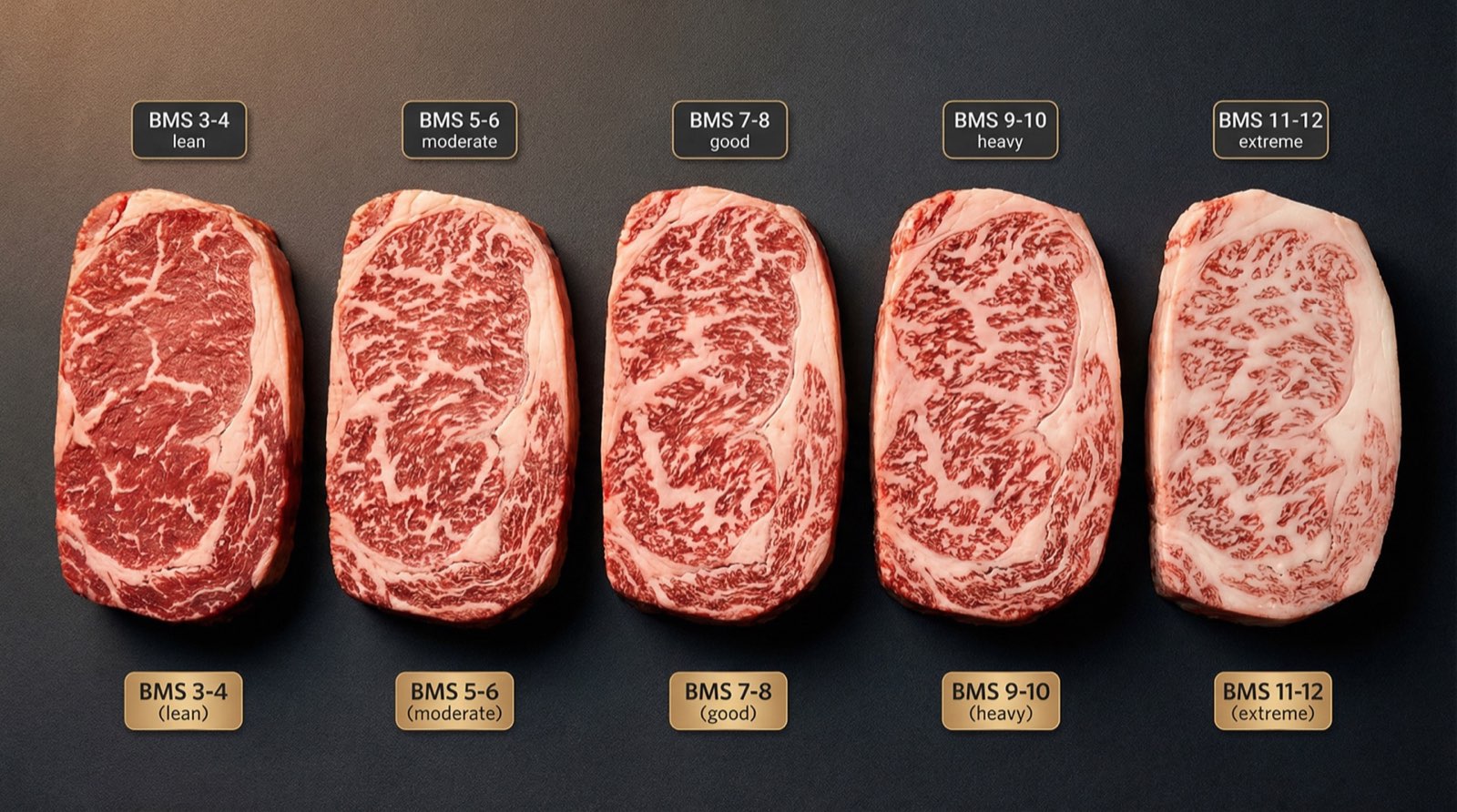
Understanding Wagyu Marbling: A Visual Journey Through BMS Grades
After thirty years studying wagyu cattle in Kobe and across Japan, I've learned that the most misunderstood aspect of wagyu quality is not the science of marbling—it's the visual identification of it. Anyone can memorize that BMS 12 is the highest grade. But can you look at a ribeye and confidently distinguish between BMS 8 and BMS 10? Can you determine whether a $200 steak is worth the premium over a $120 alternative?
This guide will teach you exactly that. We'll walk through each grade of the Beef Marbling Standard (BMS) scale from 1 to 12, focusing on what you actually see when you examine wagyu beef, and what that means for your buying decisions.
What Are Wagyu Marbling Grades?
The BMS (Beef Marbling Standard) is Japan's official marbling measurement system, ranging from 1 (practically no marbling) to 12 (extraordinary marbling). This scale measures intramuscular fat—the delicate web of fat distributed throughout the muscle tissue.
What makes this system unique is its precision. While USDA Prime simply requires "abundant" marbling, Japanese BMS grades divide that "abundant" category into seven distinct levels (BMS 6 through 12). This granular approach reflects the Japanese philosophy of continuous improvement and perfectionism in wagyu breeding.
The Three Key Visual Elements
When examining wagyu marbling, you're assessing three interconnected characteristics:
- Distribution: How evenly the marbling spreads across the muscle
- Density: The quantity of fat relative to lean muscle
- Fineness: The texture and particle size of the marbling
These three elements work together to create the signature appearance—and eating experience—of each grade level.
The Complete BMS Visual Guide: Grades 1-12
BMS 1: Minimal Marbling
Visual Characteristics: At BMS 1, you're looking at beef that resembles standard commodity beef. The muscle is predominantly red with only trace amounts of visible fat. You might see one or two thin streaks of white running through the meat, but they're isolated and sparse.
What You'll Notice: The lean muscle has a deep red color. The surface appears almost entirely uniform. Any fat present typically appears along the edges or in very thin, widely-spaced lines that don't create a network pattern.
Buying Considerations: This is technically wagyu by breed, but it doesn't deliver the characteristic wagyu experience. Price point should reflect this—if you're paying premium wagyu prices for BMS 1, you're being overcharged. This grade works well for applications where you want leaner beef, like tartare or carpaccio, but it won't provide the buttery texture associated with higher grades.
BMS 2: Light Marbling
Visual Characteristics: BMS 2 shows slightly more marbling than BMS 1, but it's still quite modest. You'll see thin white streaks running through the red muscle, creating a subtle striped appearance. The marbling remains linear rather than web-like.
What You'll Notice: The fat streaks are more numerous than BMS 1 but still clearly separated from one another. There's no "blending" effect—you can easily trace individual fat lines from one edge of the cut to another. The overall appearance is still heavily dominated by red muscle tissue.
Buying Considerations: BMS 2 represents entry-level wagyu marbling. It's an improvement over conventional beef but shouldn't command top-tier prices. This grade suits buyers who want a taste of wagyu character without the intensity or cost of higher grades. Excellent for braising or slow-cooking applications where fat will render gradually.
BMS 3: Modest Marbling
Visual Characteristics: At BMS 3, you begin to see the marbling start to form small networks. Rather than purely linear streaks, the fat begins branching and connecting. You'll notice small pockets where multiple fat lines intersect, creating delicate crosshatch patterns.
What You'll Notice: The muscle still appears predominantly red, but the white marbling is clearly more present than in lower grades. When you look closely, you can see the fat beginning to distribute more evenly across the cut. The overall visual impression shifts from "red with white streaks" to "red with white patterns."
Buying Considerations: BMS 3 is where wagyu begins to differentiate itself more noticeably from conventional beef. The eating experience will be noticeably more tender and flavorful than BMS 1-2. This grade offers good value—you're getting recognizable wagyu characteristics at more accessible price points. Ideal for grilling or pan-searing.
BMS 4: Moderate Marbling
Visual Characteristics: BMS 4 represents a significant visual jump. The marbling network becomes more sophisticated—you'll see intricate branching patterns that resemble tree roots or river deltas. The fat distribution becomes more even across the entire surface.
What You'll Notice: The ratio of red to white shifts noticeably. While red muscle still dominates, the marbling creates a more balanced appearance. You'll observe that the fat particles are finer and more evenly sized. The crosshatch patterns from BMS 3 evolve into more complex geometric networks.
Buying Considerations: This is the threshold where wagyu truly begins to deliver its signature experience. BMS 4 provides enough marbling to create the buttery texture and rich flavor wagyu is known for, but at a price point that's often significantly lower than premium grades. For many buyers, this grade represents the "sweet spot" of value versus experience.
BMS 5: Good Marbling
Visual Characteristics: At BMS 5, the marbling network becomes dense enough that you start seeing more white than in lower grades. The fat creates intricate lace-like patterns throughout the muscle. Individual fat streaks become harder to trace from edge to edge because they interconnect so extensively.
What You'll Notice: The surface takes on a more uniform appearance—not because the marbling is perfectly even, but because it's so thoroughly distributed that there are no large "blank" areas of pure red muscle. The fat particles are fine and delicate. Under good lighting, you'll see the marbling has depth—it's not just surface-level but penetrates throughout the muscle.
Buying Considerations: BMS 5 is where American Wagyu and Australian Wagyu often peak. This grade delivers an excellent wagyu experience with pronounced tenderness and flavor. Price increases become steeper beyond this point, so many experienced buyers consider BMS 5 the optimal balance of quality and value for regular consumption.
BMS 6: Abundant Marbling
Visual Characteristics: BMS 6 marks the entry point to what Americans classify as "abundant" marbling (though Japan divides this category into seven grades). The marbling creates an almost equal balance between red muscle and white fat. The networks become so interconnected that they create complex geometric patterns reminiscent of snowflakes or frost crystals.
What You'll Notice: At this grade, the visual impact is immediately striking. The cut has a distinctive appearance that sets it apart from conventional beef. The marbling is so fine and evenly distributed that it creates a almost velvet-like texture to the appearance. You'll notice the fat has a creamy, lustrous quality rather than appearing stark white.
Buying Considerations: This is where you enter premium territory. BMS 6 represents the lower end of true Japanese A5 wagyu quality. The eating experience is luxurious—extremely tender with pronounced buttery flavor. However, prices reflect this quality jump. Consider this grade for special occasions rather than everyday consumption. The richness means smaller portions are satisfying.
BMS 7: Very Abundant Marbling
Visual Characteristics: BMS 7 takes the complexity of BMS 6 and amplifies it. The marbling network becomes so intricate that it's difficult to identify individual fat streaks—they merge into a continuous web. The ratio shifts further toward white, though red muscle remains clearly visible.
What You'll Notice: The cut appears almost painted or airbrushed—the marbling is so fine and even that it creates a smooth visual gradient. When you examine the edge of the cut, you can see how deeply the marbling penetrates. The fat has a silky, almost translucent quality. Under overhead lighting, the surface develops an subtle iridescent shimmer.
Buying Considerations: At BMS 7, you're in rarefied territory. This grade commands premium prices even within the A5 category. The richness is intense—a 3-ounce portion is often sufficient. Best suited for simple preparations (salt, high heat) that let the intrinsic quality shine. This is celebration-level beef for true wagyu enthusiasts.
BMS 8: Exceptional Marbling
Visual Characteristics: BMS 8 represents a masterclass in marbling distribution. The white and red areas achieve near-perfect balance, creating an appearance similar to fine marble or granite. The marbling particles are extraordinarily fine—almost powder-like in their delicacy.
What You'll Notice: The cut has an unmistakable luxury appearance. The marbling creates flowing patterns that seem almost artistic. The color contrast between the red muscle and white fat becomes less stark—the fat takes on a creamy, almost pink-tinged hue that blends harmoniously with the muscle. The overall effect is mesmerizing.
Buying Considerations: BMS 8 is where prices escalate significantly. You're paying not just for quality but for rarity—only the finest wagyu cattle achieve this grade. The eating experience borders on overwhelming richness for those unaccustomed to high-grade wagyu. This is strictly special occasion territory. Treat it as you would fine caviar or aged vintage wine.
BMS 9: Extraordinary Marbling
Visual Characteristics: At BMS 9, the marbling becomes so extensive that white begins to dominate the visual appearance. The fat creates continuous waves and swirls throughout the muscle. The network is so dense that you'd struggle to find a quarter-inch square of pure red muscle anywhere on the cut.
What You'll Notice: The cut looks almost too perfect to be real—like a computer-generated image. The marbling has a three-dimensional quality, with multiple layers visible at different depths. The fat has a lustrous, creamy appearance that reflects light beautifully. When you tilt the cut, you can see the marbling creating depth and texture.
Buying Considerations: BMS 9 represents the top 1% of wagyu production. Prices reflect this exclusivity. A single ribeye can cost several hundred dollars. The richness is extreme—many people find portions larger than 2-3 ounces overwhelming. This grade is for wagyu connoisseurs who appreciate the pinnacle of breeding and husbandry. Not recommended as an introduction to wagyu—start lower and work your way up.
BMS 10: Phenomenal Marbling
Visual Characteristics: BMS 10 pushes marbling to levels that seem almost impossible. The white fat clearly dominates, with red muscle appearing as delicate threads woven through a creamy white matrix. The marbling creates continuous, flowing patterns that cover every millimeter of the surface.
What You'll Notice: The cut appears more white than red at first glance. The marbling is so fine that individual fat particles are nearly impossible to distinguish—they merge into a continuous, silky texture. The surface has an almost waxy appearance due to the density of intramuscular fat. When properly aged, this beef develops an iridescent quality.
Buying Considerations: At this grade, you're entering the realm of the extraordinary. BMS 10 is exceptionally rare and commands prices that reflect that scarcity. The eating experience is unique—almost buttery to the point of being liquid. Many chefs recommend serving this grade at slightly cooler than room temperature to prevent the fat from becoming too soft. This is museum-quality beef for once-in-a-lifetime experiences.
BMS 11: Supreme Marbling
Visual Characteristics: BMS 11 represents marbling so extreme that it challenges conventional notions of beef. The fat content is so high that the cut appears predominantly white with delicate red marbling running through it—almost an inversion of normal beef appearance. The marbling creates continuous, flowing rivers of fat.
What You'll Notice: The cut looks more like white marble with red veining than traditional red meat with white marbling. The texture appears almost creamy or mousse-like. The fat has a lustrous, pearl-like quality. When you hold the cut up to light, you can see the intricate internal structure of the marbling network.
Buying Considerations: BMS 11 is extraordinarily rare—even in Japan, you might only encounter this grade at specialty restaurants or exclusive butcher shops. The price per ounce rivals luxury ingredients like truffles or saffron. The richness is so intense that serving sizes are minimal—think 1-2 ounces. This isn't everyday food; it's edible art for serious collectors and connoisseurs.
BMS 12: Ultimate Marbling
Visual Characteristics: BMS 12 represents the absolute pinnacle of marbling—the highest grade achievable under the Japanese system. The marbling is so extensive that the cut appears almost entirely white with fine threads of red muscle tissue. The fat creates continuous, elaborate patterns that resemble fine lacework or frost crystals.
What You'll Notice: At BMS 12, you're looking at beef that defies conventional appearance. It's predominantly white with delicate red tracery. The marbling is so fine and dense that the surface appears almost smooth and uniform. The fat has an exceptional creamy quality and reflects light with an almost opalescent shimmer. The overall appearance is breathtaking—even people unfamiliar with wagyu recognize this as something extraordinary.
Buying Considerations: BMS 12 is the rarest of the rare. Most wagyu enthusiasts will never encounter this grade in person. When available, it commands astronomical prices—think hundreds of dollars for a few ounces. The eating experience is unlike any other beef—the texture is almost custard-like, with fat that melts well below body temperature. This is strictly for serious collectors, special commemorations, or once-in-a-lifetime culinary experiences. Approach with reverence and minimal preparation to let the intrinsic quality speak for itself.
How to Evaluate Marbling When Buying Wagyu
The Four-Point Visual Assessment
When you're standing at a butcher counter or examining online photos, use this systematic approach:
- Overall Balance: What's the ratio of red to white? Is it roughly 70/30 (lower grades), 50/50 (mid grades), or 30/70 (premium grades)?
- Distribution Evenness: Are there large blank areas with no marbling, or is it spread consistently across the entire surface?
- Network Complexity: Do you see simple linear streaks (lower grades) or intricate interconnected networks (higher grades)?
- Fat Particle Size: Is the marbling coarse and chunky, or fine and delicate?
Common Visual Misidentifications
Confusing BMS 6 with BMS 8: The most common error I see is overestimating marbling by 2-3 grades. BMS 6 has abundant marbling, but BMS 8 has exceptional marbling with noticeably finer particle size and more complete distribution. If you can easily trace individual fat streaks across the cut, you're likely looking at BMS 6 or lower.
Mistaking Surface Fat for Marbling: The thick cap of external fat on a ribeye is not marbling. Marbling is specifically the intramuscular fat—the fat within the muscle tissue. A cut can have extensive external fat but minimal marbling, or vice versa.
Overweighting Color: Fat color varies based on diet and aging. Yellower fat doesn't necessarily indicate lower quality—grass-fed wagyu often has more golden-hued fat. Focus on distribution and fineness rather than pure white color.
Photography Considerations
When buying online, be aware that photography can be misleading:
- Lighting: Bright overhead lighting can make marbling appear more prominent by creating strong contrast
- Angles: Photos taken at specific angles can emphasize or hide marbling networks
- Color Adjustment: Digital enhancement can increase the apparent contrast between fat and muscle
- Cherry-Picking: The steak photographed might be the best example from a batch—others may have less marbling
Request multiple photos from different angles and lighting conditions. Reputable sellers will gladly provide these.
Price-to-Grade Relationships: What Should You Pay?
Marbling grade should directly correlate with price, but the relationship isn't linear—it's exponential. Here's what I've observed across markets:
Value Tiers
BMS 1-3 (Entry Level): These grades should be priced 20-40% above conventional prime beef. If you're paying double or triple the price of USDA Prime for BMS 2, you're overpaying.
BMS 4-5 (Sweet Spot): Expect to pay 2-3x the price of conventional prime. This tier offers the best value-to-experience ratio for most buyers. A 12-ounce ribeye might cost $80-120.
BMS 6-8 (Premium): Prices jump significantly—typically 4-6x conventional prime prices. A 12-ounce ribeye in this range might cost $150-250. You're paying for rarity and exceptional quality.
BMS 9-10 (Luxury): Expect to pay 8-12x conventional prime prices or more. These grades are special occasion purchases. A 12-ounce ribeye might cost $300-500.
BMS 11-12 (Ultra-Premium): Pricing becomes highly variable based on availability and seller. You might pay $50-100+ per ounce. These grades are investment-level purchases for serious collectors.
Red Flags When Buying
- Claiming BMS 10+ without certification or detailed provenance
- BMS 8+ at prices comparable to BMS 5-6 (likely mislabeled or misgraded)
- Refusing to provide clear photographs or video of the actual product
- Vague origin information ("Japanese-style wagyu" instead of specific breed and farm)
- Using terms like "BMS-equivalent" or "comparable to BMS X" instead of actual grading
Matching Grade to Preparation Method
Different marbling levels suit different cooking approaches:
BMS 1-4: Versatile Cooking
These grades can handle high-heat grilling, braising, or stir-frying. The moderate marbling provides flavor enhancement without overwhelming richness. Suitable for larger portions (8-12 ounces) and bold seasonings.
BMS 5-7: Simple Preparations
At this level, keep preparations simple to let the marbling shine. Pan-searing or grilling with just salt and pepper is ideal. Portions should be moderate (4-6 ounces) to avoid richness fatigue. The fat content is sufficient to self-baste during cooking.
BMS 8-10: Minimal Intervention
These grades require the lightest touch. Quick sear with coarse salt, or thin-sliced as shabu-shabu or sukiyaki. Portions should be small (2-4 ounces). The extreme marbling means the beef is almost self-cooking—the fat melts at very low temperatures.
BMS 11-12: Ceremonial Approach
At the highest grades, treat the beef with reverence. Thin slicing is common—the richness is so intense that small bites are most enjoyable. Some prefer serving these grades at room temperature or even slightly cool to prevent the fat from becoming too liquid. Think 1-2 ounce portions.
Regional Variations and Visual Differences
While BMS is the Japanese standard, understanding how other regions' wagyu appears helps with buying decisions:
American Wagyu Visual Profile
American wagyu (typically Kuroge Washu crossbred with Angus) usually peaks at BMS 6-8 equivalent. The marbling tends to be slightly coarser than Japanese wagyu at the same grade level. You'll see more defined streaks rather than the ultra-fine networks of pure Japanese wagyu. The muscle color is often deeper red due to different aging protocols.
Australian Wagyu Visual Profile
Australian wagyu (also typically crossbred) ranges from BMS 4-9 equivalent. The marbling distribution is often very even due to controlled feeding programs. Fat color may be more golden due to grass-feeding periods. The marbling networks tend to fall between American (coarser) and Japanese (finer) in appearance.
True Japanese A5 Visual Markers
Authentic Japanese A5 wagyu (BMS 8-12) has distinctive visual characteristics: extremely fine marbling particles, a specific creamy color to the fat, and marbling networks that create almost fractal-like patterns. The muscle color is typically lighter—more pink than red—due to stress-free raising conditions and shorter lifespans.
FAQs: Wagyu Marbling Grades Explained
Can you reliably identify BMS grade from photos alone?
Yes and no. Experienced evaluators can estimate within 1-2 grades from high-quality photos, but precise grading requires in-person examination. Lighting, angles, and digital processing can all affect appearance. For grades BMS 1-5, visual estimation is relatively reliable. For BMS 6+, where subtle differences matter significantly, in-person evaluation or video footage from multiple angles is preferable.
Why does marbling sometimes look different on different cuts from the same animal?
Marbling distribution varies by muscle group. The ribeye (longissimus dorsi muscle) typically shows the most marbling, while the tenderloin shows less despite being from the same animal. The BMS grade is determined from a specific location—the ribeye between the 6th and 7th ribs. Other cuts from the same animal may grade differently.
Does higher BMS always mean better flavor?
Not necessarily. BMS measures marbling quantity and distribution, not flavor quality. Some people find BMS 9+ too rich and prefer the more balanced flavor of BMS 6-7. Flavor is also influenced by diet, aging, breeding genetics, and personal preference. Higher BMS guarantees more tenderness and a buttery texture, but "better" is subjective.
How much variation exists within a single BMS grade?
Each BMS grade represents a range. A "high BMS 7" can look quite different from a "low BMS 7." This is why you sometimes see half-grades (BMS 7.5) used informally, though they're not official. When buying, ask whether the grade represents the lower or higher end of that range.
Can marbling grade change during aging?
The marbling itself doesn't change, but its appearance can. Dry-aging concentrates flavors and can make marbling more visible as moisture evaporates from the muscle tissue. The visual contrast between fat and muscle often becomes more pronounced. However, the actual BMS grade (measured on fresh beef) doesn't change.
What's the most common grade for Japanese A5 wagyu?
Most Japanese A5 wagyu falls between BMS 8-10, with BMS 9 being particularly common from premier regions like Kobe, Matsusaka, and Omi. BMS 11-12 is rare even in Japan—perhaps 1-2% of A5 production. If a seller claims to regularly stock BMS 12, be skeptical unless they're an elite specialty purveyor with proper documentation.
How do you distinguish between BMS 8 and BMS 9 visually?
The key difference is in fat particle fineness and distribution completeness. At BMS 8, you can still identify distinct marbling networks—the patterns have definition. At BMS 9, the marbling becomes so fine and dense that patterns start to blur together. BMS 9 appears more uniformly white overall, with the red muscle tissue appearing as delicate threads rather than substantial areas. If you can easily trace individual fat streaks, you're likely looking at BMS 8 or lower.
Is it worth paying for BMS 10+ if I'm new to wagyu?
No. Start with BMS 5-7 to develop your palate and appreciation for wagyu characteristics. BMS 10+ is overwhelmingly rich for those unaccustomed to high-grade wagyu. It's also extremely expensive—you'll appreciate it much more after experiencing lower grades first. Think of it like wine: you wouldn't start your wine education with a $1,000 vintage.
Conclusion: Developing Your Eye for Marbling
Learning to visually assess wagyu marbling is a skill developed through practice and exposure. Start by examining different grades side-by-side whenever possible. Take photos for reference. Visit high-end butchers and ask them to show you various grades.
Remember that marbling grade is just one component of quality—aging, breeding genetics, diet, and handling all contribute to the final eating experience. A well-raised, properly aged BMS 7 can outperform a poorly handled BMS 9.
Most importantly, buy based on your intended use and budget. There's no shame in preferring BMS 5 over BMS 10—many experienced wagyu enthusiasts do. The goal isn't always to buy the highest grade; it's to buy the right grade for your purposes and to pay a fair price for what you're getting.
With the visual knowledge from this guide, you now have the tools to make informed decisions, identify value, and avoid overpaying for mislabeled or overgraded wagyu. Trust your eyes, ask questions, and demand transparency from sellers. The marbling is right there on the surface—you just need to know how to read it.
More Expert Guides
What Is Wagyu Beef? The Complete Guide to Grades, Origins & Quality
Discover wagyu beef origins, the difference between Japanese A5 and American wagyu, how BMS grading works, why marbling matters, proper cooking techniques, and what you should pay in 2026.
12 min readA5 Wagyu: Your Complete Buying & Authentication Guide (2026)
A5 wagyu represents the pinnacle of beef quality, but not all A5 is created equal. Learn how to authenticate real Japanese A5, decode BMS scores, find fair prices, and cook it perfectly at home.
14 min readA5 Wagyu Prefectures: Regional Guide to Japan's Best Beef
Discover the regional differences in Japanese A5 wagyu across 12 key prefectures. Learn which prefecture produces the flavor profile you'll love most.