Wagyu Cuts: Which to Buy and How They Differ
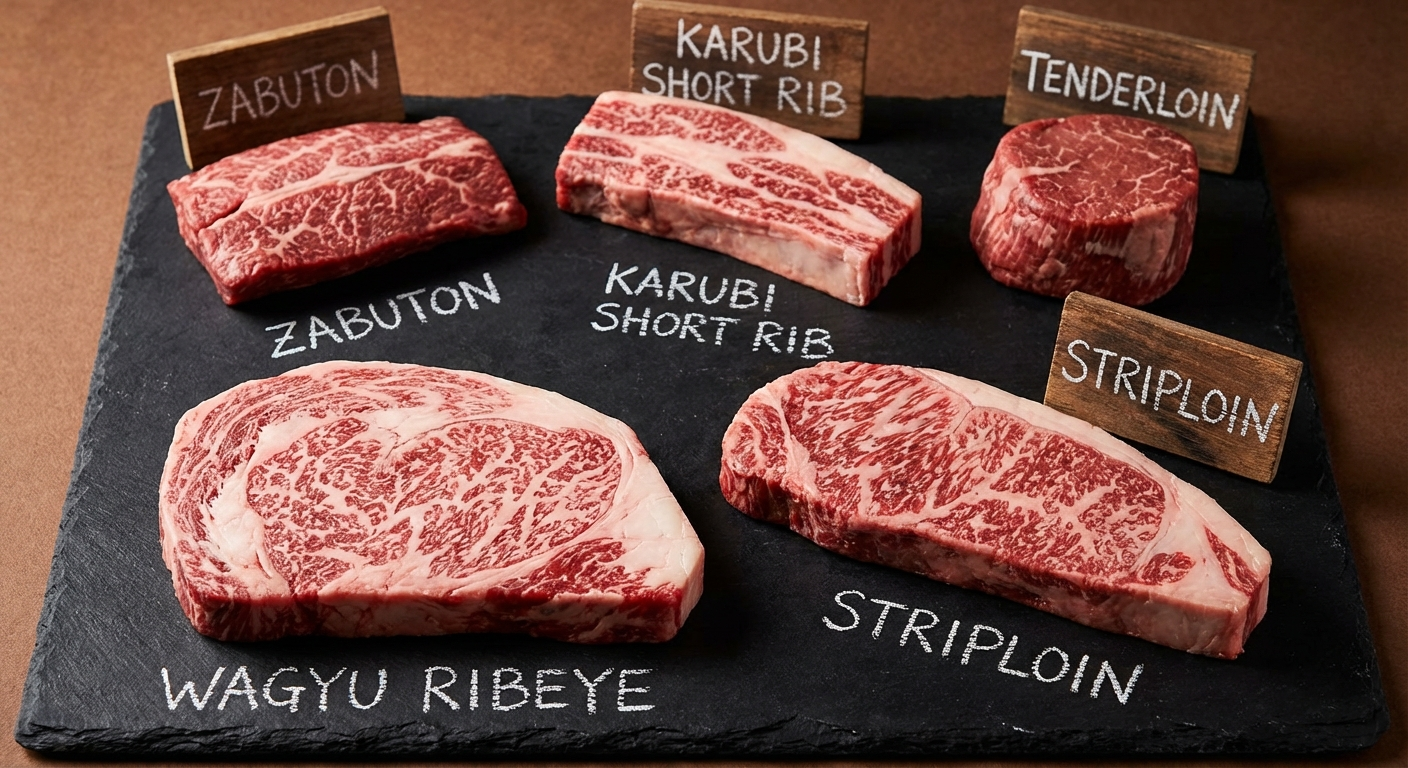
When people think "A5 Wagyu," they picture a ribeye or striploin steak. But a single A5 carcass contains dozens of individual muscles, each with different marbling patterns, textures, flavors, and ideal cooking methods. Some of the most extraordinary Wagyu cuts are ones most people have never heard of — and they're often half the price of the premium steaks.
Premium Steaks
Ribeye (Riburosu)
The ribeye is the king of Wagyu cuts. The longissimus dorsi muscle in the rib section naturally accumulates more marbling than almost any other muscle, and in A5 Wagyu, the result is breathtaking — a cross-section so heavily marbled that it looks like a piece of white and pink abstract art.
The ribeye also includes the spinalis dorsi (ribeye cap), which is arguably the single best-tasting cut on the entire animal. In A5, the cap has an almost obscene amount of marbling — it dissolves on the tongue in a way that's hard to describe.
BMS context: Ribeyes tend to grade higher than other cuts from the same carcass because the grading is done at the ribeye cross-section. The BMS you see on the certificate is literally the ribeye's marbling.
Price: $120-$200+/lb for Japanese A5.
Best cooking: Cast iron sear, 60-90 seconds per side. Or thin-slice and flash-sear yakiniku-style.
Striploin (Saaroein)
The striploin (New York strip equivalent) is from the short loin, just behind the rib. It's slightly leaner than the ribeye but still heavily marbled in A5 — and it has a firmer, more satisfying bite that many people prefer.
I often recommend striploin as the best first A5 purchase. It has excellent marbling without the extreme richness of the ribeye cap, and the texture provides more "steak" character — you're eating beef, not beef-flavored butter.
Price: $100-$180/lb for Japanese A5.
Best cooking: Cast iron sear. The firmer texture makes it more forgiving than ribeye.
Tenderloin (Hire)
The tenderloin (filet) is the leanest of the premium cuts — even in A5, it has noticeably less marbling than ribeye or striploin. What it has is extraordinary tenderness. The texture is almost custard-like, with a milder flavor that lets the clean, sweet quality of Wagyu fat shine.
Price: $130-$220/lb for Japanese A5.
Best cooking: Cut into 1-inch medallions, sear at slightly higher heat than other cuts to get a good crust on the leaner meat.
The Value Cuts (My Favorites)
Chuck Flap / Zabuton
The zabuton (literally "cushion" in Japanese) is a cut from the chuck that has marbling rivaling the best ribeyes. In Japan, it's one of the most prized yakiniku cuts. In the U.S., it's relatively unknown — which means it's dramatically underpriced relative to its quality.
A5 zabuton at $40-$60/lb delivers an eating experience comparable to striploin at $150+/lb. It's the best-kept secret in Wagyu buying.
Best cooking: Thin-slice and flash-sear. The irregular shape makes it less ideal for thick-steak presentation but perfect for yakiniku.
Short Rib (Karubi)
Karubi (short rib) is the #1 yakiniku cut in Japan — heavily marbled, intensely flavorful, and perfect for thin-slicing and grilling. In A5, the marbling in short rib is extraordinary.
Wagyu short rib is also excellent braised — the marbling renders into the braising liquid, creating a sauce of impossible richness.
Price: $30-$60/lb for Japanese A5.
Flat Iron / Top Blade (Misuji)
The misuji is the Japanese flat iron — a shoulder cut that, in Wagyu, develops remarkable marbling. It has a distinctive, slightly more mineral flavor than loin cuts, with excellent tenderness.
Price: $40-$70/lb for Japanese A5.
Tri-Tip (Tomosbara)
Wagyu tri-tip is a revelation. This bottom sirloin cut has a deep, beefy flavor that's more assertive than the loin cuts, with solid marbling that keeps it juicy. It's excellent roasted whole and sliced thin.
For Hot Pot and Thin-Slicing
Shoulder Clod / Chuck Roll
For sukiyaki and shabu-shabu, you don't need the most expensive cuts. Wagyu shoulder and chuck roll, sliced paper-thin, deliver excellent results in hot pot preparations at significantly lower prices than loin cuts.
Price: $25-$50/lb for Japanese A5.
The Value Ranking
If I'm spending my own money, here's how I prioritize Wagyu purchases by value (quality per dollar):
- Zabuton / Chuck Flap — ribeye-level marbling at chuck prices
- Short Rib (Karubi) — the yakiniku king, heavily marbled, versatile
- Striploin — the best premium steak value, balanced and accessible
- Flat Iron (Misuji) — underappreciated, excellent marbling
- Ribeye — the classic, but you're paying a premium for the name
- Tenderloin — tender but less marbled, highest price per ounce of marbling
The "off-cuts" — zabuton, karubi, misuji — are where the smart money goes. Japanese consumers know this, which is why these cuts command strong prices in Japan. In the U.S., they're still underpriced relative to their quality. You can find many of these value cuts alongside premium steaks at The Meatery's Japanese A5 collection.
Frequently Asked Questions
What is the best value Wagyu cut?
The zabuton (chuck flap) is the best value in Wagyu — it has marbling comparable to ribeye at roughly 1/3 the price. Short rib (karubi) is another excellent value cut with intense marbling and flavor, ideal for yakiniku-style cooking.
Is Wagyu ribeye better than Wagyu striploin?
Ribeye has more marbling (especially the spinalis/cap section) and a richer, fattier experience. Striploin has a firmer bite, more "steak" character, and better marbling-to-lean balance. Many enthusiasts actually prefer striploin for a more balanced eating experience.
More Expert Guides
Wagyu Zabuton: The Best-Kept Secret in Japanese Beef
Wagyu zabuton is the most undervalued cut in the A5 world — extraordinary marbling, melt-in-your-mouth texture, and a price tag that makes ribeye look like a bad deal. Here is why insiders buy it first.
13 min readHida Beef: The Complete Guide to Gifu Prefecture's Legendary Wagyu
Hida beef is one of Japan's most prestigious regional wagyu brands, raised in the mountain valleys of Gifu Prefecture. Often overshadowed by Kobe in Western markets, Hida-gyu is revered in Japan for its delicate sweetness and fine-grained marbling. Here's what makes it special.
12 min readA4 vs A5 Wagyu: The Complete Comparison Guide
A4 and A5 are both elite Japanese wagyu grades, but they deliver meaningfully different eating experiences. This guide breaks down exactly how they differ in marbling, flavor, texture, price, and when each grade is the better choice.