What Is Wagyu Beef? The Complete Guide to Grades, Origins & Quality
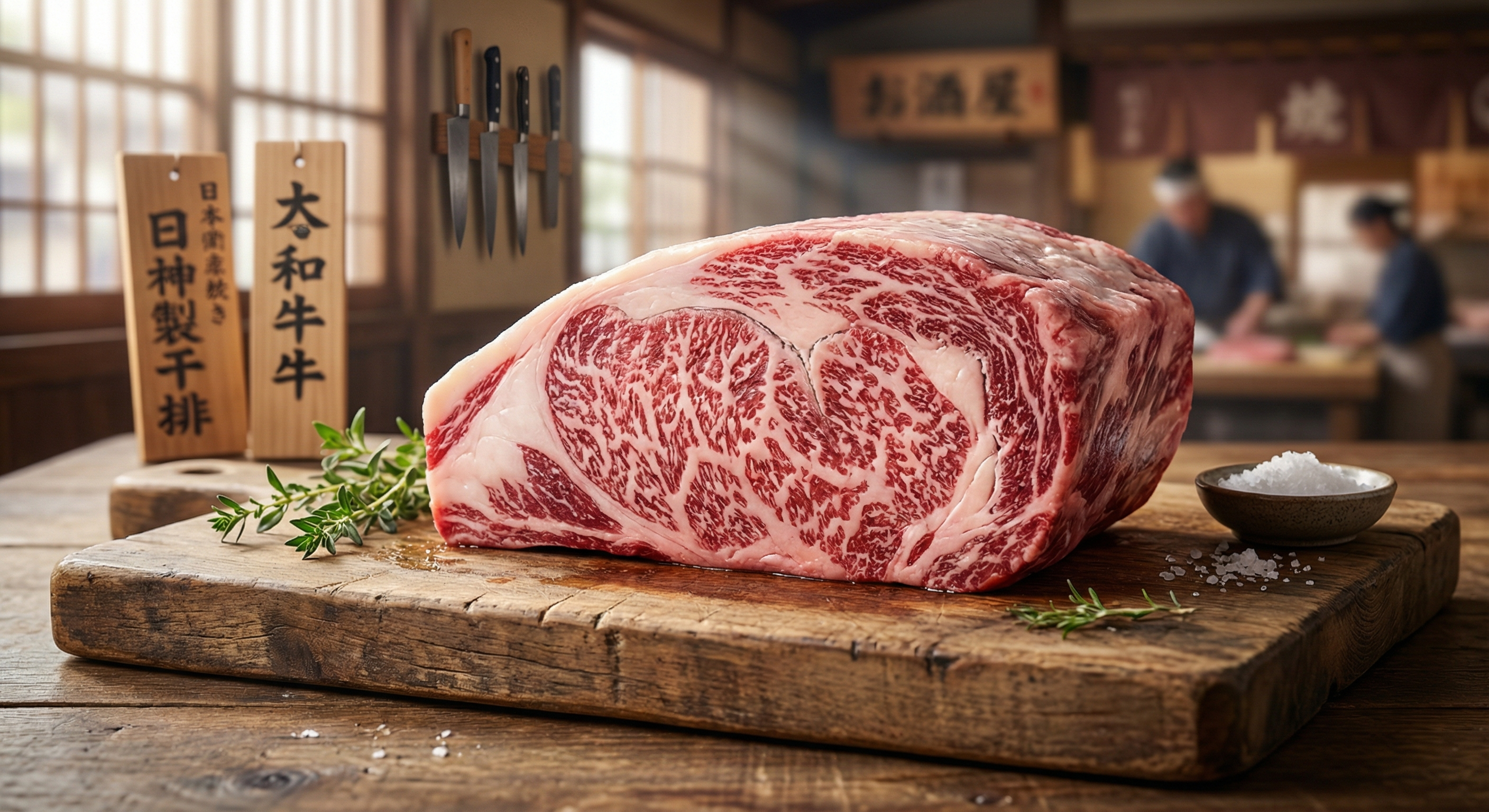
Wagyu beef has become synonymous with luxury dining — but if you ask ten people what "wagyu" actually means, you'll get ten different answers. Some think it's just expensive beef. Others assume it's all from Japan. Many believe anything labeled "wagyu" is automatically premium quality. All of these assumptions miss critical details that determine whether you're getting transcendent beef or paying $100/lb for clever marketing.
I've spent 15 years grading and sourcing wagyu — first at Tokyo beef auctions where I evaluated over 3,000 Japanese Black carcasses, then consulting with American ranchers breeding crossbred wagyu cattle. I've tasted everything from $400/lb authentic Kobe beef to $30/lb American "wagyu" burgers. The quality spectrum is enormous, the terminology is deliberately confusing, and most buyers have no framework for evaluating what they're actually purchasing.
This guide deconstructs wagyu from genetics to plate: what the term legally means, how Japanese grading systems work, what separates A5 from American wagyu, realistic pricing for 2026, cooking methods that maximize flavor, and red flags that signal inflated prices or misleading labels. By the end, you'll understand wagyu better than most steak enthusiasts and restaurant managers.
What Does "Wagyu" Actually Mean?
Wagyu is a Japanese term that translates literally to "Japanese cow" (wa = Japanese, gyu = cow). But in beef terminology, wagyu specifically refers to four heritage Japanese cattle breeds developed over centuries for exceptional marbling: Japanese Black (Kuroge Washu), Japanese Brown (Akage Washu), Japanese Shorthorn (Nihon Tankaku Washu), and Japanese Polled (Mukaku Washu).
Over 95% of wagyu beef worldwide comes from Japanese Black cattle. This breed underwent intensive genetic selection starting in the late 1800s when Japan began crossbreeding native cattle with European breeds. According to the USDA Agricultural Research Service, researchers isolated genetic markers for intramuscular fat deposition (marbling) that make Japanese Black cattle uniquely predisposed to developing extensive marbling when fed high-energy grain diets for extended periods.
Here's what's critical to understand: wagyu is a breed designation, not a quality guarantee. A cattle's genetics provide the potential for marbling — but feeding protocols, raising environment, and individual genetics determine actual marbling outcomes. A Japanese Black cow raised on pasture grass for 18 months will produce beef closer to conventional American beef than authentic Japanese A5 wagyu raised on grain for 28+ months.
Can You Raise Wagyu Cattle Outside Japan?
Yes. Wagyu genetics have been exported to the United States, Australia, and other countries. American ranchers breed purebred wagyu (100% Japanese genetics) and crossbred wagyu (typically 50% wagyu, 50% Angus). But the eating experience differs dramatically from Japanese-raised wagyu due to:
- Shorter feeding periods: American wagyu typically finishes in 400-500 days vs. 600-800 days for Japanese cattle
- Different grain formulations: Japanese cattle receive specialized grain blends, sometimes including sake mash, beer, or rice bran
- Less intensive marbling selection: Japanese breeders track and select for marbling through multiple generations with obsessive record-keeping
- Scale differences: Small Japanese farms vs. larger American operations change animal handling and stress levels
In my experience evaluating both systems, top-tier American purebred wagyu (fullblood, grain-fed 450+ days) can reach BMS 8-9 marbling. That's exceptional beef. But it rarely matches the BMS 10-12 density and fat quality of Japanese A5 from elite prefectures like Miyazaki or Matsusaka.
How Japanese Wagyu Grading Actually Works
Japan's wagyu grading system is administered by the Japan Meat Grading Association (JMGA) and represents the world's most rigorous beef quality evaluation. Every Japanese wagyu carcass sold commercially receives two separate grades:
The Letter Grade (A, B, C): Yield Classification
This measures carcass cutability — what percentage of the carcass produces usable meat. Grades work as follows:
- A Grade: ≥72% yield (above standard)
- B Grade: 69-72% yield (standard)
- C Grade: <69% yield (below standard)
Yield matters to wholesalers buying entire carcasses, but it has zero impact on steak quality or flavor. An A5 ribeye and B5 ribeye from otherwise identical cattle taste identical. Focus on the number grade instead.
The Number Grade (1-5): Quality Evaluation
This determines eating quality based on four inspection criteria. To receive a "5" quality grade (the highest possible), beef must meet strict thresholds across all four categories:
1. BMS (Beef Marbling Standard): The Primary Determinant
BMS measures intramuscular fat distribution on a 1-12 scale. Graders evaluate the ribeye cross-section between the 6th and 7th ribs, comparing marbling density against standardized photographic references.
- BMS 1-3: Minimal marbling (equivalent to USDA Select)
- BMS 4-5: Moderate marbling (USDA Choice range)
- BMS 6-7: Abundant marbling (USDA Prime equivalent)
- BMS 8-9: Very abundant marbling (A5 minimum threshold)
- BMS 10-12: Extraordinary marbling (premium A5)
To achieve Grade 5 quality, beef must score BMS 8 or higher. But here's the catch most buyers miss: BMS scoring goes from 8 to 12 within the A5 category. That's a 60% range in marbling intensity, all carrying the same A5 label. A BMS 8 A5 ribeye differs dramatically from a BMS 12 A5 ribeye in marbling density, eating experience, richness, and price.
When purchasing Japanese A5 wagyu, always ask your supplier for the specific BMS score. Anything scoring BMS 8-9 represents entry-level A5. BMS 10-11 is exceptional. BMS 12 is extraordinarily rare and commands significant price premiums.
2. Meat Color and Brightness (1-7 Scale)
According to the USDA Agricultural Marketing Service beef color standards, meat color indicates freshness, animal age, and handling quality. Japanese graders evaluate beef color against standardized Munsell color charts:
- Score 3-5: Bright cherry red to moderate red (ideal range for Grade 5)
- Score 1-2: Too pale (immature cattle or anemia)
- Score 6-7: Dark red to purplish (older cattle, stress, or longer aging)
Grade 5 beef typically scores 3-5, indicating optimal cattle age (28-32 months at harvest) and proper handling protocols.
3. Beef Firmness and Texture (1-5 Scale)
Graders physically assess muscle fiber density by pressing the ribeye cross-section. This evaluates:
- Muscle integrity: Proper collagen structure and fiber bundling
- Fat distribution: Intramuscular fat that's evenly dispersed, not clumped
- Resilience: Meat that springs back when pressed (indicates optimal pH and aging)
Grade 5 quality requires a score of 4 or 5, indicating firm, resilient muscle structure with fine-grained texture.
4. Fat Color and Luster (1-5 Scale)
Fat quality reveals genetics and feeding protocols:
- Score 1-2: Pure white to creamy white (ideal, indicates high oleic acid content)
- Score 3-4: Light cream to yellowish cream (acceptable for Grade 5)
- Score 5: Yellow fat (indicates lower-quality feed, grass finishing, or inferior genetics)
Japanese Black cattle genetics produce whiter fat with higher concentrations of monounsaturated fatty acids. Research from Texas A&M's Muscle Biology Laboratory shows wagyu cattle fat contains 40-50% oleic acid (the same heart-healthy MUFA found in olive oil) compared to 20-30% in conventional beef.
This fatty acid composition creates wagyu's characteristic low melting point (~77°F vs. 113°F for conventional beef fat) and buttery mouthfeel.
Putting It All Together: What A5 Means
To earn an A5 grade (the highest possible designation), wagyu must achieve:
- BMS score of 8-12
- Meat color score of 3-5
- Firmness score of 4-5
- Fat color score of 1-4
- Yield grade of A (≥72% cutability)
When any single criterion falls below these thresholds, the grade drops to A4 or lower — regardless of how high other scores are. This pass/fail system ensures A5 certification represents genuinely elite beef.
Japanese A5 vs. American Wagyu: Understanding the Difference
The term "wagyu" appears on everything from $8 burgers to $400 steaks, but quality varies massively depending on genetics and raising practices:
Authentic Japanese A5 Wagyu
- Genetics: 100% purebred Japanese Black (Kuroge Washu) from registered bloodlines
- Raising: Grain-fed 600-800 days (some premium producers exceed 900 days)
- Marbling: BMS 8-12 (40-50% intramuscular fat by weight in premium cuts)
- Certification: Government-tracked from birth with individual cattle ID numbers
- Price: $180-$400/lb depending on prefecture, BMS score, and cut
- Availability: Limited export quantities; most stays in Japan
Japanese A5 produces an eating experience unlike conventional beef — fat that melts below body temperature, intensely rich umami flavor, velvety texture, and minimal chew resistance.
American Wagyu (Fullblood and Crossbred)
Fullblood American Wagyu (100% Japanese genetics):
- Genetically identical to Japanese wagyu but raised in the U.S.
- Grain-fed 400-500 days (shorter than Japanese protocols)
- Marbling typically reaches BMS 6-9
- Price: $60-$120/lb for premium cuts
Crossbred American Wagyu (typically 50% wagyu, 50% Angus):
- Most common "American wagyu" on the market
- Produces beef with marbling between USDA Prime and Japanese A5
- Retains more conventional beef flavor (less buttery richness than A5)
- Price: $30-$70/lb depending on crossbreeding percentage and grading
American wagyu doesn't use the BMS system. Instead, producers use USDA grading (Prime, Choice, Select) or proprietary internal grades. Most American wagyu qualifies as USDA Prime, which requires only "moderately abundant" marbling — roughly equivalent to BMS 5-7. That's well below the BMS 8 minimum for Japanese A5.
Australian Wagyu
Australia is the world's largest wagyu producer outside Japan. Australian producers use a modified BMS scoring system (typically capping at BMS 9+). Australian fullblood wagyu raised 400+ days on grain can reach BMS 8-9, rivaling entry-level Japanese A5. Pricing falls between American and Japanese wagyu: $80-$150/lb for premium cuts.
Why Wagyu Marbling Creates Superior Beef
Marbling isn't just about appearance — it fundamentally changes how beef cooks, tastes, and feels:
Lower Melting Point
Wagyu fat melts at approximately 77°F (25°C), significantly lower than conventional beef fat at 113°F (45°C). This means wagyu fat begins rendering at room temperature. When you cook wagyu to 125-130°F internal temperature, the fat has already melted completely, creating a butter-like texture and self-basting effect that keeps muscle fibers moist.
Oleic Acid Content
Japanese wagyu contains 40-50% oleic acid compared to 20-30% in conventional beef. Oleic acid is a monounsaturated fat associated with heart health (it's the primary fat in olive oil) and produces a distinctly rich, buttery flavor with subtle sweetness.
Uniform Fat Distribution
High BMS scores indicate fat evenly dispersed throughout muscle tissue rather than concentrated in large pockets. This creates consistent tenderness and flavor in every bite rather than alternating between lean sections and fatty sections.
Umami Intensity
Wagyu contains elevated levels of glutamate and inosinate — the primary molecules responsible for umami (savory) taste. The high fat content also acts as a flavor carrier, coating your palate and extending flavor perception.
The Truth About Wagyu Pricing in 2026
Wagyu pricing varies wildly based on origin, genetics, marbling, cut, and seller markup. Here's what you should actually pay:
Japanese A5 Wagyu
- Ribeye: $200-$350/lb (BMS 10-12 from premium prefectures like Miyazaki, Kobe, Matsusaka)
- Striploin: $180-$280/lb
- Tenderloin (filet): $220-$400/lb (highest prices due to scarcity)
- Sirloin: $120-$180/lb
- Chuck eye or secondary cuts: $60-$100/lb
American Fullblood Wagyu
- Ribeye: $80-$140/lb (BMS 7-9 equivalent)
- Striploin: $70-$120/lb
- Filet: $90-$150/lb
American Crossbred Wagyu (50% wagyu genetics)
- Ribeye: $35-$60/lb
- Ground wagyu: $12-$20/lb
- Burgers: $8-$15 per 6oz patty
Red Flags for Overpriced Wagyu
- American "A5" wagyu: The A5 designation is Japanese only. If an American seller uses "A5," they're intentionally misleading you.
- Vague origin labels: "Wagyu beef" without specifying Japanese, American, or Australian origin typically indicates lower-quality crossbred product at inflated prices.
- Restaurant markup over 4x: Restaurants typically charge 3-4x ingredient cost. If a $40 wagyu steak implies $10/lb wholesale cost, you're getting crossbred wagyu at A5 pricing.
- BMS scores above 12: The scale caps at 12. Anyone claiming "BMS 14" or higher is fabricating numbers.
How to Cook Wagyu Beef Properly
Cooking wagyu requires different techniques than conventional steaks due to the high fat content:
Best Cooking Methods for Japanese A5
1. High-heat sear (recommended for 1-1.5" thick steaks):
- Bring steak to room temperature (30 minutes out of the fridge)
- Season with only coarse salt (skip pepper until after cooking — it burns)
- Preheat cast iron skillet or carbon steel pan to 500°F+ (screaming hot)
- Add minimal oil (wagyu renders plenty of fat)
- Sear 90 seconds per side for 1" thick steak
- Target 125-130°F internal temperature (medium-rare to medium)
- Rest 5 minutes before slicing
2. Yakiniku-style thin slicing:
This is how Japanese restaurants typically serve A5 — sliced paper-thin (2-3mm) and seared quickly on a hot grill or griddle for 20-30 seconds per side. The thin cut prevents overwhelming richness and allows for better portion control (A5 is intensely rich; most people struggle finishing more than 4oz).
3. Sous vide + quick sear:
- Sous vide at 129°F for 60 minutes (ensures even doneness without overcooking)
- Pat completely dry with paper towels
- Sear in ripping-hot cast iron 30-45 seconds per side
- No additional resting needed (steak already rested in sous vide bath)
Cooking American Wagyu
American fullblood and crossbred wagyu has less marbling than A5, so it cooks more like USDA Prime beef:
- Reverse sear works well for thick cuts (1.5"+ steaks): Oven at 250°F until internal temp hits 115°F, then sear in hot cast iron 90 seconds per side
- Grill over high direct heat for 4-5 minutes per side (1" ribeye)
- Sous vide at 133°F for medium (American wagyu handles medium better than A5 due to lower fat content)
Common Wagyu Cooking Mistakes
- Over-seasoning: Salt only. The fat carries so much flavor that heavy seasoning masks the beef's natural richness.
- Cooking past medium: The fat renders out completely by 140°F+, leaving dry, chewy meat. Aim for 125-135°F internal.
- Adding butter or oil: Wagyu renders enough fat naturally. Extra fat makes it greasy.
- Not resting: Even 3-4 minutes allows juices to redistribute. Cutting immediately causes juice loss.
- Using lean cuts: Wagyu filet (tenderloin) has less marbling than ribeye or striploin. For maximum wagyu experience, choose ribeye or chuck eye.
Where to Buy Authentic Wagyu Beef
Sourcing matters. Here's where to buy legitimate wagyu with transparent grading:
Recommended Online Retailers
- Holy Grail Steak Co.: Wide selection of Japanese A5 from multiple prefectures, BMS scores clearly listed, competitive pricing
- Crowd Cow: Japanese A5 and American fullblood wagyu, farm transparency, BMS scoring provided
- Snake River Farms: American wagyu specialist, proprietary Gold Grade (BMS 9-12 equivalent)
- Grand Western Steaks: Australian wagyu, BMS 8-9+, wholesale pricing for bulk orders
What to Look For When Buying
- Specific origin labeling: "Japanese A5 Miyazaki Prefecture" not just "wagyu"
- BMS score disclosure: Reputable sellers list actual BMS numbers, not vague "premium" labels
- Cattle ID traceability: Japanese A5 should have individual cattle identification numbers
- Realistic pricing: If Japanese A5 ribeye is under $150/lb, question authenticity
- Clear photos: Marbling should be visible in product photos (some sellers use stock photos of higher-grade beef)
Is Wagyu Worth the Price?
After grading thousands of wagyu carcasses and tasting beef across the full quality spectrum, here's my honest assessment:
Japanese A5 wagyu (BMS 10-12) is worth experiencing at least once. It's genuinely unlike any other beef — a unique eating experience driven by centuries of genetic selection and obsessive feeding protocols. But it's extraordinarily rich. Most people feel satisfied after 3-4oz. Buying a full 16oz A5 ribeye for $250+ often results in leftovers or feeling uncomfortably full.
American fullblood wagyu (BMS 7-9) offers the best value proposition. You get exceptional marbling and tenderness at $80-$120/lb — significantly cheaper than Japanese A5 but still far superior to USDA Prime. This is the sweet spot for regular wagyu consumption.
Crossbred American wagyu (50% genetics) is hit-or-miss. Some producers raise it properly and deliver excellent beef at reasonable prices ($35-$50/lb). Others use "wagyu" as marketing while delivering beef barely better than USDA Choice at inflated prices. Buy from reputable sources with transparent grading.
Avoid wagyu burgers and hot dogs. Ground wagyu negates the entire point — you're paying for marbling distribution and texture, both of which disappear when beef is ground. Ground chuck produces identical burger results at 1/4 the price.
Final Recommendations
If you're buying wagyu for the first time:
- Start with American fullblood wagyu ribeye (BMS 8-9). It's expensive but not absurdly so, and it demonstrates what marbling does to beef quality without the $300/lb shock.
- If you want to try Japanese A5, buy a small portion (4oz per person) rather than full steaks. The richness is intense — most people can't finish 8oz+ servings.
- Always ask for specific BMS scores. "A5" alone tells you almost nothing — the range from BMS 8 to BMS 12 is massive.
- Cook it simply. Salt, high heat, 125-130°F internal temperature. Let the beef speak for itself.
Wagyu represents the pinnacle of centuries of cattle breeding and feeding innovation. When you buy legitimate, properly graded wagyu and cook it correctly, you'll understand why it commands premium prices. But the market is flooded with misleading labels and inflated pricing — use this guide to navigate the noise and identify genuine quality.
Frequently Asked Questions
What does wagyu beef mean?
Wagyu means "Japanese cow" and refers to four heritage Japanese cattle breeds: Japanese Black (Kuroge Washu), Japanese Brown, Japanese Shorthorn, and Japanese Polled. Over 95% of wagyu comes from Japanese Black cattle bred specifically for intense intramuscular fat marbling.
What is the difference between A5 wagyu and regular wagyu?
A5 is the highest Japanese wagyu grade, requiring BMS marbling scores of 8-12 (on a 1-12 scale), ideal meat color, firm texture, and white/creamy fat. Regular "wagyu" often refers to American crossbred cattle with 50% wagyu genetics and significantly less marbling (BMS 4-7 equivalent).
Why is wagyu beef so expensive?
Japanese A5 wagyu costs $180-$400/lb due to: (1) cattle raised 600-800 days on specialized grain diets (vs. 200-300 days for conventional beef), (2) intensive genetic selection over generations, (3) limited export quantities, (4) rigorous grading standards, and (5) exceptional marbling (40-50% intramuscular fat by weight).
Is American wagyu as good as Japanese wagyu?
American fullblood wagyu (100% Japanese genetics) can reach BMS 8-9 marbling, rivaling entry-level Japanese A5. But most American wagyu is crossbred (50% wagyu, 50% Angus) with less marbling (BMS 5-7). Japanese A5 from premium regions typically achieves BMS 10-12 with higher-quality fat composition.
What is BMS in wagyu grading?
BMS (Beef Marbling Standard) measures intramuscular fat distribution on a 1-12 scale. Japanese A5 wagyu requires BMS 8+ (very abundant marbling). BMS 10-12 represents extraordinary marbling seen in premium A5. American USDA Prime typically rates BMS 5-7 equivalent.
How should you cook wagyu beef?
Cook wagyu simply: season with salt only, sear in a screaming-hot cast iron pan for 90 seconds per side, and target 125-130°F internal temperature (medium-rare to medium). Japanese A5 is often sliced thin and seared quickly (yakiniku-style) due to its intense richness. Avoid overcooking past 135°F.
What is the best cut of wagyu?
Ribeye offers the most marbling and richest wagyu experience. Striploin (New York strip) balances marbling with beefy flavor. Tenderloin (filet) has less marbling but exceptional tenderness. For maximum wagyu character, choose ribeye or chuck eye cuts.
Is wagyu healthier than regular beef?
Wagyu contains 40-50% oleic acid (a heart-healthy monounsaturated fat found in olive oil) vs. 20-30% in conventional beef. However, wagyu has significantly more total fat. It is not "healthier" in a low-fat sense — portion control is essential due to its richness.
More Expert Guides
A5 Wagyu: Your Complete Buying & Authentication Guide (2026)
A5 wagyu represents the pinnacle of beef quality, but not all A5 is created equal. Learn how to authenticate real Japanese A5, decode BMS scores, find fair prices, and cook it perfectly at home.
14 min readA5 Wagyu Prefectures: Regional Guide to Japan's Best Beef
Discover the regional differences in Japanese A5 wagyu across 12 key prefectures. Learn which prefecture produces the flavor profile you'll love most.
12 min readA5 Wagyu Buying Guide: 7 Things to Check Before You Purchase
Expert checklist for buying authentic A5 wagyu. Learn to verify grading certificates, identify fair pricing, choose cuts, and avoid common buyer mistakes.