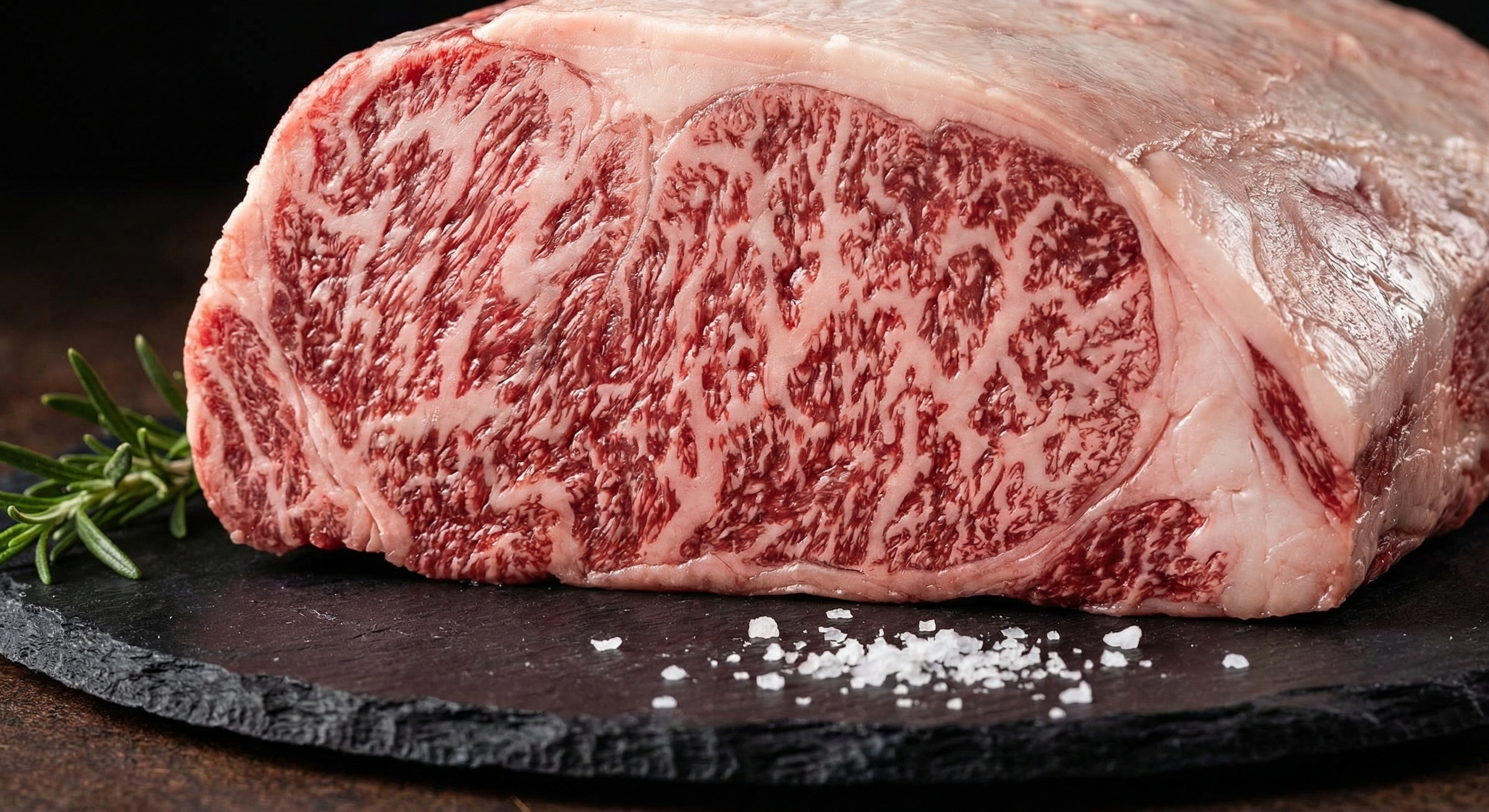
Wagyu beef represents the pinnacle of beef quality worldwide, prized for its extraordinary marbling, buttery texture, and rich umami flavor. But "wagyu" encompasses far more than a single type of beef — it includes distinct breeds, grading systems, geographical origins, and production methods that dramatically affect quality and price.
This guide breaks down everything you need to know about wagyu beef, from Japanese A5 to American crossbreeds.
## What Is Wagyu Beef?
**Wagyu** (和牛) literally translates to "Japanese cow" (wa = Japanese, gyu = cow). The term refers to four specific Japanese cattle breeds:
1. **Japanese Black (黒毛和種 Kuroge Washu)** — 95% of all wagyu production
2. **Japanese Brown (赤毛和種 Akage Washu)** — leaner, raised primarily in Kumamoto
3. **Japanese Shorthorn (日本短角和種 Nihon Tankaku Washu)** — heritage breed, minimal marbling
4. **Japanese Polled (無角和種 Mukaku Washu)** — rare, found in Yamaguchi Prefecture
The overwhelming majority of premium wagyu beef comes from Japanese Black cattle, which possess exceptional genetic predisposition for intramuscular fat (marbling).
### Why Wagyu Beef Is Different
Wagyu cattle have unique genetic traits that allow them to deposit fat *within* the muscle tissue (intramuscular fat) rather than around it (intermuscular fat). This creates the signature marbling pattern — fine streaks of white fat running through deep red muscle.
This marbling contains high concentrations of:
- **Monounsaturated fatty acids** (healthier fat profile than conventional beef)
- **Oleic acid** (the same fat found in olive oil, contributing to wagyu's low melting point)
- **Omega-3 and omega-6 fatty acids**
The fat melts at around 77°F (25°C), lower than human body temperature, which is why wagyu literally melts in your mouth.
## Japanese Wagyu vs American Wagyu
The term "wagyu" appears on beef from multiple countries, but quality and genetics vary significantly.
### Japanese Wagyu
**Japanese wagyu** refers to beef from purebred wagyu cattle raised in Japan. These cattle are:
- 100% fullblood wagyu genetics
- Raised for 28-32 months (vs 18-24 months for conventional beef)
- Fed specialized high-energy diets rich in grains and roughage
- Graded under Japan's strict beef grading system
Japanese wagyu is subdivided by **prefecture** (region), with each area producing distinct flavor profiles:
- **Kobe beef** (Hyogo Prefecture) — the most famous, sweet and buttery
- **Matsusaka beef** (Mie Prefecture) — considered the most luxurious
- **Ohmi beef** (Shiga Prefecture) — Japan's oldest wagyu brand (400+ years)
- **Kagoshima wagyu** (Kagoshima Prefecture) — largest producer by volume
- **Miyazaki wagyu** (Miyazaki Prefecture) — won multiple national competitions
- **Hida beef** (Gifu Prefecture) — known for high marbling and clean finish
Each prefecture maintains strict standards for breeding, feeding, and grading.
### American Wagyu
**American wagyu** (also called "Kobe-style beef" in the U.S.) is typically:
- **Crossbred** — F1 (50% wagyu genetics) or F2/F3 (75%+ wagyu genetics)
- Wagyu cattle crossed with Angus or other beef breeds
- Raised for 400-450 days on grain
- Graded under USDA standards (Prime, Choice, Select)
American wagyu delivers **more marbling than USDA Prime** but significantly less than Japanese A5 wagyu. It offers a middle ground:
- More beefy flavor (from Angus genetics)
- Moderate marbling (BMS 6-9 equivalent)
- Lower price point than Japanese imports
- Easier to cook for home chefs unfamiliar with high-marbling beef
Some American producers raise **fullblood wagyu** (100% wagyu genetics), but this represents a small fraction of U.S. wagyu production.
### Australian Wagyu
**Australian wagyu** falls between American and Japanese in quality:
- Mix of fullblood and crossbred cattle
- Graded using the AUS-MEAT marbling score (MB 1-12)
- MB 8-9+ is considered equivalent to Japanese A4-A5
- Often more affordable than Japanese imports due to scale
Australia is now the largest exporter of wagyu beef outside Japan.
## Wagyu Grading Systems
Understanding wagyu grades is essential to making informed purchases. Different countries use different systems.
### Japanese Grading System
Japanese wagyu is graded on **two factors**:
#### 1. Yield Grade (A, B, C)
Measures the percentage of usable meat from the carcass:
- **A** = 72%+ yield (most common)
- **B** = 69-72% yield
- **C** = below 69% yield
Yield grade has no bearing on quality or marbling — it's a butchering efficiency metric.
#### 2. Quality Grade (1-5)
Based on four factors:
- **Marbling (BMS score 1-12)** — most important
- **Meat color and brightness (1-7)**
- **Fat color and luster (1-7)**
- **Firmness and texture (1-5)**
Quality grades:
- **Grade 5** — BMS 8-12 (highest marbling)
- **Grade 4** — BMS 6-7
- **Grade 3** — BMS 4-5
- **Grade 2** — BMS 2-3
- **Grade 1** — BMS 1 (minimal marbling)
**A5** = highest yield + highest quality. Only about 10-15% of Japanese wagyu achieves A5.
### BMS (Beef Marbling Standard)
The **BMS score** (1-12) measures intramuscular fat percentage:
- **BMS 1-3** — minimal marbling
- **BMS 4-5** — moderate marbling (equivalent to USDA Prime)
- **BMS 6-7** — high marbling (A4 grade territory)
- **BMS 8-9** — exceptional marbling (A5 entry level)
- **BMS 10-12** — extreme marbling (top-tier A5)
For context:
- USDA Prime = roughly BMS 4-5
- American wagyu = BMS 6-9
- Japanese A5 wagyu = BMS 8-12
The difference between BMS 9 and BMS 12 is visually dramatic — BMS 12 beef can be 50%+ intramuscular fat.
### American Grading (USDA)
American wagyu is graded under the same USDA system as conventional beef:
- **Prime** — highest USDA grade (8%+ intramuscular fat)
- **Choice** — moderate marbling (4-8% intramuscular fat)
- **Select** — minimal marbling (<4%)
Most American wagyu falls into the **Prime+** or **Prime++** category (unofficial designations indicating marbling beyond standard Prime).
## How Much Does Wagyu Beef Cost?
Wagyu prices vary dramatically based on origin, grade, and cut.
### Japanese A5 Wagyu
- **Ribeye:** $150-$250 per pound
- **Striploin:** $120-$200 per pound
- **Tenderloin:** $180-$300 per pound
- **Specialty cuts (zabuton, Denver):** $100-$180 per pound
Premium prefectures (Kobe, Matsusaka, Ohmi) command 20-40% higher prices than standard A5.
### American Wagyu
- **Ribeye:** $40-$80 per pound
- **Striploin:** $35-$65 per pound
- **Ground wagyu:** $15-$25 per pound
Fullblood American wagyu costs 30-50% more than crossbred.
### Australian Wagyu
- **MB 8-9 ribeye:** $60-$100 per pound
- **MB 4-5 ribeye:** $30-$50 per pound
Australian wagyu offers a strong value proposition for high marbling at moderate prices.
## Where to Buy Authentic Wagyu Beef
### Online Retailers (Verified Authentic)
- **[The Meatery](https://themeatery.com/)** — Japanese A5 wagyu, American fullblood wagyu
- **Crowd Cow** — wide selection, transparent sourcing
- **Holy Grail Steak Co.** — Japanese A5 specialists
- **Snake River Farms** — American wagyu pioneer (SRF Gold Grade)
### What to Look For
✅ **Certificate of Authenticity** (for Japanese wagyu) — includes farm, prefecture, BMS score
✅ **Transparent grading** — BMS score or USDA grade clearly stated
✅ **Photos of actual product** — not stock images
✅ **Traceable origin** — prefecture or farm name
🚩 **Red flags:**
- "Kobe-style" without Japanese origin certificate (it's not real Kobe)
- No BMS score listed for A5 claims
- Suspiciously low prices ($50/lb for "A5" is impossible)
- Vague origin ("imported wagyu" without specifics)
## How to Cook Wagyu Beef
High-marbling wagyu requires different cooking techniques than conventional beef.
### General Rules
1. **Don't overcook** — medium-rare (130-135°F) maximum
2. **Use minimal seasoning** — salt only, or salt + pepper
3. **Cook hot and fast** — sear at high heat, short cook times
4. **Let it rest** — 5-10 minutes after cooking
### Best Methods by Grade
**Japanese A5 wagyu (BMS 9-12):**
- **Thin slices (1/4-inch)** seared 30-45 seconds per side
- **Yakiniku** (Japanese BBQ) — grill over charcoal, bite-sized pieces
- **Shabu-shabu** — swish thin slices in hot broth for 10-15 seconds
Thick steaks of BMS 12 can be overwhelming due to richness — portion sizes of 2-3 oz are typical in Japan.
**American wagyu (BMS 6-9):**
- **Reverse sear** — low oven (250°F) to 115°F internal, then sear
- **Cast iron** — 2 minutes per side for 1-inch steaks
- **Grill** — high heat, 3-4 minutes per side
American wagyu tolerates traditional steak cooking methods better than Japanese A5.
## Is Wagyu Beef Healthy?
Compared to conventional beef, wagyu contains:
- **Higher monounsaturated fat** (MUFA) — the "good" fat
- **More oleic acid** — linked to reduced LDL cholesterol
- **Higher omega-3 to omega-6 ratio**
However, wagyu is still calorie-dense due to high fat content:
- 3 oz A5 wagyu = ~500 calories (vs ~200 calories for lean beef)
Wagyu is best enjoyed in moderation as a premium indulgence rather than a daily protein source.
## Wagyu Beef FAQ
### Is all wagyu from Japan?
No. Wagyu cattle have been exported and crossbred in the U.S., Australia, and other countries. Only beef from purebred wagyu raised in Japan is "Japanese wagyu."
### What's the difference between A4 and A5 wagyu?
A5 has higher marbling (BMS 8-12) vs A4 (BMS 6-7). Both are exceptional quality, but A5 represents the absolute top tier.
### Can you get real Kobe beef in the U.S.?
Yes, but it's rare and expensive. Kobe beef must be from Tajima-gyu cattle raised in Hyogo Prefecture and meet strict marbling/quality standards. Authentic Kobe beef comes with a certificate.
### Why is wagyu so expensive?
Multiple factors: 28-32 month raising period (vs 18 months for conventional beef), specialized high-grain diets, limited supply, import costs, and strict quality controls.
### What does wagyu taste like?
Wagyu has a buttery, rich, umami-forward flavor with a tender, almost custard-like texture. The fat melts quickly on the tongue, delivering a luxurious mouthfeel distinct from conventional beef.
## Final Thoughts
Wagyu beef spans a wide quality spectrum — from American crossbred wagyu burgers to Japanese A5 BMS 12 masterpieces. Understanding the grading systems, origins, and quality indicators allows you to make informed purchases and set appropriate expectations.
For first-time buyers, American wagyu or Australian MB 6-8 offers an accessible entry point. For special occasions, Japanese A5 from verified sources delivers an unmatched experience.
The key is knowing what you're buying and cooking it appropriately for the marbling level.
---
*Kenji Matsuda is a third-generation Japanese wagyu specialist and certified beef grader. He has evaluated over 10,000 wagyu carcasses and works directly with prefecture breeding associations in Japan.*
Frequently Asked Questions
What is wagyu beef?
Wagyu beef is beef from four specific Japanese cattle breeds (Japanese Black, Japanese Brown, Japanese Shorthorn, Japanese Polled) known for exceptional marbling due to unique genetic traits that allow intramuscular fat deposition.
What is the difference between Japanese wagyu and American wagyu?
Japanese wagyu is 100% purebred wagyu raised in Japan and graded under the Japanese system (A5, BMS scores). American wagyu is typically crossbred (50-75% wagyu genetics mixed with Angus) and graded under USDA standards. Japanese wagyu has significantly higher marbling.
What does A5 mean for wagyu?
A5 is the highest grade in Japan's beef grading system. "A" indicates top yield grade (72%+ usable meat), and "5" is the highest quality grade based on marbling (BMS 8-12), color, texture, and fat quality. Only 10-15% of Japanese wagyu achieves A5.
How much does wagyu beef cost?
Japanese A5 wagyu costs $120-$300 per pound depending on cut and prefecture. American wagyu costs $35-$80 per pound. Australian wagyu (MB 8-9) costs $60-$100 per pound. Prices vary by grade, origin, and retailer.
Where can I buy authentic wagyu beef?
Buy from verified retailers like The Meatery, Crowd Cow, Holy Grail Steak Co., or Snake River Farms. Look for Certificate of Authenticity (for Japanese wagyu), transparent BMS scores, traceable origin (prefecture/farm), and actual product photos.
How do you cook wagyu beef?
Cook wagyu hot and fast to medium-rare maximum (130-135°F). For Japanese A5, use thin slices (1/4-inch) seared 30-45 seconds per side. For American wagyu, reverse sear or use cast iron/grill like premium steaks. Use minimal seasoning (salt only).
Is wagyu beef healthy?
Wagyu contains higher monounsaturated fats and oleic acid compared to conventional beef, which may offer cardiovascular benefits. However, it is calorie-dense (3 oz A5 = ~500 calories) due to high fat content. Best enjoyed in moderation.
What is BMS score in wagyu?
BMS (Beef Marbling Standard) is a 1-12 scale measuring intramuscular fat percentage. BMS 1-3 is minimal marbling, BMS 4-5 is equivalent to USDA Prime, BMS 6-7 is A4 territory, and BMS 8-12 is A5 grade. Higher BMS = more marbling.
More Expert Guides
16 min readA5 Wagyu: Complete Buying Guide (2026)
A5 Wagyu is the pinnacle of Japanese beef — but what does that actually mean? This complete guide covers grading, pricing, where to buy, and how to cook the world's most luxurious beef.
12 min readA5 Wagyu: The Ultimate Guide to Japan's Highest Grade
A5 wagyu represents the absolute pinnacle of beef grading in Japan. Less than 10% of Japanese wagyu earns this designation. Here's everything you need to know about A5 grading, BMS scores, prefecture differences, and how to buy authentic A5 beef.
13 min readFullblood Wagyu vs Crossbred: What Actually Changes When You Mix the Genetics
The label says "wagyu" but the genetics tell a completely different story. Fullblood, purebred, F1, F2, crossbred — each generation changes the marbling, flavor, and price. Here is what actually happens when you mix wagyu genetics with other breeds.