Omi Beef vs Kobe Beef: Japan's Oldest vs Most Famous Wagyu
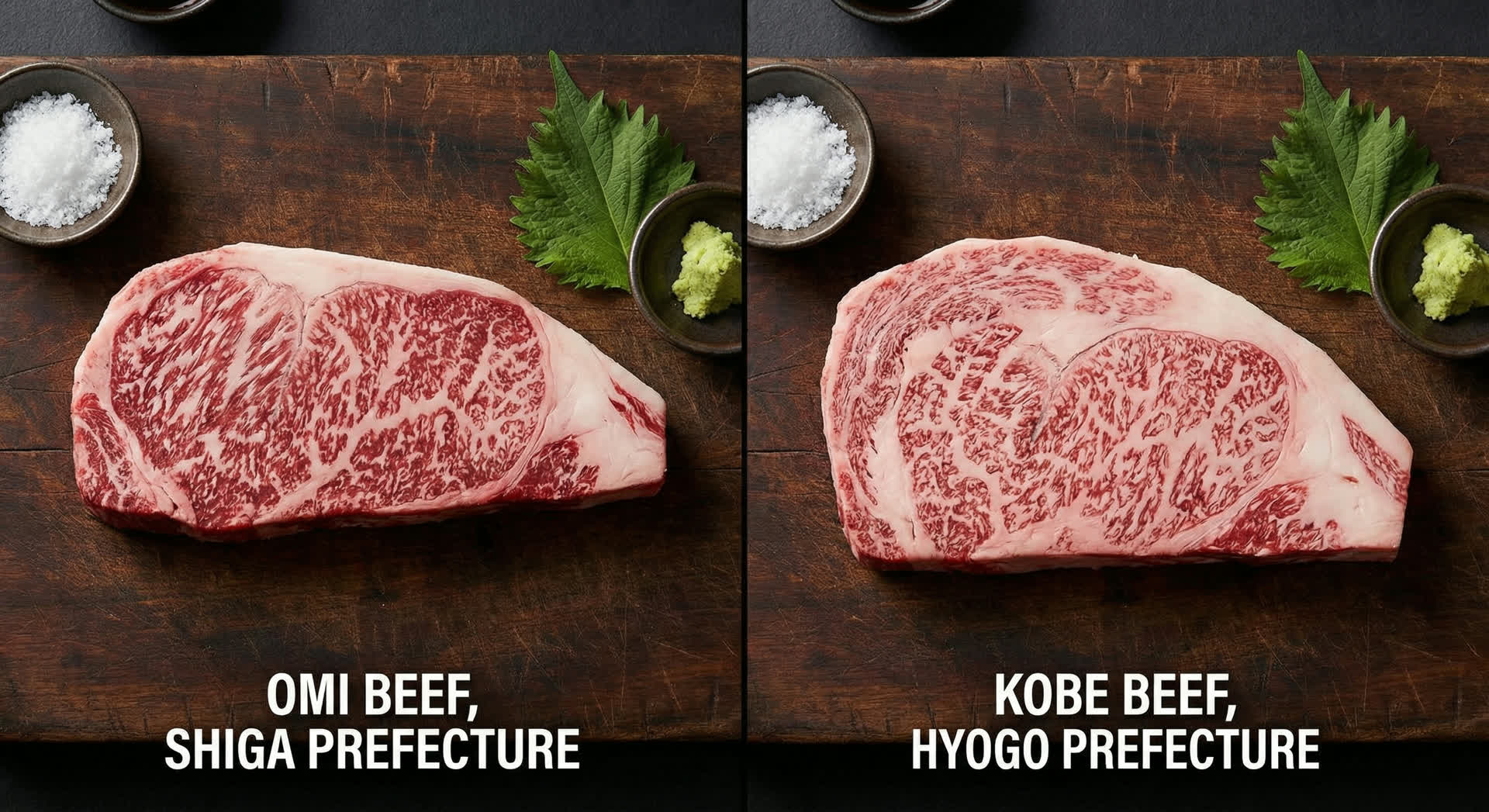
Omi Beef vs Kobe Beef: Japan's Oldest vs Most Famous Wagyu
When most people think of Japanese wagyu, one name dominates: Kobe. It's become synonymous with luxury beef worldwide, appearing on high-end menus from New York to Dubai. But within Japan itself, connoisseurs know a different story. They know that before Kobe beef became a global brand, before Matsusaka and Yonezawa gained recognition, there was Omi beef—Japan's oldest documented wagyu production region with over 400 years of continuous history.
I've spent fifteen years studying Japanese beef culture, traveling to production regions, interviewing farmers, and tasting every major wagyu brand available. The Omi versus Kobe question is one I encounter constantly from serious beef enthusiasts who've moved beyond the hype and want to understand the nuanced differences between these two legendary products.
Let me show you how these two wagyu titans actually compare—in history, production, flavor profile, availability, and value. By the end, you'll understand not just which is "better," but which is right for your palate and budget.
The History: 400 Years vs. Global Fame
Omi Beef: Japan's Oldest Wagyu Brand
Omi beef (近江牛, Ōmi-gyū) originates from Shiga Prefecture, which surrounds Lake Biwa, Japan's largest freshwater lake, located in the Kansai region northeast of Kyoto. The history is extraordinary and well-documented.
The story begins in the early Edo period, around 1590, when the feudal lord Ii Naomasa received cattle from the Omi region as tribute. These weren't dairy or draft animals—they were specifically bred and raised for their meat quality. This is remarkable because Japan's Buddhist traditions historically discouraged meat consumption, making Omi beef production a rare and privileged exception.
By the 1600s, Omi beef was being presented to the Tokugawa shogunate as a premium delicacy, and by the 1800s, it had established a reputation as the finest beef in Japan. When Emperor Meiji lifted the official ban on meat consumption in 1872 (marking Japan's modernization period), Omi beef was already a mature, sophisticated product with centuries of selective breeding behind it.
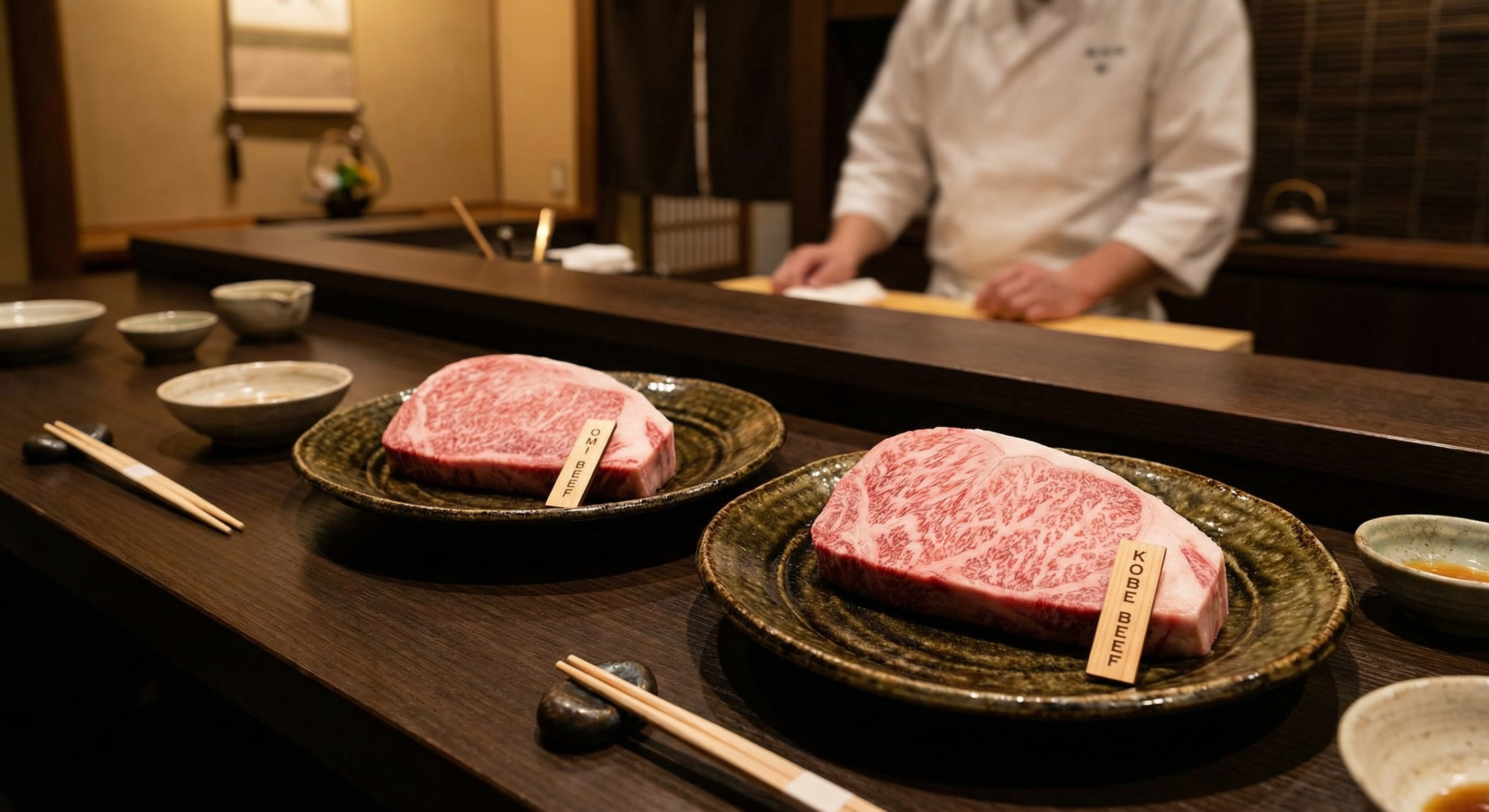
Today, Omi beef is one of Japan's "Big Three" wagyu brands (along with Kobe and Matsusaka), and it proudly claims the title of Japan's oldest beef brand—a designation that's not just marketing but historically verifiable.
Kobe Beef: The Global Icon
Kobe beef (神戸ビーフ, Kōbe bīfu) comes from Tajima cattle raised in Hyogo Prefecture, with Kobe being the prefectural capital and the brand's namesake city. While the Tajima cattle bloodline is ancient, "Kobe beef" as a branded product is considerably younger than Omi beef—emerging in the late 19th century as Japan opened to Western trade.
The key moment came in 1868 when the port of Kobe opened to foreign trade. Western merchants and diplomats encountered Tajima beef, were astonished by its quality and marbling (nothing like this existed in the West), and began exporting it. The name "Kobe beef" stuck because it was the port city where foreigners first discovered it.
By the early 20th century, Kobe beef had become legendary among international travelers. By the late 20th century, it had achieved global luxury brand status. Today, it's the most recognized wagyu brand worldwide, even though most people who claim to have eaten it actually haven't (more on that shortly).
So we have an interesting contrast: Omi beef is the historical elder with domestic prestige but limited international recognition. Kobe beef is the younger brand (relatively speaking) that became a global phenomenon.
Production Standards and Criteria
Both Omi and Kobe beef have strict certification standards. Understanding these helps explain the quality and rarity of each.
Omi Beef Standards
To be certified as authentic Omi beef, cattle must meet these requirements:
- Breed: Japanese Black cattle (Kuroge Washu), the primary wagyu breed
- Region: Born, raised, and processed within Shiga Prefecture
- Raising period: Must be raised for the longest period in Shiga (at least 12 months, typically 28-32 months total)
- Quality grade: Must achieve A4 or A5 grade (highest two grades on Japan's beef grading scale)
- Marbling score: Typically BMS 6+ (on a scale of 1-12, with 12 being highest marbling)
- Traceability: Complete documentation from birth through processing
Annual production is approximately 6,000 head, making Omi beef significantly rarer than commodity beef but more available than Kobe.
Kobe Beef Standards
Kobe beef has even stricter criteria, which contributes to its rarity and prestige:
- Breed: Tajima cattle specifically—a particular strain of Japanese Black cattle from Hyogo Prefecture
- Region: Born, raised, and processed in Hyogo Prefecture
- Marbling score: Minimum BMS 6, with most achieving BMS 8-12
- Quality grade: Must achieve A4 or A5 grade
- Weight restrictions: Carcass weight between 270-470 kg for heifers/steers
- Yield score: Gross meat yield must be high
- Fine texture: Meat must have very fine texture and firmness
- Traceability: Complete tracking via individual cattle ID number
Annual production is approximately 3,000-4,000 head—roughly half that of Omi beef. Only about 10-15% of Tajima cattle ultimately qualify for the Kobe beef designation. The rest may be sold as "Tajima beef" or simply "wagyu," but cannot use the Kobe brand.
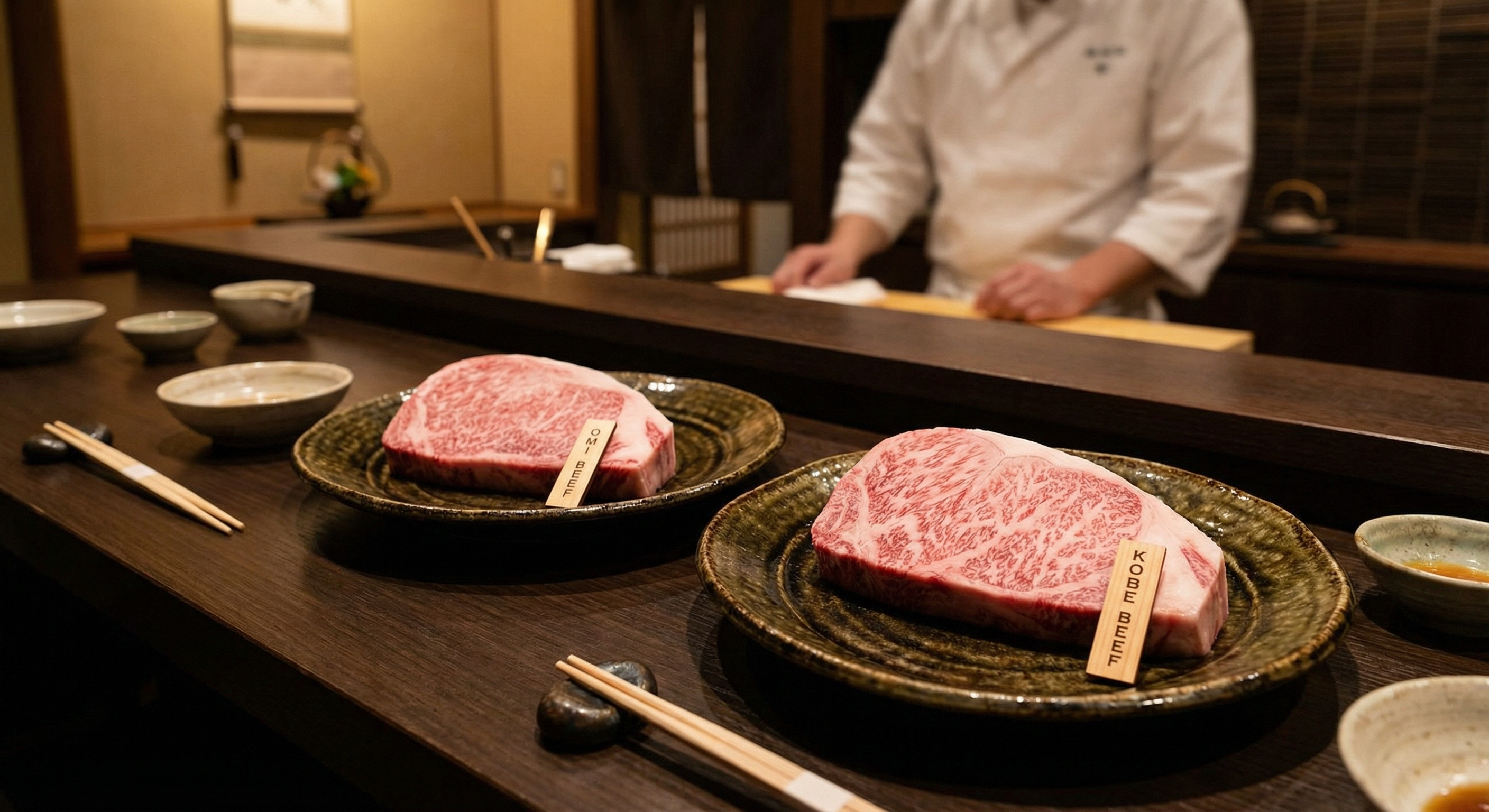
Why the Standards Matter
These strict criteria mean both Omi and Kobe represent the absolute pinnacle of Japanese beef production. Neither is "commodity wagyu" that you might find in a wholesale club. Both command premium prices because both deliver extraordinary quality.
The key difference: Kobe's standards are slightly more restrictive (particularly regarding the specific Tajima cattle strain and the higher minimum marbling), which translates to marginally higher prices and rarity.
Taste Profile and Texture Differences
This is where things get interesting—and subjective. Both are exceptional, but they're not identical.
Omi Beef Characteristics
Omi beef is known for:
Marbling: Extremely fine, even marbling throughout the meat. The intramuscular fat is distributed in delicate, lace-like patterns. While high-grade Omi beef (BMS 8-10) has spectacular marbling, it tends toward slightly less intensity than the absolute highest-grade Kobe.
Fat quality: Omi beef fat has a relatively low melting point (around 77-86°F / 25-30°C), which means it literally melts on your tongue at body temperature. The fat is sweet, clean-tasting, and never greasy or cloying.
Flavor profile: Rich but balanced, with pronounced umami depth and a slightly sweet finish. The flavor is complex—you taste the beef itself, not just the fat. Many describe Omi beef as having a cleaner, more "refined" flavor compared to the pure opulence of Kobe.
Texture: Exceptionally tender with a silky, almost buttery texture. The fine marbling creates a melt-in-your-mouth experience that doesn't require extended chewing. Some connoisseurs describe Omi beef as having a slightly firmer "tooth" than Kobe, providing more textural satisfaction.
Aftertaste: Long, pleasant, with the fat flavor lingering without heaviness. You're satisfied but not overwhelmed.
Kobe Beef Characteristics
Kobe beef is characterized by:
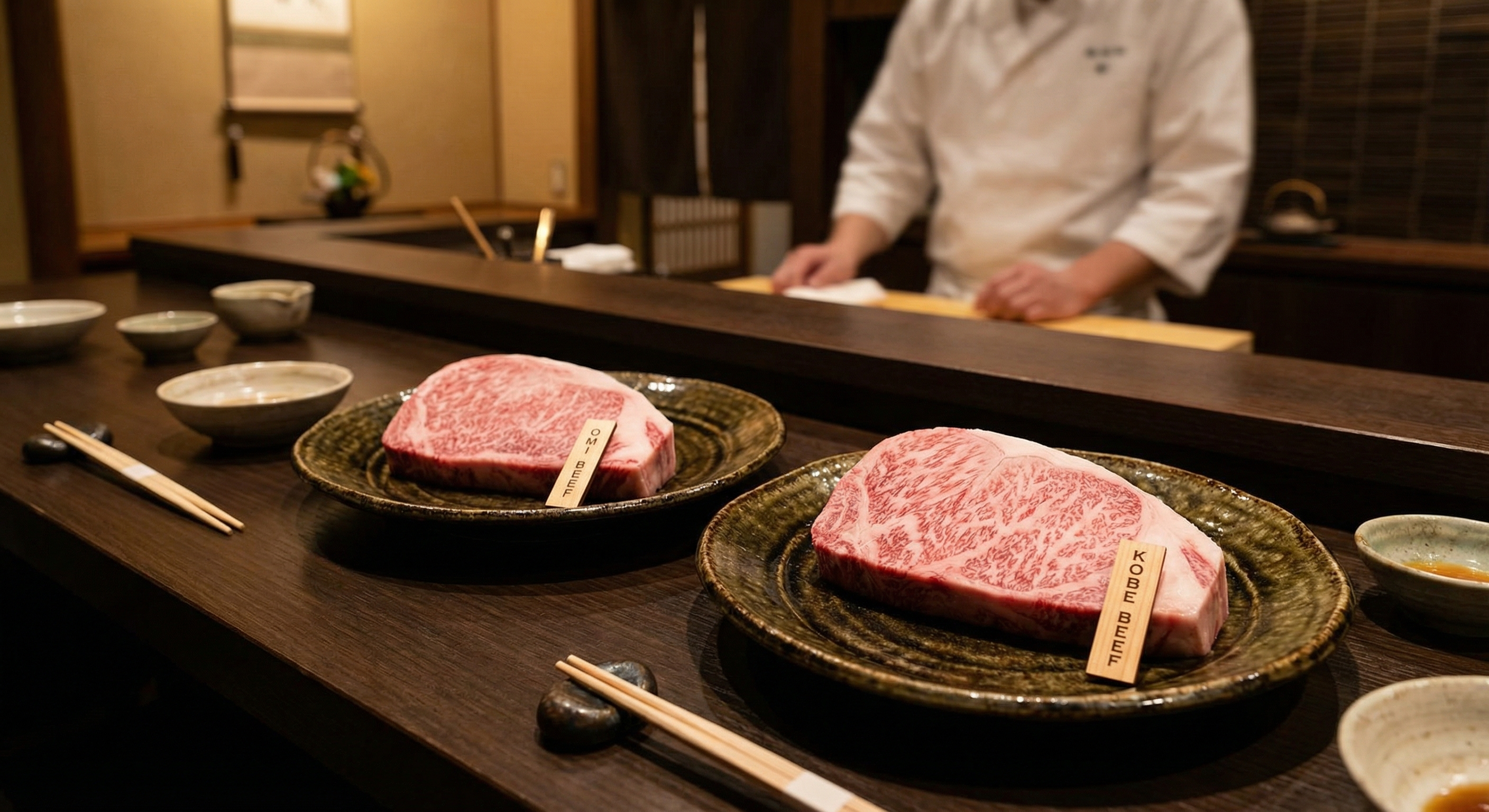
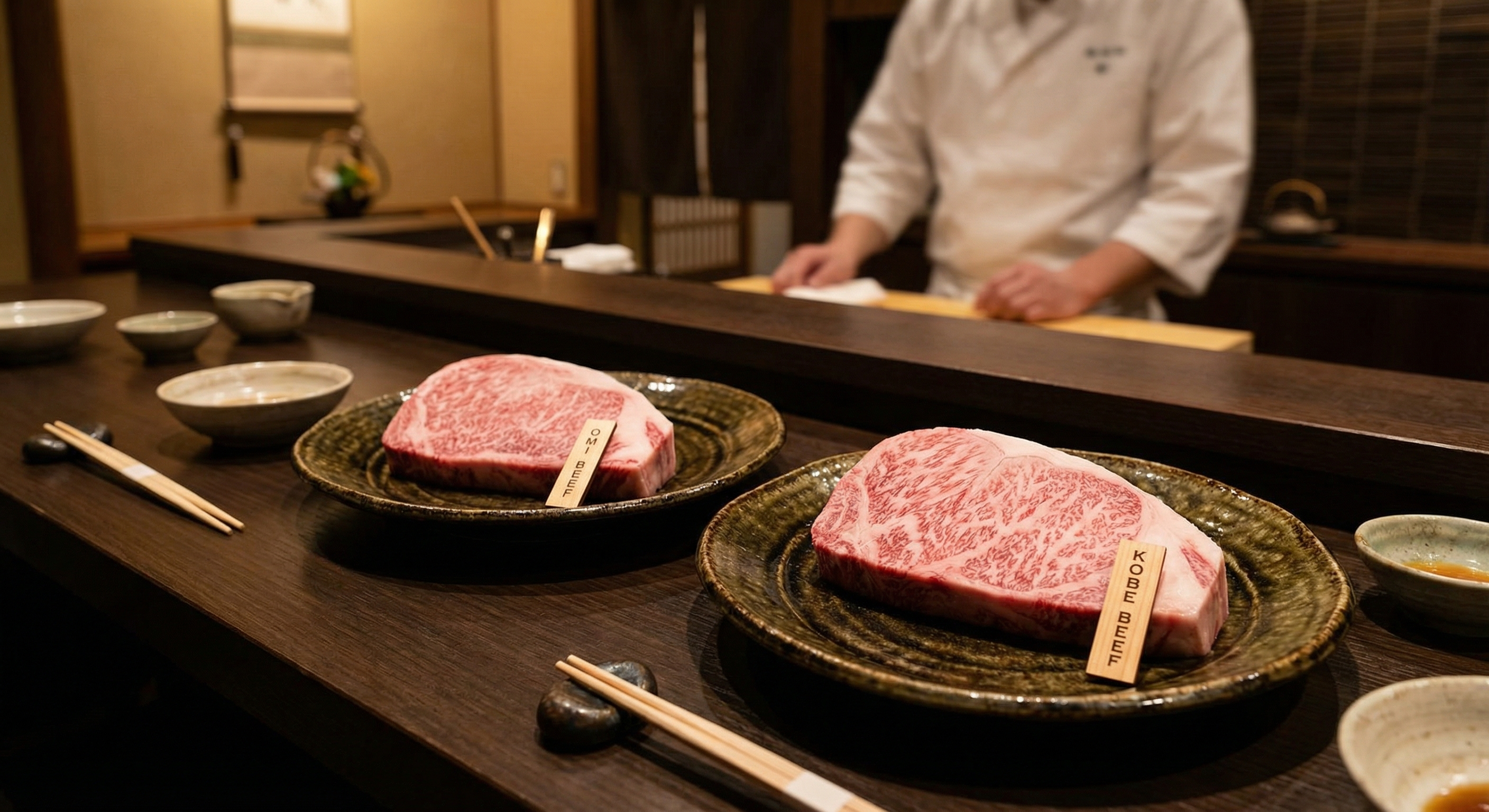
Marbling: Legendary, intense marbling that often reaches BMS 10-12 in top specimens. The characteristic "shimofuri" (frost-like) marbling pattern is so fine and dense that the meat often appears almost pink-white rather than red. This is what people mean when they say Kobe beef "doesn't look like meat."
Fat quality: Extremely low melting point (often 77°F / 25°C or below), creating the famous "melts in your mouth" sensation. The fat is remarkably sweet with subtle nutty notes. Some detect faint sake-like aromatics, attributed to the Tajima cattle's specific genetics and diet.
Flavor profile: Intensely rich, almost decadent. The flavor is buttery, sweet, and deeply savory simultaneously. Kobe beef prioritizes fat flavor—it's luxurious and opulent in a way that can be almost overwhelming if you're not prepared for the richness.
Texture: Supremely tender, to the point where it requires almost no chewing. The texture is soft, yielding, and dissolves easily. For some, this is perfection. For others, it lacks the textural resistance they expect from "steak."
Aftertaste: Long-lasting richness. The fat coats your palate. It's satisfying but can feel heavy, especially in portions larger than 4-6 ounces.
Side-by-Side Comparison
| Characteristic | Omi Beef | Kobe Beef |
|---|---|---|
| Marbling Intensity | High (BMS 6-10) | Very High (BMS 8-12) |
| Fat Melting Point | 77-86°F (25-30°C) | 77°F (25°C) or lower |
| Flavor Balance | Balanced (beef + fat) | Fat-forward |
| Texture | Silky with slight firmness | Extremely soft, yielding |
| Richness Level | Rich but refined | Intensely decadent |
| Ideal Portion Size | 4-8 oz | 3-6 oz |
Which Tastes "Better"?
This is entirely personal preference. If you want the absolute pinnacle of marbling intensity and melt-in-your-mouth fat experience, Kobe wins. If you prefer a more balanced flavor where you still taste the beef alongside the luxurious fat, and you appreciate a touch more textural firmness, Omi may appeal more.
Think of it this way: Kobe beef is like a 100-year-old balsamic vinegar—intensely concentrated, precious, and best appreciated in small quantities. Omi beef is like a perfectly aged Barolo—complex, refined, and you can enjoy a bit more of it without feeling overwhelmed.
Availability and Where to Buy
In Japan
Omi Beef: Readily available throughout Shiga Prefecture and in high-end restaurants and department store meat counters in Kyoto, Osaka, and Tokyo. You can visit specialized Omi beef restaurants in Shiga (particularly in Omi-Hachiman city) where it's the local specialty. Prices in Japan range from ¥5,000-15,000 per 100g ($300-900 per pound equivalent) depending on grade and cut.
Kobe Beef: Available in upscale restaurants throughout Japan, with particularly strong representation in Kobe, Osaka, Tokyo, and major cities. You can also purchase it at department store food halls (depachika) or specialty butchers. Prices range from ¥8,000-25,000 per 100g ($480-1,500 per pound equivalent) depending on grade and cut.
Outside Japan
Omi Beef: Extremely rare internationally. Very limited export occurs, primarily to high-end restaurants in Hong Kong, Singapore, and occasionally the United States. As of 2026, only a handful of US importers carry authentic Omi beef, and it's almost exclusively restaurant-allocated rather than retail. If you see "Omi beef" on a menu outside Japan, verify the certificate of authenticity.
Kobe Beef: Still rare but more available than Omi. Japan began allowing limited Kobe beef exports to the US in 2012, and the program has slowly expanded. As of 2026, a small number of certified importers and high-end butchers carry authentic Kobe beef in the US. Expect to pay $150-400 per pound retail, with restaurant prices reaching $50-100+ per ounce.
Important: The vast majority of "Kobe beef" sold outside Japan is not authentic Kobe beef. Before 2012, zero authentic Kobe beef was available in the US—yet it appeared on thousands of menus. This was either mislabeled American wagyu or outright fraud. Even today, verify certification if paying Kobe prices.
Verification and Authentication
Both Omi and Kobe beef come with certificates of authenticity that include:
- Individual cattle identification number (10-digit for Japanese cattle)
- Birth date and location
- Raising history (farm locations and duration)
- Processing date and location
- Marbling score and quality grade
- Official seal from the respective producers' association
Legitimate restaurants and retailers will provide these certificates upon request. If they can't or won't, you're not getting authentic product.
Pricing: What to Expect
Retail Pricing (2026)
In Japan:
- Omi beef: ¥5,000-15,000 per 100g ($33-100 per 100g, ~$300-900/lb) depending on grade and cut
- Kobe beef: ¥8,000-25,000 per 100g ($53-167 per 100g, ~$480-1,500/lb) depending on grade and cut
In the United States (when available):
- Omi beef: $200-350 per pound (rare, mostly restaurant allocation)
- Kobe beef: $150-400 per pound for ribeye, strip, tenderloin; specialty cuts can exceed $500/lb
Restaurant Pricing
In Japan:
- Omi beef tasting course (80-120g total): ¥8,000-20,000 ($55-135)
- Kobe beef tasting course (80-120g total): ¥12,000-30,000 ($80-200)
- Full yakiniku (grilled meat) courses featuring either brand: ¥15,000-50,000+ ($100-335+)
In the United States:
- Authentic Kobe beef: $50-100+ per ounce in high-end steakhouses
- A 6-ounce Kobe beef service can easily run $400-600 per person with sides and wine
- Omi beef: Extremely rare; when available, expect similar or slightly lower pricing than Kobe
Value Consideration
Neither Omi nor Kobe beef represents "value" in the traditional sense—both are ultra-premium luxury products. However, within the luxury wagyu category:
Omi beef often offers slightly better value because you're getting comparable quality (some argue superior) at 10-30% lower prices than Kobe in most markets. The primary reason Kobe costs more is brand recognition and demand, not necessarily superior product.
If you're in Japan and have the opportunity to compare, trying Omi beef can be revelatory—you may discover you prefer it to Kobe while spending less.
Cooking Recommendations
Both Omi and Kobe beef are delicate, highly marbled products that require different handling than American steaks.
Best Preparation Methods
Yakiniku (Japanese BBQ): Thinly sliced (3-5mm) and briefly grilled over high heat (10-20 seconds per side). This is the traditional way to enjoy both and allows the fat to render slightly while maintaining the tender texture. Serve with minimal seasoning—just sea salt or a light tare (sweet soy) sauce.
Shabu-shabu (hot pot): Paper-thin slices swished in simmering broth for seconds. The low cooking temperature preserves the delicate fat and creates a silky texture. Excellent for experiencing the pure flavor without any char or crust.
Sukiyaki: Thin slices simmered in sweet soy broth with vegetables. The richness of the beef balances the sweet-savory broth beautifully.
Steak (Western-style): Possible but requires careful technique. Cut steaks 1-1.5 inches thick, bring to room temperature, season simply with salt, and sear briefly in a very hot pan (1-2 minutes per side maximum). Aim for rare to medium-rare internal temperature (120-130°F). The high fat content means the meat cooks faster than American beef and can become greasy if overcooked.
What NOT to Do
- Don't cook past medium-rare: The fat renders out, leaving the meat dry and greasy simultaneously
- Don't use heavy sauces: You're masking $100+ per pound beef—let the flavor speak
- Don't serve large portions: 3-6 ounces per person is plenty due to richness
- Don't grill like a regular steak: The high fat content causes flare-ups; use gentle, controlled heat
- Don't overthink it: The beef is so good that simple salt and heat are all you need
Pairing Suggestions
Both Omi and Kobe beef benefit from supporting elements that cut richness:
- Wine: Bold reds with good tannin structure—Cabernet Sauvignon, Barolo, or aged Bordeaux. The tannins cut through fat beautifully.
- Sake: Junmai Daiginjo or aged Junmai with umami depth to complement the beef
- Sides: Simple grilled vegetables, steamed rice, pickled vegetables (tsukemono) for contrast. Avoid heavy, creamy sides.
- Condiments: Flaky sea salt, wasabi, grated daikon radish, ponzu sauce for brightness
Which Should You Buy?
Choose Omi Beef If:
- You appreciate historical significance and want to experience Japan's oldest wagyu brand
- You prefer balanced flavor where you taste both beef and fat, not just fat
- You like a touch more textural firmness in your wagyu
- You want exceptional quality at a slightly lower price than Kobe (10-30% less typically)
- You're visiting Shiga Prefecture and want to support the local specialty
- You can find a reliable source—it's worth seeking out
Choose Kobe Beef If:
- You want the most famous, globally recognized wagyu brand
- You prioritize maximum marbling intensity and the most luxurious mouthfeel
- You want to experience the absolute pinnacle of what Japanese wagyu represents
- You're celebrating a special occasion and want the "name brand" cachet
- You have access to authentic, certified Kobe and want to try the legend
- You prefer extremely soft, yielding texture over any textural resistance
Or Consider Both
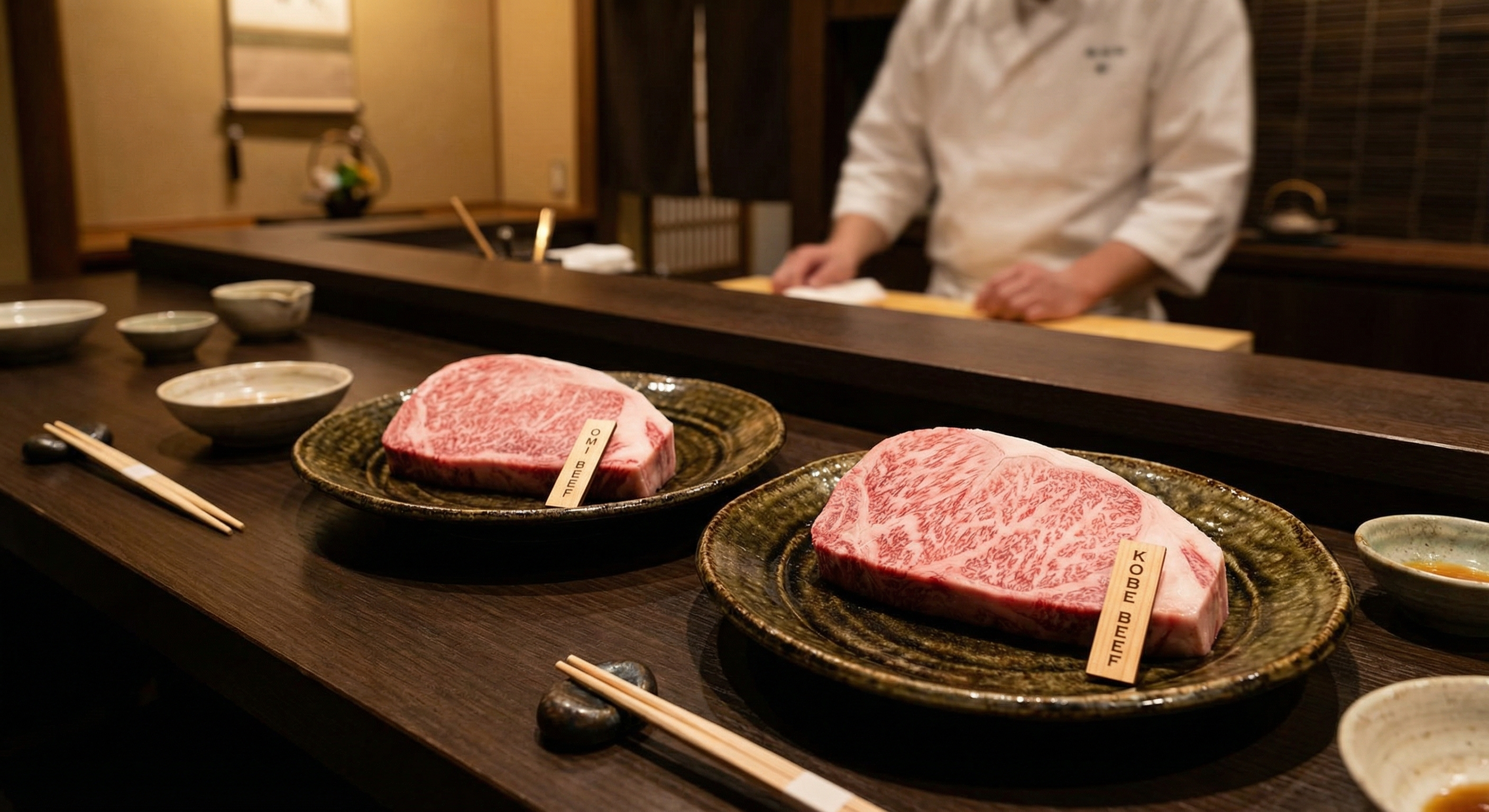
If you have the opportunity (and budget), trying both side-by-side is the ideal scenario. Many high-end wagyu specialists in Japan offer comparison tastings. This allows you to develop your own preference based on direct experience rather than reputation or price.
You may discover—as I have—that your preference depends on context. For yakiniku where I'm eating multiple cuts and lots of meat, I often prefer Omi's more balanced profile. For a special-occasion steak where I'm eating a small, precious portion, Kobe's extreme luxury has its place.
Frequently Asked Questions
Is Omi beef better than Kobe beef?
"Better" is subjective and depends on personal preference. Omi beef offers a more balanced flavor profile with slightly firmer texture and pronounced beef flavor alongside its luxurious fat. Kobe beef emphasizes extreme marbling and fat richness with supremely soft texture. Both meet the highest Japanese quality standards (A4/A5 grade). Omi has deeper historical roots (400+ years vs. ~150 years) and is often 10-30% less expensive, making it arguably better value. For pure marbling intensity, Kobe edges ahead. Try both if possible to determine your preference.
Why is Omi beef less famous than Kobe beef internationally?
Kobe's international fame stems from historical accident and marketing. When Japan opened to foreign trade in 1868, Kobe was a major port city where Western merchants first encountered Japanese wagyu. The name "Kobe" stuck and spread globally through word-of-mouth among international travelers. Omi beef, while older and equally prestigious within Japan, didn't have the same international exposure point. Additionally, Kobe beef has been more aggressively marketed internationally and had slightly higher export volumes. Fame doesn't equal superiority—Omi remains highly prestigious among Japanese beef connoisseurs.
Can I buy authentic Omi beef or Kobe beef in the United States?
Authentic Kobe beef has been available in limited quantities in the US since 2012 through certified importers. Only a small number of high-end butchers and restaurants carry it, and it's expensive ($150-400/lb retail). Omi beef is extremely rare in the US with minimal export allocation—it's almost exclusively available to high-end restaurants rather than retail consumers. Both require certificates of authenticity showing the individual cattle ID number, birth/raising location, and quality grade. Before 2012, zero authentic Kobe was available in the US, so be skeptical of historical claims.
How much does Omi beef cost compared to Kobe beef?
In Japan, Omi beef typically costs 10-30% less than Kobe beef. Omi ranges from ¥5,000-15,000 per 100g ($300-900/lb equivalent) while Kobe ranges from ¥8,000-25,000 per 100g ($480-1,500/lb equivalent) depending on grade and cut. Outside Japan (where both are rare), prices are more similar with authentic Kobe running $150-400/lb retail and Omi (when available) at $200-350/lb. Restaurant pricing shows similar patterns—Kobe commands premium pricing due to brand recognition even when quality is comparable.
What makes Omi beef unique if it's the oldest wagyu brand?
Omi beef's 400+ year history means centuries of selective breeding and refined raising techniques specific to Shiga Prefecture's environment near Lake Biwa. The region's climate, water quality, and traditional feeding methods (which evolved over centuries) create Omi beef's characteristic balanced flavor profile and fine marbling. Historical documentation shows Omi beef was presented to Japanese emperors and shoguns as tribute, establishing quality standards long before modern grading systems existed. This generational knowledge and terroir create subtly different characteristics than newer wagyu brands, even when final marbling scores are similar.
Conclusion: Two Legends, Different Paths
The Omi versus Kobe debate isn't about declaring a winner—it's about understanding two parallel expressions of Japanese beef excellence that took different paths to prominence.
Kobe beef became the global icon, the luxury brand recognized worldwide, the name that appears on bucket lists. Its intense marbling, supremely soft texture, and rich flavor profile represent the apotheosis of what wagyu can be. It earned its reputation honestly through exceptional quality, even if the fame sometimes overshadows equally deserving alternatives.
Omi beef is the historical foundation, the regional treasure, the connoisseur's choice that rewards those who look beyond marketing. Its 400-year heritage, balanced flavor, and refined character offer a different kind of luxury—one rooted in tradition and terroir rather than global branding.
If you can only try one, Kobe offers the experience that lives up to its legendary status. If you have the chance to explore both, you'll discover that Japan's beef culture is richer and more nuanced than any single brand—even one as famous as Kobe.
And if you find yourself in Shiga Prefecture at a traditional Omi beef restaurant, eating 400-year-old culinary heritage while tourists crowd Kobe steakhouses an hour away, you'll understand what connoisseurship really means. Sometimes the best experiences are the ones you have to seek out.
Now the only question is: which will you try first?
— Kenji Matsuda
Frequently Asked Questions
What is the main difference between Omi beef and Kobe beef?
The main differences are history, flavor profile, and marbling intensity. Omi beef is Japan's oldest wagyu brand (400+ years) from Shiga Prefecture, with balanced beef-and-fat flavor and slightly firmer texture. Kobe beef is from Hyogo Prefecture with more intense marbling (often BMS 10-12 vs. Omi's 6-10), supremely soft texture, and fat-forward flavor. Kobe is more famous internationally while Omi has deeper domestic prestige. Both achieve A4/A5 quality grades, but Kobe typically costs 10-30% more due to brand recognition.
Which is more expensive, Omi beef or Kobe beef?
Kobe beef is typically 10-30% more expensive than Omi beef. In Japan, Kobe ranges from ¥8,000-25,000 per 100g ($480-1,500/lb) while Omi ranges from ¥5,000-15,000 per 100g ($300-900/lb). In the US, authentic Kobe retails for $150-400/lb while Omi (extremely rare) runs $200-350/lb when available. The price difference reflects Kobe's global brand recognition rather than necessarily superior quality—many Japanese connoisseurs consider Omi equal or superior while costing less.
Is Omi beef really the oldest wagyu brand in Japan?
Yes, Omi beef is verifiably Japan's oldest documented wagyu brand with over 400 years of continuous production history. Records show cattle from the Omi region (Shiga Prefecture) were presented as tribute to feudal lords as early as 1590, and by the 1600s Omi beef was being gifted to the Tokugawa shogunate. By the 1800s, it was established as Japan's finest beef—all before the Meiji Restoration lifted the official ban on meat consumption in 1872. This centuries-long heritage gives Omi beef unique historical prestige within Japan.
Can you buy authentic Omi beef outside of Japan?
Authentic Omi beef is extremely rare outside Japan with very limited export. Small quantities go to high-end restaurants in Hong Kong, Singapore, and occasionally the United States, but it's almost never available at retail—mostly restaurant allocation only. In the US, only a handful of certified importers carry it as of 2026. If you see "Omi beef" on a menu outside Japan, request the certificate of authenticity with the individual cattle ID number, birth location (must be Shiga Prefecture), and quality grade (should be A4 or A5).
Which tastes better, Omi beef or Kobe beef?
Taste preference is entirely personal. Kobe beef offers more intense marbling (BMS 8-12), extremely soft texture, and rich, fat-forward flavor that can be almost overwhelming in large portions. Omi beef provides more balanced flavor where you taste both beef and fat, with a touch more textural firmness that some prefer. If you like pure luxury and maximum marbling, Kobe wins. If you prefer refined balance and want to taste the actual beef alongside its fat, Omi may appeal more. Both are exceptional A4/A5 grade wagyu—try both if possible to develop your own preference.
More Expert Guides
What Is Wagyu Beef? The Complete Guide to Grades, Origins & Quality
Discover wagyu beef origins, the difference between Japanese A5 and American wagyu, how BMS grading works, why marbling matters, proper cooking techniques, and what you should pay in 2026.
12 min readA5 Wagyu: Your Complete Buying & Authentication Guide (2026)
A5 wagyu represents the pinnacle of beef quality, but not all A5 is created equal. Learn how to authenticate real Japanese A5, decode BMS scores, find fair prices, and cook it perfectly at home.
14 min readA5 Wagyu Prefectures: Regional Guide to Japan's Best Beef
Discover the regional differences in Japanese A5 wagyu across 12 key prefectures. Learn which prefecture produces the flavor profile you'll love most.