Halal Wagyu Beef: Everything You Need to Know Before You Buy
Halal Wagyu Beef: Everything You Need to Know Before You Buy
Wagyu beef has earned a global reputation for its extraordinary marbling, buttery texture, and depth of flavor. For Muslim consumers who observe halal dietary laws, the question is straightforward: can you enjoy this level of quality while staying true to your faith? The answer is yes — and the halal wagyu market is growing faster than most people realize.
This guide explains what makes wagyu halal, how to verify certifications, which producers and farms to trust, and which cuts deliver the best experience.
What Makes Beef Halal?
Halal, meaning "permissible" in Arabic, refers to food prepared according to Islamic law. For beef, the requirements center on slaughter:
- The animal must be alive and healthy at the time of slaughter
- A Muslim slaughterman (or qualified Person of the Book) performs the act
- Bismillah (the name of God) is invoked before slaughter
- A swift, deep cut severs the jugular veins, carotid arteries, and windpipe in a single motion
- The blood must drain completely from the carcass before processing
These rules apply regardless of the breed. A wagyu steer raised on the finest Japanese genetics follows the same halal slaughter protocol as any other bovine. The breed determines quality; the slaughter method determines halal status.
Why Halal Wagyu Is Growing in Demand
Several factors are driving growth in the halal wagyu segment:
- Rising Muslim middle class globally — an estimated 1.8 billion Muslims worldwide, with growing purchasing power in Southeast Asia, the Middle East, and Western diaspora communities
- Premium dining culture in the Gulf states — Dubai, Riyadh, and Doha are home to some of the world's most ambitious steakhouses, many of which serve exclusively halal meat
- Western Muslim consumers seeking high-quality cuts that meet their dietary requirements without compromise
- Restaurant demand — halal-certified fine dining is expanding rapidly in London, New York, Sydney, and Toronto
The global halal food market is projected to exceed $2.5 trillion by 2028. Within that, premium beef — especially wagyu — commands a growing share as consumers trade up from commodity halal beef to heritage and specialty breeds.
Halal Wagyu Producers Worth Knowing
Australia
Australia is the largest producer of halal wagyu beef outside Japan. Several factors make it a natural fit:
- Established wagyu genetics — Australian breeders have been crossing wagyu bloodlines since the 1990s, with herds now reaching F4 and fullblood status
- Strong halal infrastructure — Australia exports more halal-certified meat than any other country, with government-audited certification bodies
- Key producers: Jack's Creek, Blackmore Wagyu, Mayura Station, and Rangers Valley all offer halal-certified lines
Australian halal wagyu typically scores BMS 6–9+, placing it firmly in the premium tier. Most Australian halal wagyu is grain-fed for 300–600 days, producing consistent marbling and a clean, beefy flavor.
Japan
Traditional Japanese wagyu (Kobe, Matsusaka, Omi, and other regional brands) is not routinely halal-slaughtered. However, a small number of Japanese producers have begun offering halal-certified wagyu to serve export markets in Malaysia, Indonesia, and the UAE.
These programs are limited in scale and typically require advance ordering. If you see "halal Japanese A5 wagyu" at retail, verify the certification carefully — the supply is genuinely small.
United States
American wagyu producers are increasingly pursuing halal certification to reach domestic Muslim consumers and export markets. The American halal wagyu market includes both dedicated halal ranches and conventional producers who run certified halal processing lines.
American halal wagyu tends to be crossbred (wagyu × Angus), which means marbling scores are generally lower than fullblood Australian or Japanese wagyu but still significantly higher than conventional beef.
Understanding Halal Certification for Wagyu
Not all halal labels carry equal weight. When buying halal wagyu, look for recognized third-party certification.
Recognized Certification Bodies
- ISWA (Islamic Services of Western Australia) — widely accepted across the Middle East and Southeast Asia
- AFIC (Australian Federation of Islamic Councils) — the umbrella body for Australian halal certification
- IFANCA (Islamic Food and Nutrition Council of America) — the leading U.S. halal certifier
- JAKIM (Department of Islamic Development Malaysia) — the gold standard for Malaysian import approval
- MUI (Indonesian Ulema Council) — required for Indonesian market access
Red Flags to Watch For
- Self-certification without third-party auditing
- Expired certificates — halal certification requires annual renewal and facility audits
- Vague claims like "halal-friendly" or "Muslim-owned" without specifying the slaughter protocol
- No certificate number traceable to a recognized body
When buying online or at a butcher, ask to see the halal certificate. Reputable producers display it prominently and can provide the certificate number on request.
Grading Halal Wagyu: What the Numbers Mean
Halal status does not change the grading. Wagyu is graded by the same systems regardless of slaughter method:
Japanese BMS (Beef Marbling Standard)
- BMS 1–3: Minimal marbling (Select equivalent)
- BMS 4–5: Moderate marbling (Choice equivalent)
- BMS 6–8: High marbling (Prime equivalent)
- BMS 9–12: Exceptional marbling (beyond USDA scale — true wagyu territory)
Australian AUS-MEAT
Australian wagyu uses the AUS-MEAT marble score (0–9+), which maps roughly to the Japanese BMS but with a slightly different scale. A score of 9+ on the Australian scale is comparable to BMS 11–12 on the Japanese scale.
USDA Grading
American halal wagyu crosses are graded under the standard USDA system: Select, Choice, and Prime. Some producers also reference BMS scores for their wagyu-cross products.
The key takeaway: when comparing halal wagyu from different countries, always note which grading system is being used. A "score of 9" means different things in Japan versus Australia.
Best Halal Wagyu Cuts to Try First
If you are new to halal wagyu, these cuts offer the best introduction:
Ribeye (Cube Roll)
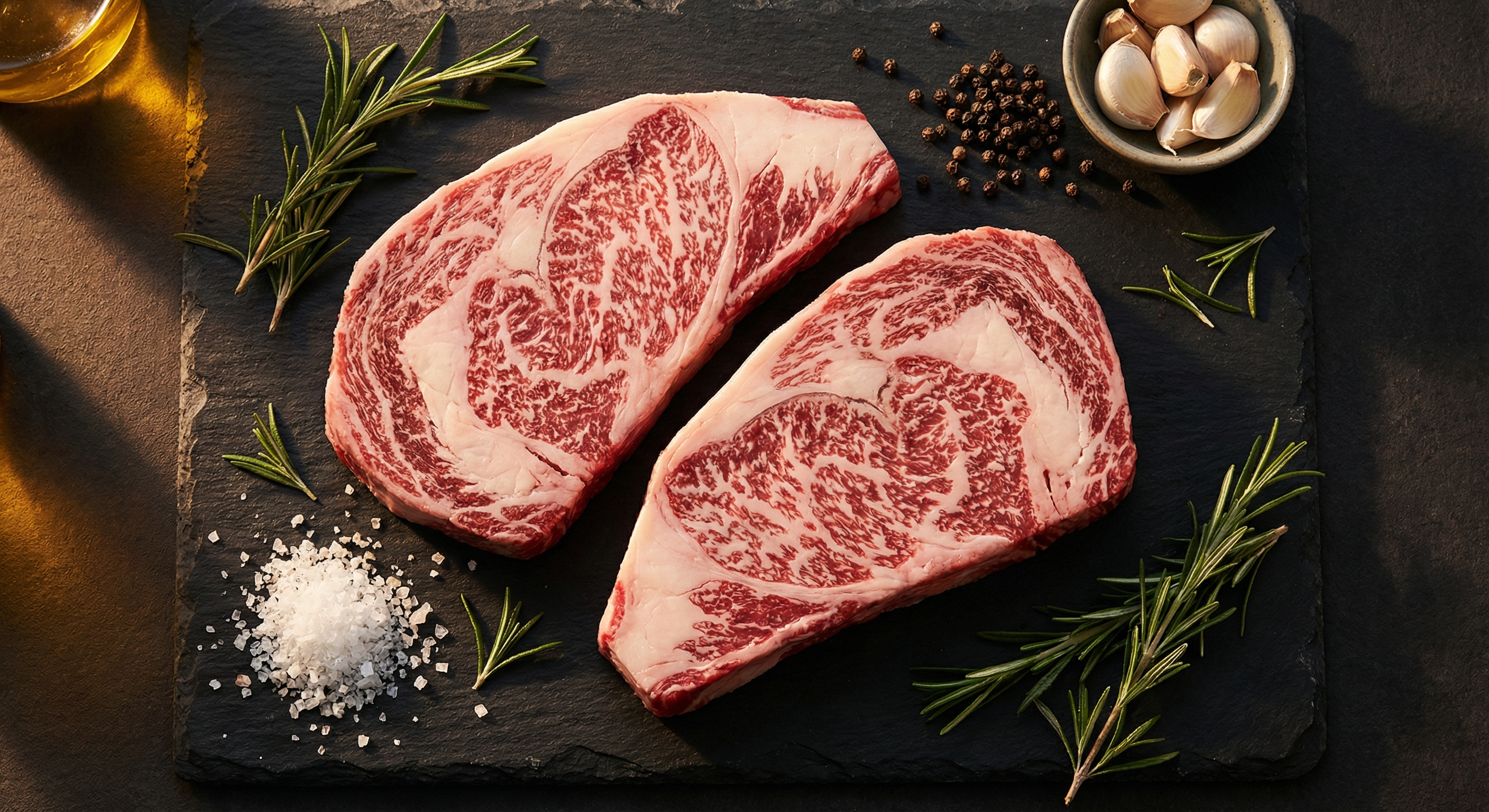
The ribeye is the showcase cut for wagyu marbling. The intramuscular fat renders during cooking, creating the signature buttery mouthfeel. For halal wagyu BMS 6+, a simple sear with salt is all you need.
Striploin (Sirloin)
Slightly leaner than ribeye but with a firmer texture and cleaner beef flavor. Striploin is the preferred cut in many Middle Eastern and Southeast Asian wagyu restaurants.
Chuck Roll
An underrated value cut that benefits enormously from wagyu genetics. The chuck roll from a well-marbled halal wagyu animal rivals the ribeye of conventional beef — at roughly half the price.
Short Ribs
Wagyu short ribs are extraordinary when braised low and slow or grilled Korean-style (galbi). The high fat content keeps them moist through long cooking times, making them forgiving for home cooks.
Cooking Halal Wagyu at Home
Halal wagyu follows the same cooking principles as any high-grade wagyu:
- Bring to room temperature — remove from the refrigerator 30–45 minutes before cooking
- Season simply — coarse salt and black pepper. The beef is the star
- Use high heat for steaks — cast iron or carbon steel, seared 90 seconds per side for a 1-inch cut
- Rest before slicing — 5 minutes minimum to allow juices to redistribute
- Serve in smaller portions — wagyu is rich. A 4–6 oz serving is satisfying where you might eat 8–12 oz of conventional steak
For BMS 9+ cuts, many chefs recommend slicing thin and serving yakiniku-style over a grill or hot plate. The extreme marbling means large portions can feel overwhelmingly rich.
Where to Buy Halal Wagyu Online
The online halal wagyu market has matured significantly. When purchasing, confirm the halal certification applies to the specific product — not just the brand. Some producers offer both halal and non-halal lines from the same genetics.
For premium wagyu with clear sourcing and certification information, The Meatery's wagyu collection provides detailed provenance for every cut.
Frequently Asked Questions
Is all wagyu automatically halal?
No. Wagyu refers to the breed of cattle, not the slaughter method. Wagyu beef is only halal if the animal was slaughtered according to Islamic law by a qualified Muslim slaughterman.
Does halal slaughter affect the taste of wagyu?
No. Blind taste tests consistently show no detectable difference between halal and conventional slaughter when the breed, feed program, and aging are identical. The marbling, genetics, and feeding regimen determine flavor — not the slaughter protocol.
Is halal wagyu more expensive?
Marginally. Halal certification adds a small cost for auditing and compliance, but the primary price driver remains the wagyu grade and origin. A halal BMS 9 Australian wagyu steak costs roughly the same as its non-halal equivalent.
Can I find halal Kobe beef?
Genuine Kobe beef with halal certification is extremely rare. A very small number of Kobe cattle have been halal-slaughtered for export, but availability is limited to specific importers in the UAE and Malaysia. If a retailer claims to sell halal Kobe beef, ask for both the Kobe beef authentication certificate and the halal certificate.
The Bottom Line
Halal wagyu is not a compromise — it is the same extraordinary beef, processed according to Islamic dietary law. The market is maturing rapidly, with reliable supply chains from Australia, growing options from American producers, and limited but genuine availability from Japan.
Whether you are a home cook exploring wagyu for the first time or a seasoned enthusiast seeking halal-certified cuts, the quality is there. Focus on reputable certifications, understand the grading system for your source country, and start with a well-marbled ribeye or striploin. The beef speaks for itself.
Frequently Asked Questions
Is all wagyu automatically halal?
No. Wagyu refers to the breed of cattle, not the slaughter method. Wagyu beef is only halal if the animal was slaughtered according to Islamic law by a qualified Muslim slaughterman with Bismillah invocation and proper blood drainage.
Does halal slaughter affect the taste of wagyu?
No. Blind taste tests show no detectable difference between halal and conventional slaughter when breed, feed program, and aging are identical. Marbling, genetics, and feeding regimen determine flavor — not the slaughter protocol.
Where can I buy halal wagyu beef?
Australia is the largest source of halal-certified wagyu, with producers like Jack's Creek, Blackmore, and Mayura Station. In the U.S., look for IFANCA-certified products. Always verify the halal certificate number with a recognized certification body.
Is halal wagyu more expensive than regular wagyu?
Only marginally. Halal certification adds a small cost for auditing and compliance, but the primary price drivers remain wagyu grade, origin, and cut. A halal BMS 9 Australian wagyu steak costs roughly the same as its non-halal equivalent.
More Expert Guides
Wagyu Ribeye Steak: The Complete Guide to Buying, Cooking, and Enjoying
Wagyu ribeye is the crown jewel of steak cuts — extraordinary marbling wrapped around the most flavorful primal on the animal. Here's how to buy, cook, and serve it without wasting a single bite.
12 min readWagyu Teppanyaki: The Complete Guide to Japan's Theatrical Steak Experience
Teppanyaki transformed wagyu from an ingredient into a performance. This guide covers the best cuts, iron griddle technique, essential sauces, and how to recreate the full experience at home.
13 min readWagyu Filet Mignon: The Complete Guide to the Most Tender Cut
Wagyu filet mignon combines the beef world's most tender muscle with its most intensely marbled breed. Learn how to select the right grade, what to expect at each price point, and the cooking methods that do this extraordinary cut justice.