Fullblood Wagyu vs Crossbred: What Actually Changes When You Mix the Genetics
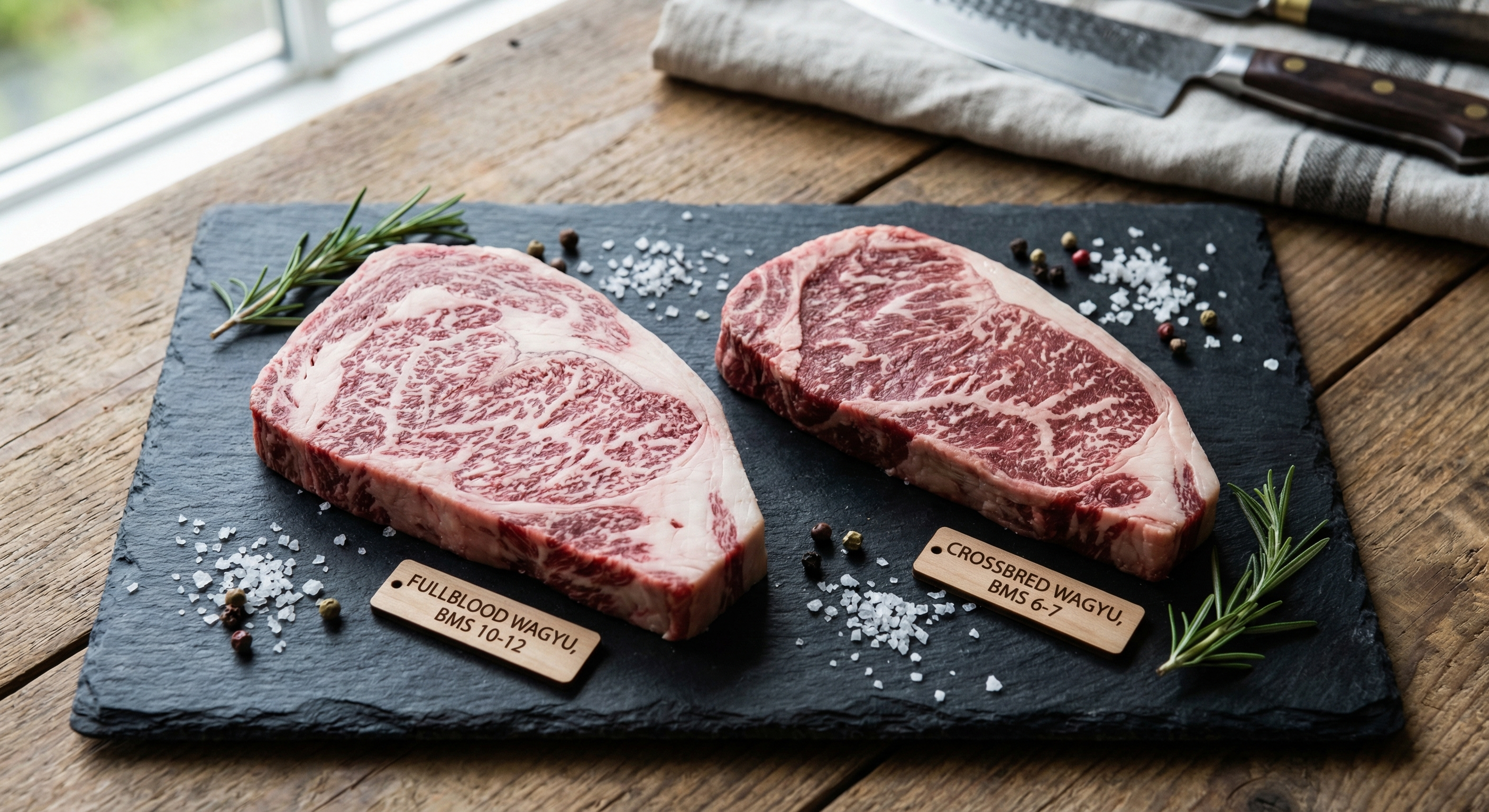
Walk into any high-end butcher shop or browse a premium beef website and you will see the word “wagyu” everywhere. But not all wagyu is created equal. The difference between a fullblood Japanese Black steak and an F1 crossbred wagyu-Angus steak is as significant as the difference between USDA Prime and Select — same species, completely different eating experiences. Understanding the genetics behind the label is the single most important thing you can do before spending $50 to $200 per pound on beef.
Fullblood, Purebred, and Crossbred: Definitions That Matter
Before comparing, you need precise definitions. The wagyu industry uses specific terms that carry legal weight in registries and auction houses:
Fullblood Wagyu: 100% wagyu genetics with documented pedigree tracing back to Japanese foundation animals. Both parents are registered fullblood wagyu. No outside breed genetics at any point in the lineage. This is the purest expression of wagyu marbling genetics and produces the highest BMS scores.
Purebred Wagyu: At least 93.75% wagyu genetics (equivalent to F4 generation or higher). Purebred animals result from crossing fullblood wagyu sires back into crossbred females over four or more generations. The American Wagyu Association registers these separately from fullblood animals. Most purebred wagyu is functionally very close to fullblood in marbling potential, but the pedigree distinction matters for breeding programs and pricing.
Crossbred Wagyu (F1): First-generation cross, typically 50% wagyu and 50% Angus, Hereford, or Holstein. An F1 is produced by breeding a fullblood wagyu bull to a cow of another breed. This is the most common “American Wagyu” product on the market.
F2, F3, F4: Each subsequent generation bred back to fullblood wagyu increases the wagyu percentage — F2 is 75%, F3 is 87.5%, F4 is 93.75% (purebred threshold). Each step brings the marbling genetics closer to fullblood expression.
The Genetics: Why Marbling Changes With Each Cross
Wagyu marbling is not controlled by a single gene. It is a polygenic trait — dozens of genes working together influence how and where intramuscular fat deposits form. Japanese Black cattle were selectively bred for centuries to maximize these traits, and the resulting genetic package is remarkably consistent in fullblood animals.
When you cross a fullblood wagyu with an Angus, the F1 offspring inherits half of those marbling genes. But genetics is not a simple average. Some wagyu marbling genes are partially dominant, meaning the F1 animal typically marbles better than a straight Angus but significantly less than a fullblood wagyu. The sashi fat distribution pattern — the intricate web of intramuscular fat that defines premium Japanese wagyu — becomes less refined with each dilution of wagyu genetics.
Research from Japanese livestock stations shows that the SCD gene (stearoyl-CoA desaturase), which influences the fatty acid composition and melting point of wagyu fat, has a strong association with the breed’s signature buttery texture. Fullblood wagyu carry specific variants of SCD and other lipogenesis genes that crossbred animals may or may not inherit, depending on which parental alleles they receive.
The Marbling Ceiling by Genetics
Here is what the data shows across thousands of carcasses graded in the United States and Australia:
| Classification | Wagyu % | Typical BMS Range | Peak BMS Potential |
|---|---|---|---|
| F1 Crossbred | 50% | 4–7 | 8 (rare) |
| F2 | 75% | 5–8 | 9 |
| F3 | 87.5% | 6–9 | 10 |
| F4 / Purebred | 93.75% | 7–10 | 11 |
| Fullblood | 100% | 8–12 | 12 |
Notice that the floor rises with each generation almost as much as the ceiling. A fullblood wagyu that scores BMS 8 is considered below average for the breed. An F1 crossbred scoring BMS 7 is considered exceptional. The genetics set both the floor and the ceiling of marbling potential.
Flavor: What You Actually Taste
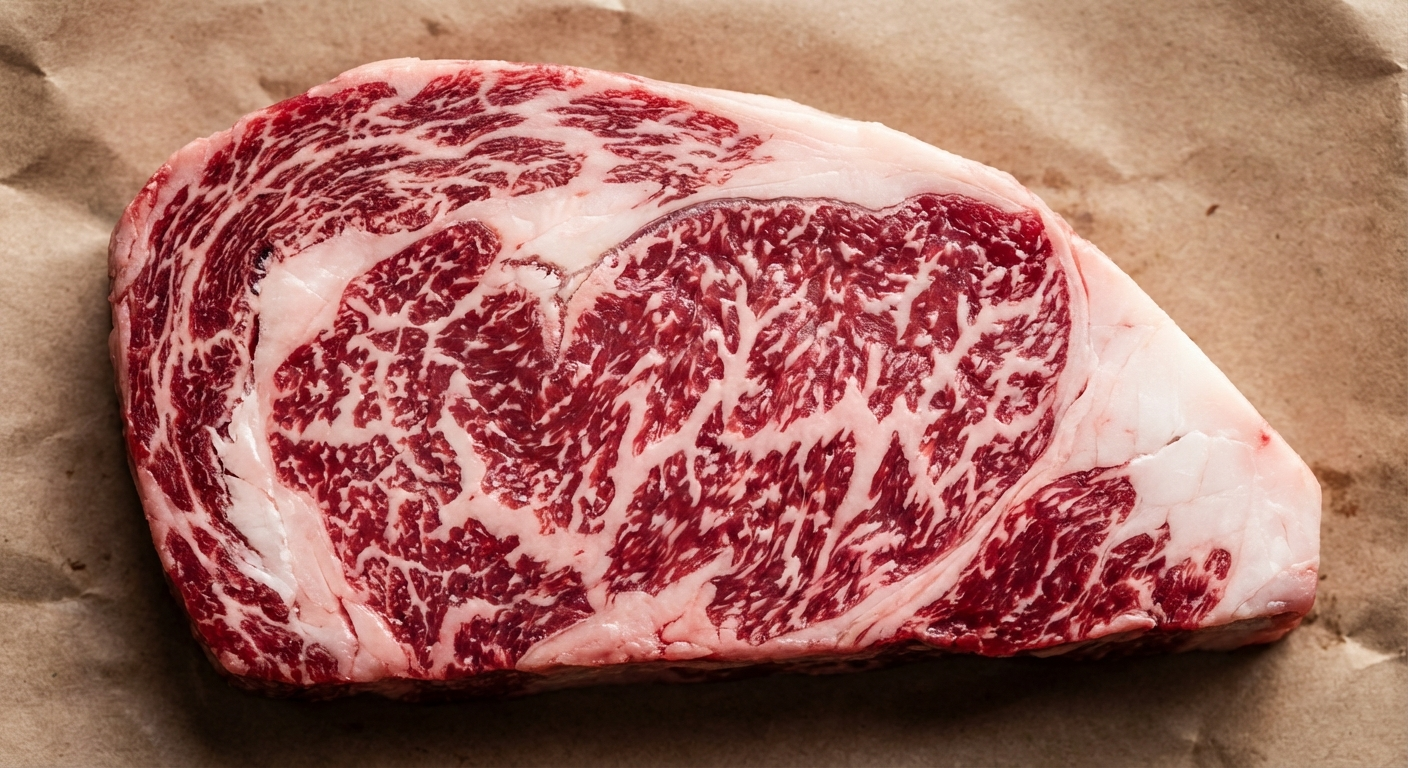
Marbling scores tell you about fat quantity, but they do not capture everything about flavor. The eating experience differs between fullblood and crossbred wagyu in several distinct ways:
Fullblood wagyu (BMS 9–12):
- Intensely buttery with a clean, sweet finish
- Fat melts at or below body temperature — dissolves on the tongue
- Minimal chew; almost custard-like texture in the highest grades
- Strong umami backbone with subtle sweetness
- Rich enough that 3–5 ounces is a complete serving
- Best served as yakiniku, tataki, or thinly sliced
Crossbred wagyu (BMS 5–7):
- Noticeably more marbled than standard beef with enhanced juiciness
- Retains the traditional “beefy” flavor profile from the Angus genetics
- More chew and structure than fullblood — feels like a premium steak
- Fat has a slightly higher melting point; still tender but less melt-in-your-mouth
- Standard 8–12 ounce steak portions work well
- Excels as a thick-cut seared steak or sous vide preparation
Neither profile is objectively better. Many experienced beef enthusiasts actually prefer F1 crossbred wagyu for everyday steak dinners because it delivers enhanced marbling with the familiar steak experience. Fullblood wagyu at BMS 10+ is a different category entirely — more of a delicacy than a traditional steak dinner.
Price: What the Genetics Cost You
The price difference between fullblood and crossbred wagyu is substantial, and it reflects the economics of production as much as the eating quality.
Why fullblood costs more:
- Smaller gene pool: Fullblood wagyu genetics outside Japan trace back to a handful of animals exported before Japan banned live exports in 1997. Limited genetics means limited supply.
- Longer feeding: Fullblood wagyu are typically fed for 400–600+ days on grain to develop maximum marbling. Crossbred cattle reach market weight in 300–400 days.
- Lower yield: The extreme marbling in fullblood wagyu means more fat relative to lean meat, reducing the usable yield per carcass.
- Registry and verification: Fullblood status requires DNA-verified parentage and registration with breed associations, adding cost at every stage.
Typical retail pricing for ribeye steaks in the United States (2026):
| Classification | Price per lb (USD) | Typical Serving Cost |
|---|---|---|
| F1 Crossbred (BMS 5–6) | $30–$55 | $25–$45 (10 oz) |
| F2–F3 (BMS 6–8) | $50–$80 | $40–$65 (10 oz) |
| Purebred (BMS 8–10) | $80–$120 | $35–$55 (5 oz) |
| Fullblood Japanese A5 (BMS 10–12) | $120–$250 | $50–$100 (4 oz) |
Note the serving size shift. Because fullblood A5 wagyu is so rich, you eat less per sitting. The per-serving cost difference is actually smaller than the per-pound difference suggests. A $200/lb A5 ribeye at 4 ounces costs $50 per serving. An F1 crossbred at $40/lb and 10 ounces costs $25. The fullblood is twice the price per serving, not five times — though the experiences are genuinely different.
How to Read Labels: Protecting Yourself as a Buyer
The biggest issue in the wagyu marketplace is labeling ambiguity. In the United States, there is no federal regulation requiring sellers to disclose wagyu percentage. A steak labeled “American Wagyu” could be anywhere from F1 (50%) to fullblood (100%). Here is how to decode what you are actually buying:
Green flags:
- “Fullblood” with an American Wagyu Association (AWA) registration number
- Japanese Certificate of Authenticity with 10-digit nose print ID for imported A5
- Specific BMS score listed (e.g., “BMS 9+”)
- DNA-verified parentage documentation available
- Specific breed and generation disclosed (e.g., “F1 Wagyu x Angus”)
Red flags:
- “Wagyu-style” or “Wagyu-inspired” — meaningless marketing terms
- “Kobe-style” without being from Hyōgo Prefecture — legally questionable outside Japan
- No breed percentage or registry information available
- “Wagyu” burgers or ground beef under $15/lb — likely minimal wagyu genetics
- BMS claims without third-party grading documentation
Australian Wagyu: A Third Category
Australian wagyu deserves special mention because Australia has developed the largest fullblood wagyu herd outside Japan. Australian producers imported wagyu genetics earlier and in larger numbers than American ranchers, and their grading system (AUS-MEAT) provides more granularity than USDA grading for high-marbling beef.
Australian wagyu is available in both fullblood and crossbred classifications, with some producers specializing in high-percentage crosses (F3 and F4) that approach purebred quality at more accessible prices. Brands like Blackmore, Mayura Station, and Sher Wagyu have built reputations for fullblood quality that rivals many Japanese prefectural brands. If you want fullblood wagyu without the import costs of Japanese A5, Australian fullblood is often the best value proposition.
Which Should You Buy?
The right choice depends entirely on what you want from the experience:
Buy fullblood wagyu when:
- You want the most intense marbling and melt-in-your-mouth texture possible
- You are serving it Japanese-style: thin slices, shabu-shabu, sukiyaki, or teppanyaki
- It is a special occasion and you want an unforgettable centerpiece
- You appreciate richness over portion size
- You have verified the source and grading documentation
Buy crossbred wagyu when:
- You want an elevated steak experience with familiar portion sizes
- You are grilling thick-cut steaks for a dinner party
- You want enhanced marbling without the intensity of BMS 10+
- You prefer beefy flavor with a buttery edge rather than pure butteriness
- Budget matters — crossbred delivers the best marbling per dollar
Consider purebred or high-percentage cross (F3/F4) when:
- You want near-fullblood quality at a 30–50% price reduction
- You are exploring different BMS levels to find your personal preference
- You cook wagyu regularly and want excellent quality without top-tier pricing
Cooking Adjustments by Genetics
The fat content changes how you should cook the steak:
Fullblood (BMS 9+): Cook in a dry, screaming-hot pan or on the teppan. No added oil — the fat renders itself. Slice thin (quarter-inch) against the grain. Internal temp target: 125–130°F for medium-rare. Thick cuts work poorly because the extreme fat content can feel overwhelmingly rich in large bites.
Crossbred (BMS 5–7): Cook like a premium steak with a hard sear and rest. Thick cuts (1.5–2 inches) work well. You can use a small amount of high-smoke-point oil for the initial sear. Internal temp target: 125–135°F. Standard steak portions and slicing apply.
The biggest mistake people make is treating all wagyu the same in the kitchen. A fullblood A5 ribeye cooked like a standard 12-ounce steak will be an unpleasantly rich, greasy experience. Conversely, an F1 crossbred sliced thin like sashimi will taste underwhelming. Match the cooking method to the genetics.
The Bottom Line
Fullblood wagyu and crossbred wagyu are both legitimate products that deliver genuine value — but they deliver fundamentally different eating experiences. Fullblood is a delicacy defined by extreme richness, melt-in-your-mouth texture, and small portions. Crossbred is a premium steak elevated by enhanced marbling and juiciness in familiar formats.
The genetics determine the ceiling. The feeding and management determine how close to that ceiling the animal reaches. And the cooking determines whether you actually enjoy the result. Know what you are buying, cook it accordingly, and both fullblood and crossbred wagyu will deliver one of the best beef experiences available.
Frequently Asked Questions
What is the difference between fullblood and purebred wagyu?
Fullblood wagyu is 100% wagyu genetics with a verified pedigree — both parents are registered fullblood wagyu with no outside breed genetics at any point. Purebred wagyu is at least 93.75% wagyu (F4 generation), meaning a small percentage of non-wagyu genetics remains from the original cross several generations back. In practice, purebred wagyu can marble nearly as well as fullblood, but the distinction matters for breeding programs and top-tier pricing.
Is F1 wagyu worth the price over USDA Prime?
F1 (50%) wagyu typically marbles at BMS 5-7, which overlaps with the top end of USDA Prime (BMS 4-5) but extends beyond it. At BMS 6-7, you get noticeably more intramuscular fat, juiciness, and tenderness than even the best Prime steaks. Whether the 2-3x price premium is "worth it" depends on your palate and budget, but the quality difference is real and measurable.
Can crossbred wagyu ever reach A5 grade?
Technically, A5 is a Japanese grading standard applied only to cattle raised and processed in Japan, so crossbred wagyu outside Japan cannot receive an A5 grade. In terms of marbling, F1 crossbred wagyu very rarely reaches BMS 8 (the minimum for A5), and even F2-F3 animals seldom achieve consistent BMS 10+ scores. Fullblood genetics are essentially required for reliable A5-level marbling.
Why did Japan ban wagyu exports?
Japan declared wagyu a "national living treasure" and banned the export of live wagyu cattle and genetic material (semen and embryos) in 1997 to protect the breed's economic value and genetic integrity. A small number of fullblood wagyu were exported to the US and Australia before the ban, and all fullblood wagyu outside Japan trace back to these foundation animals. The ban ensures Japan maintains genetic superiority in wagyu production.
More Expert Guides
Kagoshima Wagyu: The Complete Guide to Japan's Wagyu Olympics Champion
Kagoshima Prefecture produces more wagyu cattle than any other region in Japan and won the prestigious Wagyu Olympics in both 2017 and 2022. Here's what makes Kagoshima beef special — and why it deserves a place alongside Kobe, Matsusaka, and Miyazaki in any wagyu conversation.
13 min readWagyu Zabuton: The Best-Kept Secret in Japanese Beef
Wagyu zabuton is the most undervalued cut in the A5 world — extraordinary marbling, melt-in-your-mouth texture, and a price tag that makes ribeye look like a bad deal. Here is why insiders buy it first.
13 min readHida Beef: The Complete Guide to Gifu Prefecture's Legendary Wagyu
Hida beef is one of Japan's most prestigious regional wagyu brands, raised in the mountain valleys of Gifu Prefecture. Often overshadowed by Kobe in Western markets, Hida-gyu is revered in Japan for its delicate sweetness and fine-grained marbling. Here's what makes it special.