How to Authenticate Japanese Wagyu: A Buyer's Guide
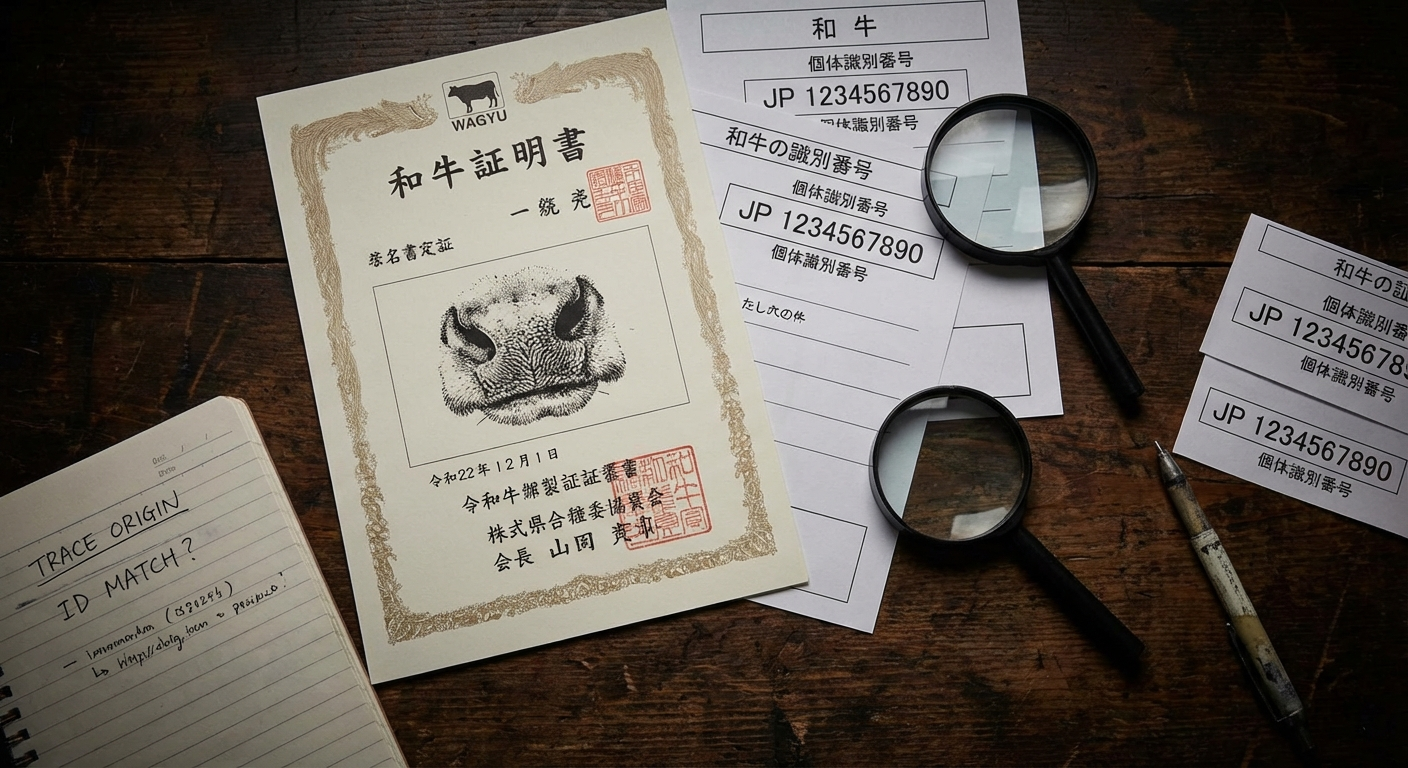
I'll be direct: fraud in the Wagyu market is widespread. Mislabeled origin, inflated BMS claims, "Japanese A5" that's actually Australian crossbred — I've seen it all. The premium pricing creates enormous incentive to deceive, and the average consumer doesn't have the knowledge to detect it.
That changes now. Here's exactly how to verify authenticity.
Japan's Traceability System
Japan has the most comprehensive beef traceability system in the world, established by law in 2003. Every registered beef animal in Japan receives:
- A unique 10-digit individual identification number at birth
- A nose print certificate (unique as a human fingerprint)
- A lifetime movement record (every farm transfer documented)
- A complete 3-generation pedigree
- Slaughter and grading records linked to the ID
This ID number is the key to verification. It can be looked up on Japan's national traceability website, where you'll find the animal's birth date, breed, sex, every farm it lived on, the slaughter date, and the processing facility.
What to Ask For When Buying
When purchasing Japanese Wagyu, request:
- The 10-digit individual ID number: This is non-negotiable. If the seller can't provide it, the product's authenticity is unverifiable.
- The prefecture of origin: Legitimate sellers know exactly where their beef comes from.
- The specific BMS score: Not just "A5" — the actual number (8, 9, 10, etc.).
- The processing/export date: Japanese Wagyu should be relatively recently processed. Beef that's been sitting in cold storage for years loses quality.
Red Flags That Indicate Fraud
- No traceability number available: The biggest red flag. Every legitimate Japanese Wagyu import has documentation.
- Prices significantly below market: Japanese A5 striploin at $50/lb is almost certainly not Japanese A5. The production and import costs make prices below $80-$100/lb for premium cuts essentially impossible.
- "A5 Wagyu" with no BMS specified: Sellers who know their product specify the BMS. Those who don't often can't because the product isn't what they claim.
- "Kobe" anything at a non-authorized establishment: Check the Kobe Beef Association's authorized list.
- Vague sourcing: "From Japan" without a specific prefecture. Legitimate sellers are specific because their customers want to know.
- Visual inconsistency: If the marbling doesn't match the claimed BMS score, trust your eyes. BMS 10 looks dramatically different from BMS 6.
How to Verify Online
Japan's Individual Cattle Identification Registry is publicly accessible. With the 10-digit ID number, you can verify:
- The animal existed and was processed in Japan
- The breed (should be Japanese Black/Kuroge for most premium Wagyu)
- The date and location of processing
- That the details match what the seller claims
The JMGA grade is sometimes available separately through the exporter's documentation. Ask the seller for the full grading certificate or a photo of it.
Buying from Trusted Sources
The safest approach is buying from established retailers with reputations to protect. Look for:
- Detailed product pages with BMS scores, prefecture, and individual ID numbers
- Photos of the actual product (not stock images)
- Clear return policies and customer service
- Positive reviews from verified buyers
- Import documentation available on request
Building a relationship with a trusted seller is the best long-term strategy. Once you find a source like The Meatery that consistently delivers authentic product with full documentation, stay with them. The peace of mind is worth any small price premium over unverified sources.
Frequently Asked Questions
How can I check if Japanese Wagyu is authentic?
Ask for the 10-digit individual ID number from Japan's traceability system. This number can be verified on Japan's national database to confirm the animal's breed, origin, and processing details. No ID number = no way to verify authenticity.
What percentage of "Wagyu" in the U.S. is fake?
Studies and investigations have found significant mislabeling in the premium beef market. While exact percentages are debated, a substantial portion of "Wagyu" and especially "Kobe" claims at restaurants cannot be verified. Always buy from sellers who provide documentation.
More Expert Guides
Wagyu Zabuton: The Best-Kept Secret in Japanese Beef
Wagyu zabuton is the most undervalued cut in the A5 world — extraordinary marbling, melt-in-your-mouth texture, and a price tag that makes ribeye look like a bad deal. Here is why insiders buy it first.
13 min readHida Beef: The Complete Guide to Gifu Prefecture's Legendary Wagyu
Hida beef is one of Japan's most prestigious regional wagyu brands, raised in the mountain valleys of Gifu Prefecture. Often overshadowed by Kobe in Western markets, Hida-gyu is revered in Japan for its delicate sweetness and fine-grained marbling. Here's what makes it special.
12 min readA4 vs A5 Wagyu: The Complete Comparison Guide
A4 and A5 are both elite Japanese wagyu grades, but they deliver meaningfully different eating experiences. This guide breaks down exactly how they differ in marbling, flavor, texture, price, and when each grade is the better choice.