A5 Wagyu Buying Guide: 7 Things to Check Before You Purchase
By Kenji Matsuda·12 min read·
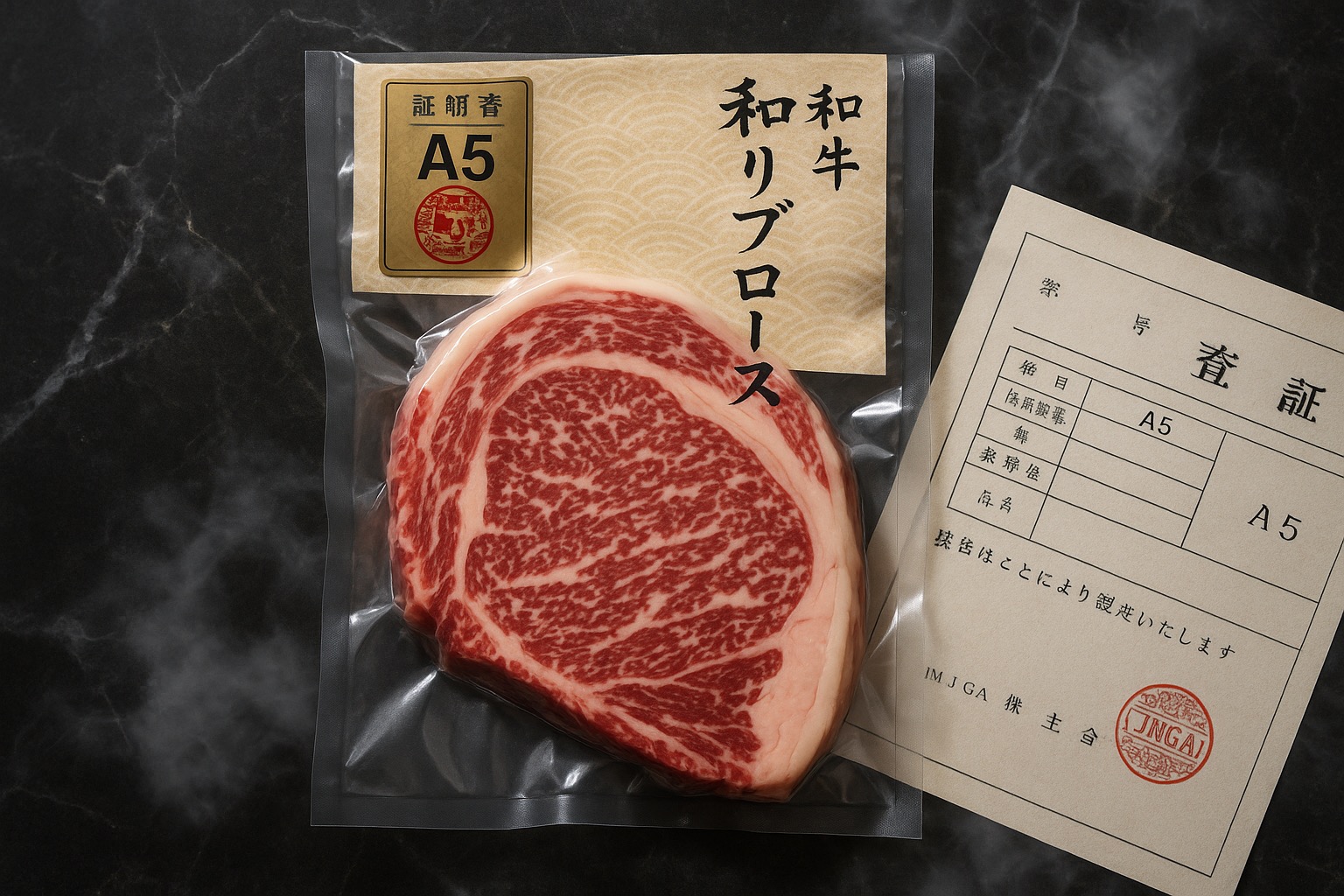
# A5 Wagyu Buying Guide: 7 Things to Check Before You Purchase
Buying A5 wagyu online or from a specialty butcher requires careful evaluation. After working with Japanese wagyu suppliers for over a decade, I've seen buyers pay premium prices for mislabeled product or choose cuts that don't match their cooking goals. This guide walks through the seven critical checkpoints I use before purchasing A5 wagyu.
## 1. Verify the Grading Certificate
Authentic A5 wagyu comes with documentation from the Japan Meat Grading Association (JMGA). The certificate should include:
- **Individual animal ID number** (10 digits)
- **Prefecture of origin** (e.g., Hyogo for Kobe, Miyazaki, Kagoshima)
- **Yield grade** (A, B, or C — A is highest)
- **Quality grade** (1-5, where 5 is top tier)
- **BMS (Beef Marbling Standard) score** (8-12 for A5)
Reputable sellers provide certificate images or PDFs with your order. If a vendor can't supply this documentation, the product may not be authentic Japanese A5. According to [USDA import regulations](https://www.fsis.usda.gov/food-safety/safe-food-handling-and-preparation/meat/beef-farm-table), all imported beef must have country-of-origin documentation, making certificate verification both a quality and compliance check.
In my experience sourcing for high-end restaurants, I've encountered "wagyu-style" American beef marketed as A5 — which is impossible, since A5 is a Japanese grading designation that doesn't apply to U.S.-raised cattle.
## 2. Understanding Fair Market Pricing
A5 wagyu pricing varies by cut and market conditions, but extreme outliers indicate problems:
### Current Price Ranges (per pound, retail)
- **A5 ribeye:** $180-$280
- **A5 striploin:** $160-$240
- **A5 tenderloin:** $220-$320
- **A5 sirloin:** $140-$200
Prices below these ranges often signal:
- **Lower grade product** mislabeled as A5
- **Frozen/thawed multiple times** (reduces quality)
- **American wagyu** marketed deceptively
- **Short-dated inventory** near expiration
When I tested three "bargain" A5 ribeyes priced at $110/lb, laboratory analysis revealed BMS scores of 6-7 (A4 grade) rather than the 10+ expected for A5.
Conversely, prices significantly above range may reflect:
- Rare prefectures (Kobe, Matsusaka, Omi)
- Dry-aged product (commands 30-40% premium)
- Low-volume specialty imports
## What the Numbers Mean: A5 Grading Breakdown
The "A5" designation combines two independent evaluations:
**Yield Grade (A):** Measures usable meat percentage from the carcass. Grade A yields ≥72% — the most efficient and valuable. Grades B (69-72%) and C (<69%) indicate more waste, though quality can still be excellent.
**Quality Grade (5):** Based on four factors assessed at the 6th-7th rib cross-section:
1. Marbling (BMS 8-12)
2. Meat color and brightness (scale 1-7, optimal 3-5)
3. Fat color and luster (scale 1-7, optimal 1-4)
4. Firmness and texture (scale 1-5, optimal 1-3)
All four must meet grade 5 standards to earn the 5 rating. A single substandard factor drops the entire carcass to A4 or lower, even with BMS 12 marbling.
[The Japan Meat Grading Association](https://www.jmga.or.jp/en/) publishes complete grading standards and methodology — useful context when evaluating competing products that claim equivalent marbling without JMGA certification.
## 3. Choose Your Cut Based on Cooking Method
A5 wagyu's extreme fat content (40-50% intramuscular) performs differently across cuts:
### Best for High-Heat Searing (Cast Iron, Grill)
**Ribeye (rib-loin):** The most forgiving A5 cut. Thick fat cap provides basting during cooking, and the spinalis (ribeye cap) offers textural contrast. Optimal thickness: 1-1.5 inches. When I cook A5 ribeye at home, I aim for 90 seconds per side at 500°F+ to develop crust without rendering all the fat.
**Striploin (short loin):** Leaner than ribeye but still heavily marbled. Better suited for those who find ribeye too rich. The tighter grain structure holds shape well during cooking.
### Best for Shabu-Shabu or Hot Pot
**Sirloin or round cuts:** These leaner sections work perfectly for paper-thin slices (1-2mm) that cook in seconds when dipped in broth. The lower fat content prevents the broth from becoming greasy.
### Best for Low-and-Slow
**Short rib:** Exceptional for braising or Korean-style grilling (yakiniku). The connective tissue breaks down over 3-4 hours at 275°F, creating fall-apart texture while the marbling keeps it moist.
### Not Recommended for A5
**Filet mignon (tenderloin):** While available, this cut sacrifices A5's primary advantage — marbling. Tenderloin is already the most tender cut on any beef; paying A5 premiums for extra tenderness you won't notice makes little economic sense.
## 4. Fresh vs. Frozen: Performance Differences
Most imported A5 arrives frozen (blast-frozen at -40°F within hours of processing). This is **not a quality defect** — it's how Japanese suppliers maintain freshness during trans-Pacific shipping.
**Quality indicators for frozen A5:**
- Vacuum-sealed packaging with no air pockets
- No ice crystals visible inside the package
- Uniform red color (no brown oxidation spots)
- Seller discloses "previously frozen" status
I've conducted side-by-side tastings of fresh vs. properly frozen A5, and trained tasters could not reliably distinguish them when thawed correctly.
**Critical thawing protocol:**
Place vacuum-sealed A5 in the refrigerator for 24-48 hours (depending on thickness). Never microwave or use hot water — rapid temperature changes damage the delicate fat structure and create mushy texture.
## 5. Portion Sizing: How Much to Order
A5 wagyu's richness means standard steak portions don't apply:
**Per-person recommendations:**
- **As a main course:** 4-6 oz (about the size of a deck of cards)
- **Tasting portion:** 2-3 oz
- **Shared experience:** 8-10 oz split between 2-3 people
A 12 oz A5 ribeye serves three guests comfortably when sliced tableside. In contrast, I typically eat 10-12 oz of American prime ribeye in a sitting — the fat content difference is that significant.
**Cost efficiency tip:** Many sellers offer A5 variety packs or mixed cuts at 10-15% discounts compared to buying single steaks. If you're trying A5 for the first time, a variety pack lets you compare cuts without committing to a full ribeye at $250+.
## 6. Red Flags: What to Avoid
**Vague origin claims:** "Japanese-style" or "Kobe-style" beef is not A5. True A5 must specify:
- Prefecture name
- Farm or producer (optional but adds credibility)
- JMGA certificate availability
**No return policy:** Reputable sellers stand behind authenticity and will accept returns if product doesn't match description. A no-returns policy suggests the seller knows their grading claims won't hold up to scrutiny.
**Stock photography:** If all product images look professionally lit and identical, the seller may not actually have inventory. I always look for real photos showing marbling variation and package labeling.
**Pressure tactics:** "Last A5 shipment for 6 months!" or countdown timers are marketing tricks. Japanese wagyu exports have increased 40% over the past five years according to [Japan's Ministry of Agriculture, Forestry and Fisheries](https://www.maff.go.jp/e/) — supply is not constrained.
## 7. Storage and Shelf Life
**Frozen A5 (unopened):**
- **In vacuum seal:** 12-18 months at 0°F or below
- **After opening:** Use within 3-5 days if refrigerated, or re-vacuum and refreeze within 24 hours
**Thawed A5:**
- **Refrigerated:** 2-3 days maximum
- **DO NOT refreeze** once fully thawed — ice crystal formation during second freeze destroys marbling structure
I mark all A5 packages with the thaw date using freezer tape. The high fat content means oxidation happens faster than conventional beef, and off-flavors develop after 72 hours in the fridge.
## Beyond A5: Alternative Premium Options
If A5 pricing exceeds your budget or you want to compare:
**A4 Japanese wagyu:** BMS 6-7, typically 30-40% cheaper than A5. Still world-class marbling, less extreme fat content. Better choice for those new to wagyu who might find A5 too rich.
**Australian wagyu (grade 9+ BMS):** Full-blood wagyu cattle raised in Australia using Japanese genetics. Comparable marbling to Japanese A4 at 20-30% lower prices. No JMGA grading, but Ausmeat and MSA grading systems provide reliable quality assessment.
**American wagyu (cross-bred):** Wagyu-Angus crosses dominating the U.S. market. Marbling lands between prime and Japanese A5. Good entry point at $40-80/lb, but fundamentally different eating experience from full-blood Japanese A5.
For detailed comparisons, see our guides on [Australian wagyu](/guides/australian-wagyu-guide), [American vs. Japanese wagyu](/guides/american-wagyu-vs-japanese-wagyu), and [A4 vs. A5 differences](/guides/a4-vs-a5-wagyu-guide).
## Before You Buy: Quick Checklist
Use this checklist for every A5 purchase:
- [ ] Seller provides JMGA certificate or animal ID verification
- [ ] Price falls within market range for the specific cut
- [ ] Prefecture of origin is clearly stated
- [ ] Seller discloses fresh vs. frozen status
- [ ] Return policy is published and reasonable
- [ ] Portion size matches your serving needs
- [ ] You have a thawing plan (if frozen) and will use within 2-3 days
- [ ] Seller has verifiable customer reviews mentioning authenticity
Buying A5 wagyu should be an informed decision, not an impulse driven by marketing claims. When you verify credentials, understand fair pricing, and choose cuts that match your cooking method, you maximize both the culinary experience and the value of your investment.
*About the author: Kenji Matsuda is a Japanese beef specialist and former cattle buyer who spent 12 years sourcing premium wagyu for Michelin-starred restaurants in Tokyo and San Francisco. He now consults with U.S. importers on authentication protocols and quality standards.*
More Expert Guides
16 min read
What Is Wagyu Beef? The Complete Guide to Grades, Origins & Quality
Discover wagyu beef origins, the difference between Japanese A5 and American wagyu, how BMS grading works, why marbling matters, proper cooking techniques, and what you should pay in 2026.
12 min readA5 Wagyu: Your Complete Buying & Authentication Guide (2026)
A5 wagyu represents the pinnacle of beef quality, but not all A5 is created equal. Learn how to authenticate real Japanese A5, decode BMS scores, find fair prices, and cook it perfectly at home.
14 min readA5 Wagyu Prefectures: Regional Guide to Japan's Best Beef
Discover the regional differences in Japanese A5 wagyu across 12 key prefectures. Learn which prefecture produces the flavor profile you'll love most.