A5 Wagyu vs American Wagyu: The Definitive Comparison
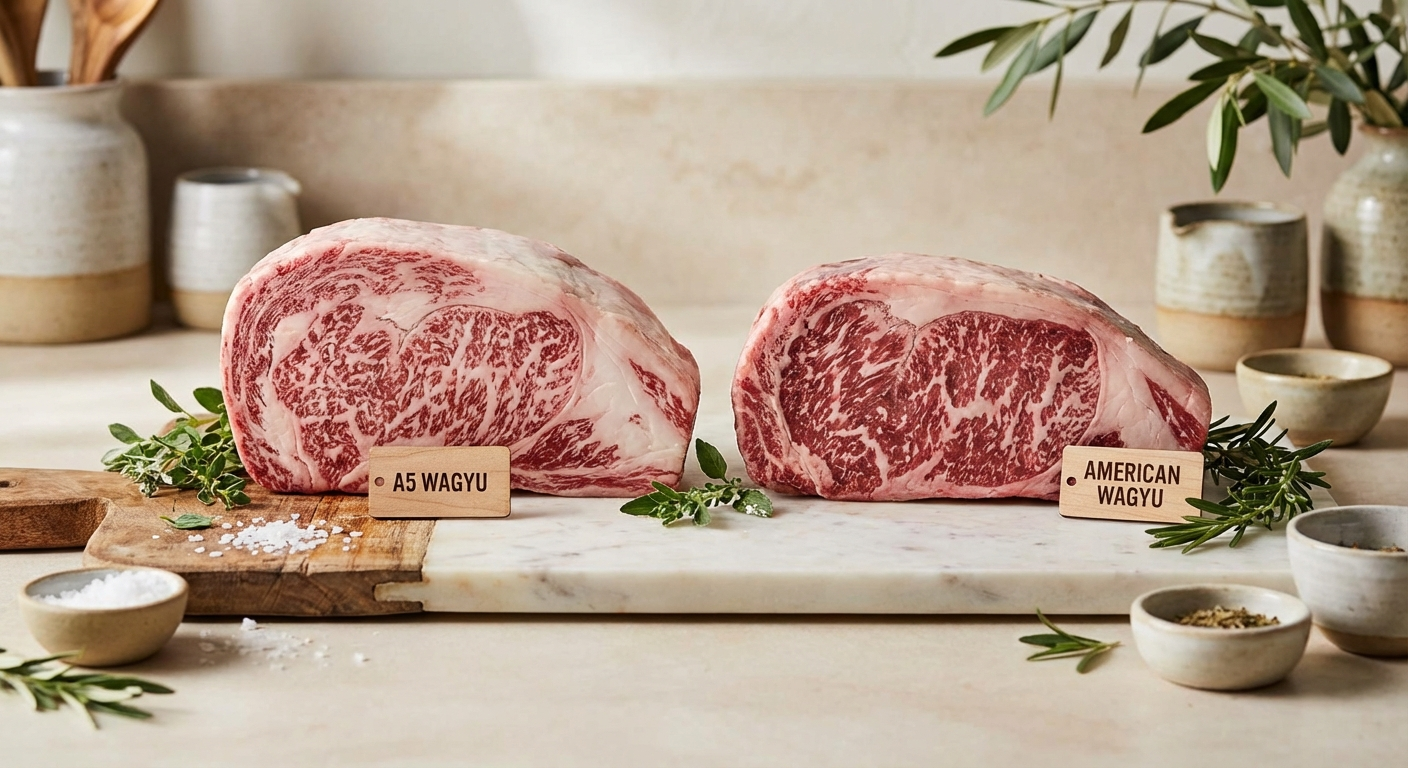
If you're standing in front of the meat case (or browsing online) trying to decide between Japanese A5 Wagyu and American Wagyu, you're looking at two of the best beef products on earth. But they are not the same thing. They aren't even really competitors.
Think of them like a Formula 1 car and a luxury GT sports car. Both are high-performance machines, but they are built for completely different purposes. I import Japanese beef for a living, but I cook American Wagyu at home almost as often. Here is the honest breakdown of how they compare.
The Core Difference: Genetics and Purity
The most important difference is bloodline.
Japanese A5 Wagyu is almost always 100% purebred Kuroge Washu (Japanese Black) cattle. They are raised in Japan under strictly regulated conditions. The "A5" is a specific grade awarded by the Japanese government, requiring the highest possible scores for marbling (BMS 8-12), meat color, fat color, and firmness.
American Wagyu is typically a crossbreed — usually 50% Wagyu genetics (from a Japanese bull) and 50% Angus (the mother). This is known as an F1 cross. The goal is to combine the intense marbling of Wagyu with the robust size and "beefy" flavor of Angus.
Note: There is "Fullblood" American Wagyu (100% Wagyu genetics raised in the US), but it represents a small percentage of the market. Unless the label explicitly says "100% Fullblood," assume American Wagyu is a cross.
Marbling: The Visual Test
You can tell them apart from across the room.
Japanese A5 looks pink or white rather than red. The intramuscular fat is so dense that it forms a "shimofuri" (frost) pattern that overwhelms the lean meat. It looks like lace. At BMS 10-12, it can be 50% fat by weight.
American Wagyu looks like the best steak you've ever seen, but it still looks like steak. It has intense marbling — far beyond USDA Prime — but you clearly see red meat with white flecks. It looks hearty.
Flavor and Texture Profile
This is where the rubber meets the road.
Japanese A5 Wagyu
- Texture: Dissolves. Literally melts in your mouth. You don't really chew it; it yields instantly.
- Flavor: Sweet, buttery, umami-rich. It doesn't taste like "steak" in the traditional sense; it tastes like rich beef butter.
- Fat Quality: The fat melts at roughly 77°F (below body temperature). It coats your palate instantly.
- The Experience: Intense. Richness overload.
American Wagyu
- Texture: Extremely tender, but with a satisfying "chew." It feels like meat.
- Flavor: The best of both worlds. You get the deep, iron-rich "beefiness" of Angus combined with the sweet richness of Wagyu fat.
- Fat Quality: The fat renders beautifully but has a slightly higher melting point. It's juicy rather than coating.
- The Experience: Satisfaction. It eats like a steak, just turned up to volume 11.
The Price Gap
Expect to pay for the import costs and the labor-intensive Japanese raising methods.
- Japanese A5 Ribeye: $120–$200 per pound.
- American Wagyu Ribeye: $40–$80 per pound.
Is A5 worth 3x the price? For a special experience, yes. For dinner on a Tuesday, probably not.
How to Cook Them (Critical Differences)
You cannot cook them the same way.
Cooking A5 Wagyu:
- Portion: 3–4 oz per person. (Seriously. It's too rich for a full steak.)
- Method: Pan-sear in stainless steel or cast iron. No oil needed.
- Doneness: Rare to Medium-Rare only. Do not overcook.
- Style: Cut into small strips or cubes. Sear 45-60 seconds per side. Eat one bite at a time.
Cooking American Wagyu:
- Portion: 12–16 oz per person (standard steak size).
- Method: Reverse sear or grill. It handles heat well.
- Doneness: Medium-Rare is ideal (130°F). The fat needs a little more heat to render than A5.
- Style: Cook it like a traditional steak. Slice and serve.
The Verdict: Which Should You Buy?
Buy Japanese A5 Wagyu if:
- You want a culinary bucket-list experience.
- You are hosting a tasting party with small plates.
- You appreciate subtle, complex flavors and texture over volume.
- You want to impress guests with "the best beef in the world."
Buy American Wagyu if:
- You want a full steak dinner (knife and fork style).
- You love the flavor of a classic ribeye but want it more tender and juicy.
- You are grilling (American Wagyu stands up to the grill; A5 causes flare-ups).
- You want luxury without the A5 price tag.
At The Meatery, we carry both because we love both. My advice? Try them side-by-side. The contrast is the best lesson you'll ever get in beef genetics.
Frequently Asked Questions
Is American Wagyu real Wagyu?
Yes, but usually it is a crossbreed. Most American Wagyu is 50% Wagyu (Japanese genetics) and 50% Angus. This creates a hybrid that balances the marbling of Wagyu with the size and flavor of Angus. "Fullblood" American Wagyu (100% Wagyu DNA) exists but is rarer and more expensive.
Why is A5 Wagyu so expensive compared to American?
A5 Wagyu is imported from Japan, where cattle are raised for 30+ months (vs 18-24 months in the US) on specialized diets. The strict grading system, limited land, and import logistics all contribute to the higher price.
Can I grill A5 Wagyu?
It is not recommended. The fat content is so high that it will drip instantly, causing massive flare-ups that will char the meat and ruin the flavor. Pan-searing or a flat-top griddle (teppanyaki) is much better for A5. American Wagyu, however, is excellent on the grill.
More Expert Guides
What Is Wagyu Beef? The Complete Guide to Grades, Origins & Quality
Discover wagyu beef origins, the difference between Japanese A5 and American wagyu, how BMS grading works, why marbling matters, proper cooking techniques, and what you should pay in 2026.
12 min readA5 Wagyu: Your Complete Buying & Authentication Guide (2026)
A5 wagyu represents the pinnacle of beef quality, but not all A5 is created equal. Learn how to authenticate real Japanese A5, decode BMS scores, find fair prices, and cook it perfectly at home.
14 min readA5 Wagyu Prefectures: Regional Guide to Japan's Best Beef
Discover the regional differences in Japanese A5 wagyu across 12 key prefectures. Learn which prefecture produces the flavor profile you'll love most.